
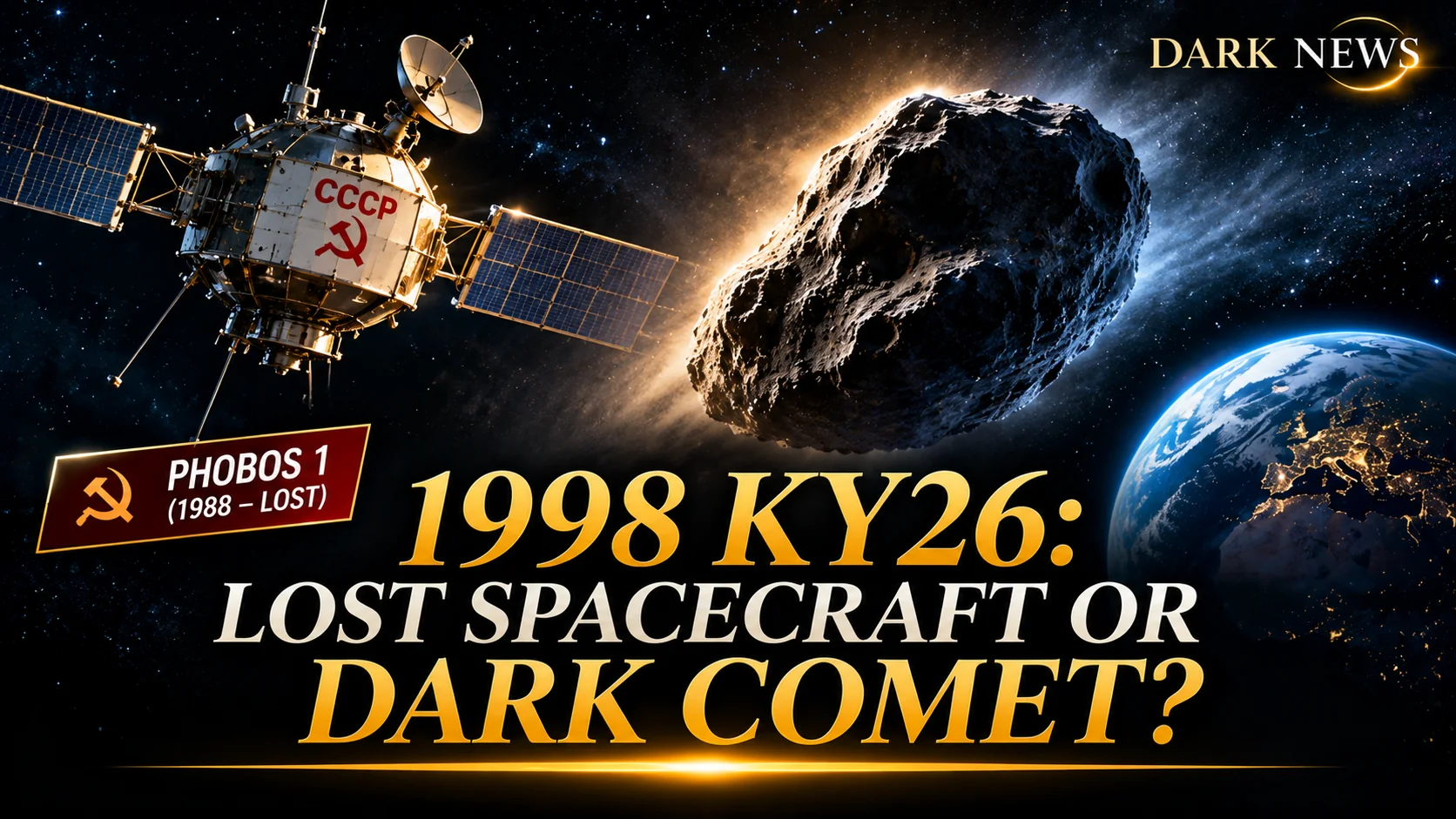

Is a tiny object moving through the Solar System a natural asteroid, an unusual ‘dark comet’—or a Soviet spacecraft missing since 1988? Astronomers are revisiting the identity of 1998 KY26, a body whose rapid rotation and subtle non-gravitational acceleration have prompted an extraordinary, still unproven hypothesis.
Eleven metres wide—and spinning every 5.35 minutes
Observations published in Nature Communications in 2025 put the object’s diameter at approximately 11 ± 2 metres and its rotation period at 5.3516 minutes. The object also reflects an unusually high proportion of visible sunlight. The numbers are measurements, but they do not by themselves tell us whether its surface is natural or manufactured.
The missing Phobos 1 hypothesis
In September 2026, researchers Adam Hibberd, Adam Crowl and Harvard astrophysicist Abraham (Avi) Loeb examined whether 1998 KY26 could be the lost Soviet Phobos 1 spacecraft. Launched in July 1988 to explore Mars and its moons, the probe lost contact after an erroneous command. The researchers compared possible spacecraft geometry, reflected sunlight, light curves and orbital motion. Their model could reproduce several observed features, and modelling sunlight pushing against a spacecraft’s surfaces improved the fit to positional data. They say the hypothesis is plausible, while explicitly acknowledging that their investigation cannot be conclusive.
What is pushing it?
The object’s measured path contains a small non-gravitational component. One possibility is outgassing from a natural body—an explanation associated with so-called dark comets, which show acceleration without an obvious bright tail. Another is pressure from sunlight, which can affect both natural surfaces and spacecraft panels. Researchers have also investigated whether an ordinary rocky object could account for the observations. A non-gravitational acceleration is not, by itself, proof of propulsion or technology.
NASA’s view—and the question of danger
NASA Administrator Jared Isaacman has publicly said he has not seen evidence that 1998 KY26 is anything other than an asteroid. The object is not considered a known threat to Earth. Its path should not be described as a mysterious spacecraft heading directly toward a collision with our planet. Close approaches and unusual orbital dynamics are different from an impact prediction.
Will Japan’s spacecraft settle the argument?
JAXA’s published Hayabusa2 extended-mission plan identifies 1998 KY26 as its target for a rendezvous in 2031, potentially allowing close-up observations. But on 17 November 2026, Loeb wrote that JAXA had cancelled the planned visit. At the time of this report, the agency’s publicly available mission overview still describes the 2031 encounter. The status therefore needs direct confirmation from JAXA before any cancellation can be treated as an established fact.
The real mystery
Could an abandoned spacecraft have travelled unnoticed through the Solar System for nearly four decades? Could an unusual natural object mimic its light reflections and orbital behaviour? The evidence currently permits investigation, not certainty. Future observations, especially high-resolution imaging or direct spacecraft reconnaissance if the mission proceeds, could distinguish the competing explanations.
Dark Page’s question: If an object can look like both a rock and a lost machine from millions of kilometres away, how much do we really know about the small bodies moving through our Solar System?
Sources: Hibberd, Crowl and Loeb, Phobos 1 hypothesis (September 2026); Nature Communications measurements (2025); JAXA Hayabusa2 mission overview; Avi Loeb, 17 November 2026.



