

← Back to Lost Treasures & Ancient Maps
On 20 July 1985, divers off the Florida Keys found what looked like a reef. Then they saw what it was made of. Hundreds of silver bars lay packed together on the seabed, among coins, copper ingots and the ballast of a ship that had gone down 363 years earlier. The search crew had spent years following a trail of scattered objects. Now they had found the main cargo of the Nuestra Señora de Atocha.
The last voyage from Havana
In September 1622, the Atocha sailed from Havana with a fleet bound for Spain. Her cargo gives some idea of the scale of Spain’s colonial trade. The Mel Fisher Maritime Museum records 1,038 silver ingots, 125 gold bars and discs, and hundreds of copper ingots. There were silver coins, worked silverware, indigo and tobacco. Emeralds from what is now Colombia and passengers’ personal possessions added to the wealth aboard. Some valuables travelled outside the official accounts, beyond the reach of the officials who collected the Crown’s taxes.
A hurricane caught the fleet near the Florida Keys within days of its departure. Only five of the 265 people aboard the Atocha survived. They held on to what remained of the mizzenmast above the water. Spanish rescuers located the wreck and marked its position, but were unable to get into the sealed holds. Another storm later scattered the wreckage. By the time the silver was raised, the people who had loaded it in the first place had been dead for centuries.
Sixteen years of “Today’s the day”
Mel Fisher began his search in 1969. The work moved between archives and open water. Spanish records helped narrow the search, while objects recovered at sea helped the crew follow the wreck’s trail. Finding pieces of the galleon was one thing. Finding the place where the bulk of its cargo had come to rest took years more.
Fisher’s refrain was “Today’s the day.” On 20 July 1975, a search vessel capsized, killing his son Dirk, his daughter-in-law Angel and diver Rick Gage. The search continued through that loss and a dispute with the State of Florida that reached the United States Supreme Court. By the summer of 1985, years of diving had produced enough evidence to keep going and still left the richest concentration of cargo out of reach.
The day the silver came into view
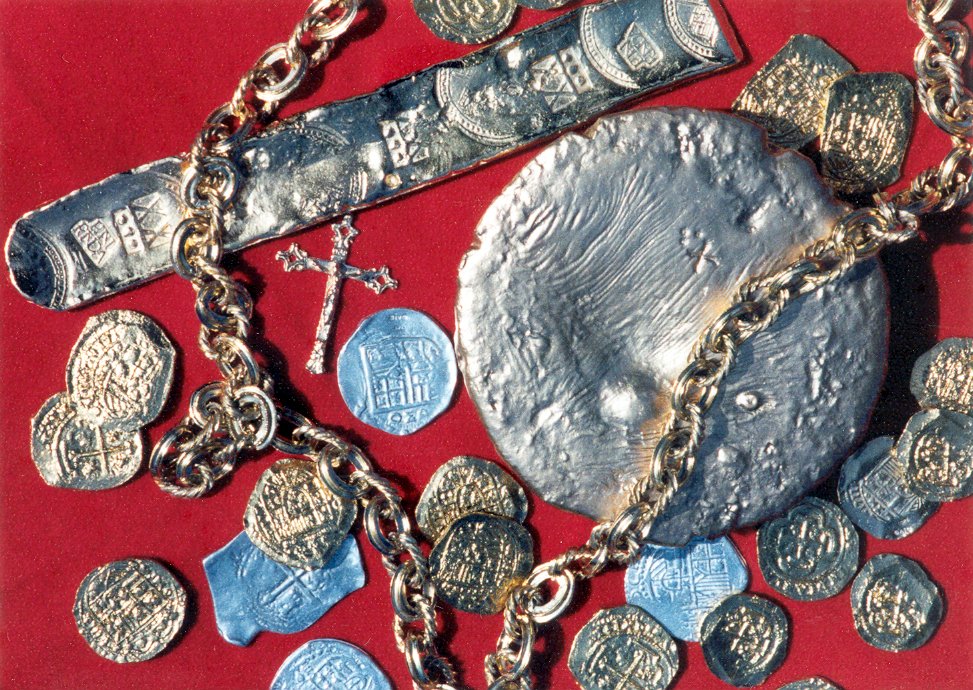
Ten years to the day after the accident, a crew led by Fisher’s son Kane reached the main deposit. The expedition’s later account records 991 silver bars and some 120,000 silver coins from that concentration. Contemporary news reports put the value of the discovery at around $400 million. The price made headlines, but the marks on the ingots told a different part of the story. An individual bar could carry a record of its weight, its purity or the people who handled it before it disappeared into the hold.
What the sea still holds
Salvors have long looked for the galleon’s sterncastle, the raised structure at the back of the ship. What may have been kept there, and what may survive together after centuries of storms, remain open questions. In June 2026, Mel Fisher’s Shipwreck Expeditions reported finding another silver bar at the wreck site. It weighed 22.5 pounds. After a discovery once measured in hundreds of bars, a single ingot was enough to put the Atocha back in the news.
The manifest survives on land. The sea is still returning the cargo one piece at a time.
Cover photograph: Replicas of recovered Atocha treasure at the McLarty Treasure Museum. Edward L. Perry IV (CC0).
Sources
- Mel Fisher Maritime Museum’s history of the 1622 fleet
- Associated Press coverage of the 1985 discovery
- Expedition chronology and recovery records
- Florida Department of State v. Treasure Salvors, Inc.
- Expedition report on the June 2026 silver-bar recovery
- Academy of Underwater Arts and Sciences biography of Mel Fisher




