

Ancient Treasure Maps: How to Tell History from Legend
What makes an ancient treasure map credible? Its date, provenance and geography matter more than the story attached to it. The Piri Reis map and the disputed Vinland Map show why a map can tell us a great deal about its makers while offering little evidence for a hidden fortune. Documented finds such as the Staffordshire Hoard provide a useful comparison.
When History Delivers Its Bounty
The past has, on occasion, opened its coffers willingly. In November 1922, Howard Carter’s lantern found what no living eyes had witnessed for over three thousand years: the largely intact tomb of Tutankhamun in Egypt’s Valley of the Kings. Gold masks, jeweled chariots, and artifacts of staggering beauty emerged into a waking world still reeling from the aftermath of the First World War. The discovery became a global sensation, anchoring the treasure hunt firmly in documented archaeology rather than folklore.
Nearly a century later, another unheralded find reshaped our understanding of early medieval Europe. In 2009, a man in Staffordshire, England, sweeping his metal detector across a plowed field, uncovered what would become the largest hoard of Anglo-Saxon gold and silver ever recorded. More than 4,000 objects and fragments—battle fittings, sword pommel caps, and fragments of noble adornment—were unearthed, belonging not to kings but to warriors whose names history had erased. The Staffordshire Hoard reminded the world that treasures can lie patient beneath ordinary soil for fifteen hundred years.
These are not legends. They are verified, photographed, museum-cataloged facts. But they also belong to a very different story than the one spun by internet myth and tabloid fantasy.
The Allure of the Unfound
Between documented finds and reckless speculation lies a vast field of the still-unlocated, the legendary, and the deliberately obscured. Consider the Amber Room, a chamber of amber panels, gold leaf, and mirrors created in the early eighteenth century for the Prussian court. It was later gifted to Peter the Great, installed in the Catherine Palace outside Saint Petersburg, and then—during the chaos of the Second World War—looted by retreating German forces. The room vanished into the fog of war. Most of the original room remains missing. Two elements of its prewar furnishings did return: a Florentine mosaic and a chest of drawers found in Germany were returned to the Tsarskoe Selo museum in April 2000. Their recovery did not resolve the fate of the amber panels.
Other treasures occupy a grayer territory. The treasure of the Knights Templar, the mythical sunken gold of the Incas, and the fabled Hoard of Ogier the Dane are stories that persist in popular culture with a magnetic strength no documentary evidence is required to sustain. Some were likely real at some point; most of the details surrounding them are almost entirely fictional. Treating them as anything other than cultural narratives is to misunderstand the relationship between history and myth.
A Warning Wrapped in Wonder
It is vital to distinguish between the archaeologist who excavates with permits, peer review, and institutional stewardship, and the treasure hunter who wanders foreign soil with a shovel and a stolen map. The former enriches collective knowledge; the latter often leaves only craters and destroyed context. Illegal excavation does not merely rob a nation of its heritage—it erases the evidence that makes interpretation possible. Once a site is disturbed out of context, the story it carried is lost forever.
And then there are the con artists. Every year, new “discovered” maps appear on auction sites. Every decade, a prospector claims to have found the lost colony of Roanoke or the buried vault beneath Plymouth Rock. These claims flourish because the imagination wants them to be true. Skepticism is not cynicism; it is the discipline that keeps the field honest.
The Map and the Territory
Ancient maps—Piri Reis, Oronteus Finaeus, the mysterious Vinland map—are seductive objects. They suggest that cartographers once knew things we have forgotten. Yet most so-called “mysterious” maps either prove, upon scrutiny, to be later forgeries or honest (if imperfect) attempts at geography by incompletely informed hands. The thrill of the hunt should not eclipse the reality of the archive.
What makes lost treasures endure is not their metallic value but their symbolism. They represent the gap between what we have and what we imagine—between the world as recorded and the world as dreamed. In that gap, there is room for wonder. But wonder without rigor is merely wishful thinking, and the earth has a way of swallowing the unwary who dig too deeply without understanding what they hold in their hands.
The Treasure Map Test
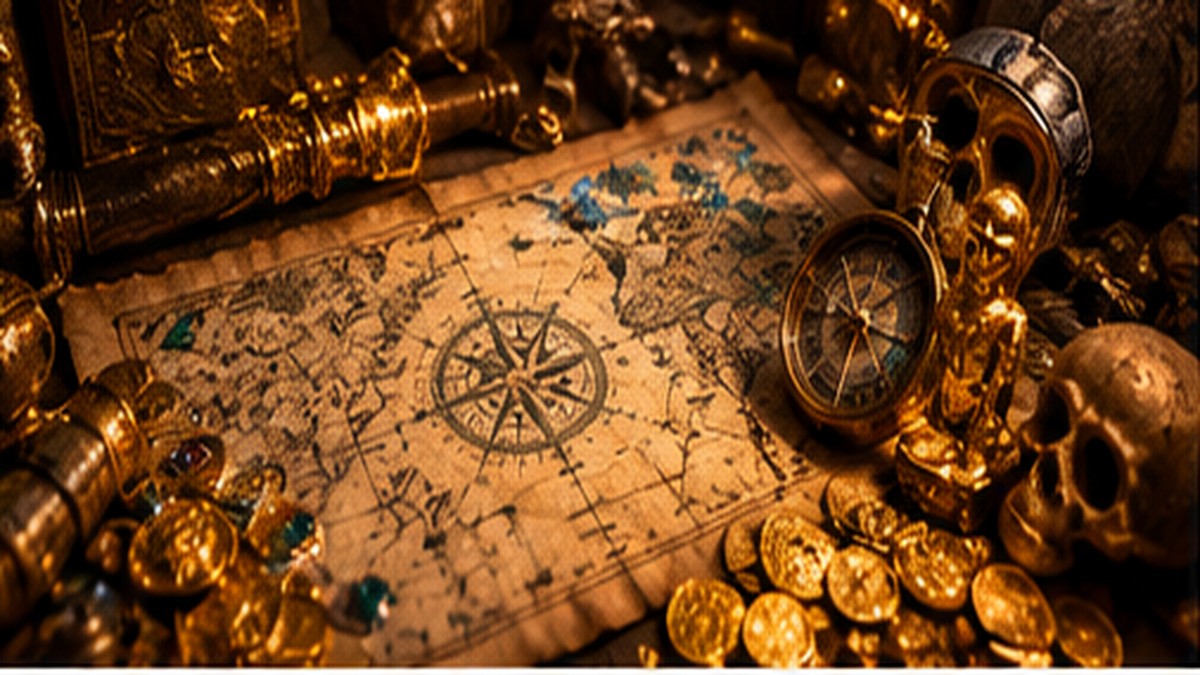
Every treasure story begins with a promise that the next mark on the map will lead to a hidden chamber. Before following it, ask whether the map is contemporary with the alleged burial, whether its symbols have a documented meaning and whether the geography fits the period. A modern drawing dressed in antique ink is not a historical source. The most valuable map may be the one that points to a question rather than a fortune.
Further reading: Famous Lost Treasures: What Was Found and What Is Still Missing · The Piri Reis Map · The Staffordshire Hoard.



