

DARK PAGE · ANCIENT LANDSCAPES
The Amazon’s Secret Geometry: Who Drew These Shapes Beneath the Forest?
The earth remembers what its makers never wrote down.
The Shapes That Emerged From the Trees
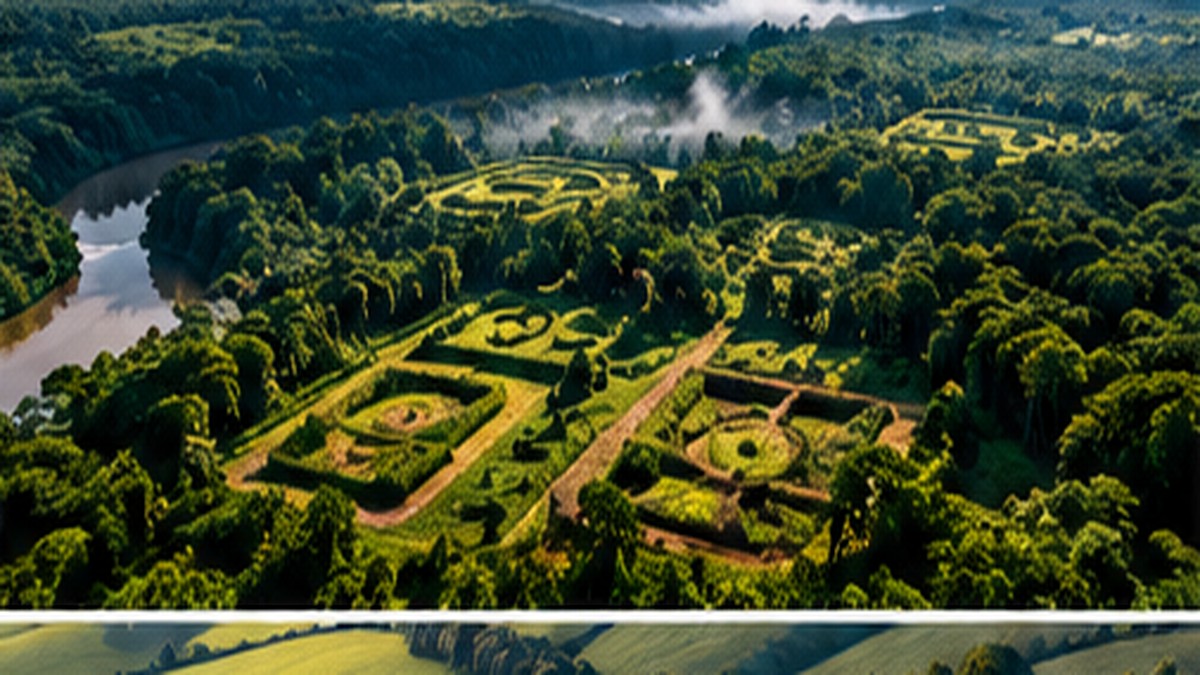
For generations, travellers looked across the Amazon and saw an apparently endless wilderness. Then aerial views and archaeological surveys began revealing something extraordinary: enormous circles, squares and straight-edged earthworks cut into the ground. Some became visible after forest clearing; others have been studied through remote sensing. The unsettling revelation is not that a lost supercivilisation has suddenly been proved. It is that the landscape holds far more human history than many outsiders once imagined.
Earth Moved by Human Hands
In parts of the southwestern Amazon, particularly Acre in Brazil, researchers have documented large geometric ditches and embankments. These were not casual marks scratched into the soil. Building them required labour, planning and knowledge of the terrain. Yet their functions remain the subject of study: ceremonial gatherings, social boundaries and other communal uses have been proposed. A geometric shape alone cannot reveal the builders’ intentions.
The Forest Is Not an Empty Museum
Archaeology has challenged the old image of the Amazon as a region with little pre-Columbian human activity. Evidence of settlements, modified soils and managed landscapes shows that people interacted with forests in complex ways. But the evidence varies dramatically across the basin. It would be equally misleading to imagine every stretch of rainforest once covered by a single vast city.
Aerial Eyes, Ground-Level Answers
Satellites and airborne instruments can identify suspicious patterns, but fieldwork is essential. Archaeologists must study layers of soil, artefacts, vegetation and the relationship between structures to establish chronology and use. Remote images are invitations to investigate, not automatic proof of a particular culture or age. Even a perfect square can conceal a complicated history.
The People Whose History Remains
The earthworks belong to histories of Indigenous peoples, not to a fantasy of anonymous vanished geniuses. Research must respect living communities and the risks posed by looting, land conversion and sensational tourism. When a site is damaged, its archaeological context may be lost before anyone can understand it.
The Unfinished Map
How many structures remain concealed by vegetation? How did their builders organise work and ceremony? What connections existed among settlements separated by forests and rivers? The Amazon’s most haunting mystery may be that the land we thought was silent has been carrying human stories all along.
Editorial note: Archaeological evidence, scholarly interpretations and popular legends are distinguished throughout this feature.
Further reading: The Turgai Geoglyphs · Five Giant Messages on Earth.




[…] reading: The Amazon’s Secret Geometry · The Turgai […]