

DARK PAGE · ANCIENT LANDSCAPES
Five Giant Messages on Earth: The Ancient Signs We Still Cannot Fully Read
The earth remembers what its makers never wrote down.
The Planet as a Canvas
Some human artworks fit inside a room. Others require a hillside, a desert or an entire landscape. Across the world, ancient communities reshaped earth and stone into forms that outlived their makers. Seen from above, they resemble a forgotten alphabet. But there is no evidence that all these monuments share a secret global language. Their real histories are more varied—and more revealing.
1. Nazca: Lines Across the Peruvian Desert
In southern Peru, ancient people removed dark surface stones to expose pale ground, creating long lines, geometric forms and figures of animals. Their preservation owes much to the region’s aridity. Researchers continue to debate the different social and ritual roles of the designs. They are monuments of human planning, not established landing strips for extraterrestrial visitors.
2. Turgai: Geometry on Kazakhstan’s Steppe
Kazakhstan’s Turgai region contains striking earthwork formations visible in aerial and satellite imagery. Crosses, squares and other forms have drawn attention, but their individual ages and purposes require careful archaeological study. Their enormous scale raises questions about cooperation and the use of landscape as a communal space.
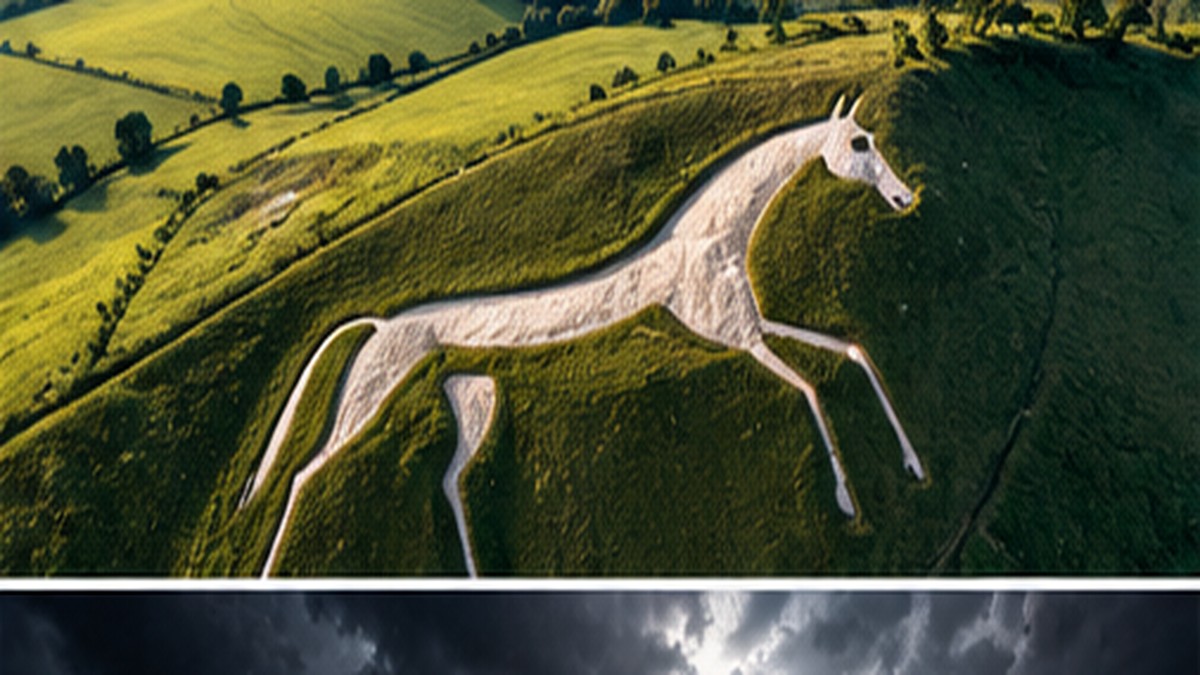
3. Uffington: The White Horse on an English Hill
The Uffington White Horse in Oxfordshire is a prehistoric hill figure cut into chalk. Its stylised shape has been maintained over centuries, allowing the pale design to remain visible against the hillside. Its exact original meaning is debated. It is a reminder that preservation is sometimes an ongoing human act rather than a gift of nature alone.
4. The Amazon: Earthworks Beneath the Trees
Geometric ditches and embankments documented in parts of the Amazon show that the region’s history includes substantial human landscape modification. Their functions and dates vary, and not every geometric feature belongs to the same cultural tradition. The forest conceals evidence, but it also protects fragile sites whose context matters more than dramatic headlines.
5. Atacama: The Giant on the Chilean Hillside
The Atacama Giant, a large anthropomorphic geoglyph on Cerro Unitas in northern Chile, forms part of a broader tradition of landscape images in the region. Interpretations have connected such figures with travel, belief and possibly astronomical ideas, but particular claims require evidence. Its monumental presence does not give us a direct translation of its makers’ intentions.
Five Places, No Single Secret
These monuments belong to different times, cultures and environments. Similar scale does not demonstrate common builders. Each requires its own evidence: dating, material study, landscape survey and engagement with local history. Perhaps the most surprising conclusion is that humanity repeatedly found ways to make the earth itself carry meaning. We can see the marks. The voices behind them are harder to recover.
Editorial note: Archaeological evidence, scholarly interpretations and popular legends are distinguished throughout this feature.
Further reading: How the Nazca Spider Was Made · Nazca Spider: Meanings and Myths · The Amazon’s Secret Geometry · The Turgai Geoglyphs.




[…] Further reading: Nazca Spider: Meanings and Myths · The Turgai Geoglyphs · Five Giant Messages on Earth. […]