
The Twelfth Room
The Twelfth RoomA Novella by Victor HorizonTHE TWELFTH ROOM A Novella by Victor Horizon Preface — A Critical Study by Robert Camiu I. The Novel That Reads the Reader There are novels one reads. And there are novels that…
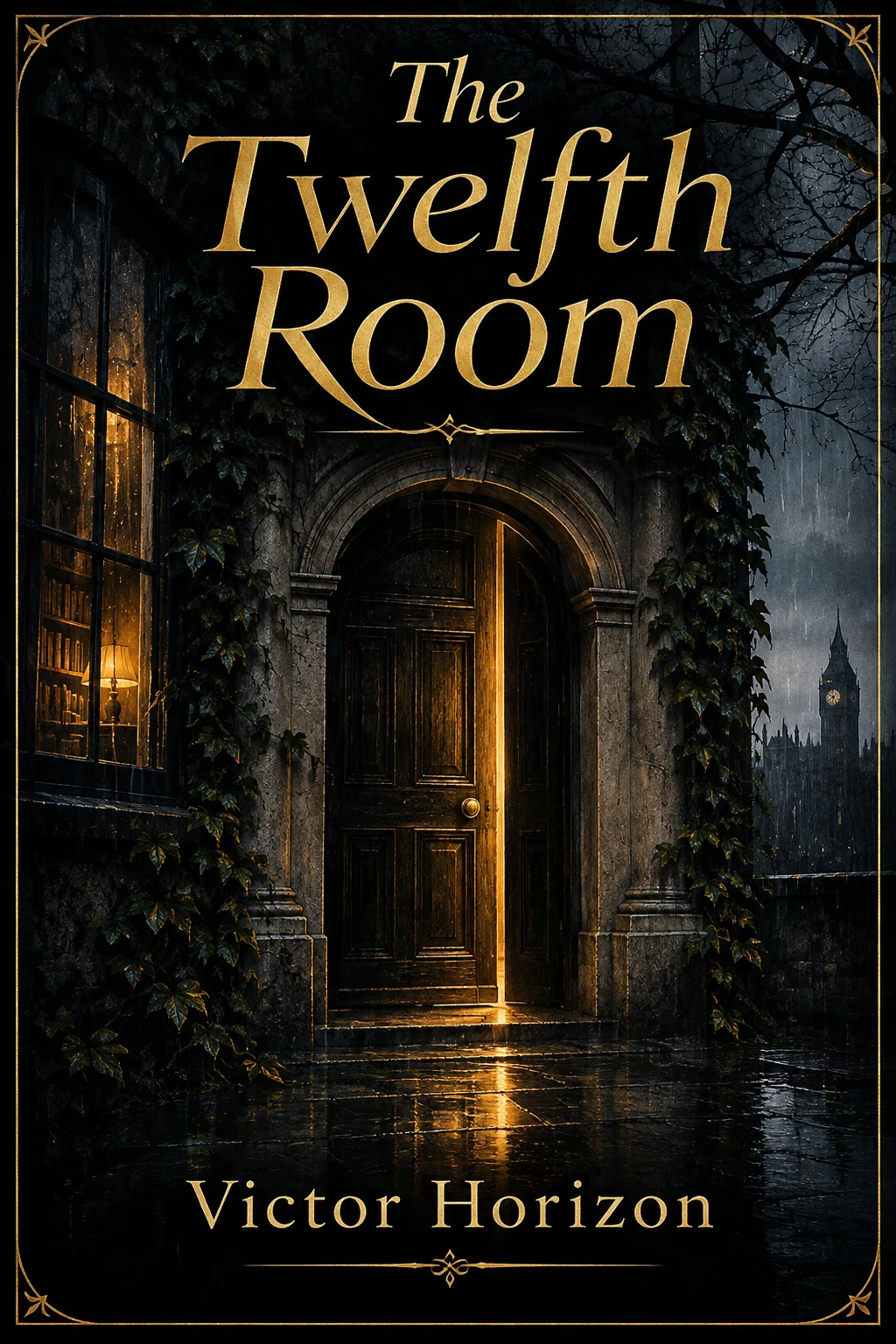
The Twelfth Room
A Novella by Victor Horizon
THE TWELFTH ROOM A Novella by Victor Horizon
Preface — A Critical Study by Robert Camiu
I. The Novel That Reads the Reader
There are novels one reads. And there are novels that read you.
The Twelfth Room belongs to the second kind.
It is not a story about a therapist. It is a story about the terrifying moment when the therapist discovers that the person he has spent his whole life treating was never his patient at all — it was himself.
Dr. Simon, a respected psychotherapist in Harley Street, London, has spent twenty years helping others make sense of their minds. He is calm. Articulate. Assured. In the drawing rooms of Hampstead and the consulting rooms of Marylebone, his name is spoken with quiet reverence.
And then one grey, rain-washed afternoon, his wife Mary asks him a single question over tea:
“Simon, have you ever imagined another woman?”
It is not an accusation. It is not even anger. It is a question asked in the stillness between two sips of tea, with the rain tapping against the tall sash windows of their Victorian terrace in Primrose Hill.
But that question does something no patient, no textbook, no supervisor has ever done. It cracks him open.
Because Simon has imagined. Not a body. Not an act. A feeling — a quiet, unnameable longing to be seen not as a husband, not as a healer, but simply as a man.
And in that moment, this novel asks its first great question, in the language of modern British life:
Can a thought be a betrayal?
II. The Architecture of the Mind
Camiu argues that the true genius of this novella lies in its central metaphor — the House.
In a rain-soaked lane on the edge of Hampstead Heath, Simon finds an old Victorian mansion. Eleven rooms are open. Light, airy, lived-in. But the twelfth room is locked.
It is not a horror device. It is Freud made into architecture.
Each room is a part of the psyche. The drawing room is the social self — polished, well-mannered, British to the bone. The study is the intellect. The kitchen is appetite and need. And the twelfth room?
The twelfth room is the unconscious. The place where we store what we cannot bear to look at.
As Simon walks through that damp, ivy-covered house, with the smell of wet earth and old wood in the air, the reader understands: he is not exploring a building. He is walking through his own mind, room by room, for the first time.
III. The Double
Then comes the most chilling moment in the novel.
Simon sees a man in the house who looks exactly like him. Same coat. Same gait. Same tired eyes.
This is Jung’s Shadow — the part of ourselves we refuse to own. In British terms, it is the man we are at 2 a.m. when no one is watching. The man who is angry, frightened, selfish, lost.
Simon tries to run from him. He tries to argue with him. He tries to treat him.
Until the old gardener — a quiet, weathered man who has tended that garden through forty London winters — says the line that changes everything:
“You are not afraid of him, sir. You are afraid that he is you.”
That is the moment The Twelfth Room stops being a psychological thriller and becomes a mirror.
IV. Memory Is Not a Photograph
One of the most brilliant chapters in the novella deals with a simple detail: the colour of a dress.
Mary remembers it as blue. Simon remembers it as green.
In any ordinary novel, this would be a mistake. Here, it is the whole point.
Modern neuroscience tells us what Camiu has long argued: memory is not a recording. It is a reconstruction. Every time we remember, we rebuild.
Simon has not lied. Mary has not lied. They have simply rebuilt the past from two different wounds.
In that quiet argument in their kitchen in Primrose Hill — kettle whistling, rain still falling outside — the novel delivers its most humane truth: two people can love each other deeply and still remember the same marriage completely differently.
V. The Wound Is Not the Identity
The middle of the novel is where most writers would lose their way. Victor Horizon does not.
Simon goes back to his childhood. To his father, a stern, silent man who believed emotion was weakness. To the boy who learned early that to be loved, he had to be useful. To be good.
He carries that wound into his marriage. He carries it into his clinic. He makes a career out of healing in others what he has never healed in himself.
And then, by the river — not the Thames of tourists, but the quiet, muddy stretch near Richmond, where the water moves slowly and the swans do not hurry — Richard sits with him and says:
“A branch is not the tree, Simon.”
It is a simple line. In British understatement, it is devastating.
You are not your trauma. You are not your fear. You are not the worst thought you have ever had.
You are the whole tree. Branch, trunk, root, and all.
VI. Why This Novel Matters in Britain Today
In a culture that prizes the stiff upper lip, that says “I’m fine” when it is falling apart, that apologises for crying on the Tube, this novel does something radical: it gives a man permission to be unfinished.
Simon does not become a perfect husband. He does not become a perfect therapist. He does not find all the answers.
He learns something far more British, and far more human: to live with the question.
To sit with Mary, not as her fixer, but as her fellow traveller. To accept that love is not about fixing each other. It is about witnessing each other, even in the locked rooms.
The final chapter does not end with a cure. It ends with a mirror.
Simon looks, and does not see himself. He sees the reader.
“This story was never mine. It was always yours.”
That is why The Twelfth Room will stay with you long after you close it on a rainy London evening. Because when you walk away from that house in Hampstead, you will realise you have been walking through your own house all along.
And somewhere inside you, there is still a twelfth room waiting to be opened — not with fear, but with kindness.
—
—
CHAPTER 1 — THE QUESTION
The rain had been falling since morning over Primrose Hill.
Not the dramatic rain of films. The quiet, persistent London rain that settles on rooftops, on black cabs, on the shoulders of people hurrying toward the Tube with their collars up. The kind of rain that makes you want to stay inside, make tea, and not answer the telephone.
Dr. Simon sat in his consulting room in Harley Street, watching the rain trace slow lines down the tall sash window.
The room was exactly as it had always been. A deep green leather chair. A bookshelf filled with Freud, Jung, Winnicott, Bowlby — their spines faded by years of use. A small Persian rug. A clock that ticked a little too loudly in the silence.
For twenty years, people had come to this room to tell him things they could tell no one else. Affairs. Fears. Childhoods. Shames. He had listened without flinching. He had a reputation in London for being the therapist other therapists went to.
That afternoon, his last patient had left early. A young woman from Camden, who cried quietly and then apologised for crying, as Londoners do.
Simon locked the door, put on his dark overcoat, and walked home through Regent’s Park. The wet leaves stuck to the pavement. A bus hissed past. Somewhere, a street musician was playing a sad tune on a violin, completely ignored by everyone.
At home, Mary was already there.
The house in Primrose Hill was warm. The smell of Earl Grey tea. The low hum of the dishwasher. A stack of unopened post on the hall table — bills, a letter from the Tavistock Clinic, a postcard from a friend holidaying in Cornwall.
Mary was in the kitchen, in a soft grey jumper, her hair tied back. She was not doing anything extraordinary. Just pouring tea into two mugs. Just being Mary.
She looked up and smiled.
“Long day?”
“The usual,” Simon said. “People telling me they are fine, while their hands shake.”
She laughed, that small, familiar laugh he had loved for twenty-three years.
They sat at the kitchen table. Outside, the rain grew heavier. The window fogged slightly. The world outside became a blur of grey and amber streetlights.
And then, without any warning, without any change in her voice, Mary asked:
“Simon, have you ever imagined another woman?”
Simon froze.
The mug stopped halfway to his lips. The tea went cold in his hand.
It was not the question itself. Therapists are asked worse every day. It was who was asking it. And how.
There was no anger in her eyes. No tears. Only a terrible, calm curiosity — as if she had been holding this question inside her for months, like a letter she was afraid to post.
“I…” he began.
Mary did not look away.
“I don’t mean… you know,” she said softly, stirring her tea. “I don’t mean anything physical. I mean… have you ever, in your mind, wished for someone else? Someone who sees you differently? Someone who doesn’t know you as… this?”
As this. As the husband. As the father. As the good man. As Dr. Simon.
Simon wanted to give a professional answer. A clean, clinical answer. Fantasy is normal. Thought is not action. The mind is not a courtroom.
But this was not his consulting room. This was his kitchen. And the woman in front of him was not his patient.
She was his wife.
And for the first time in twenty years, Dr. Simon had no answer.
“I have imagined,” he said at last, his voice barely above a whisper, “being seen. Not as a therapist. Not as a husband. Just… as a man.”
Silence.
The clock in the hallway ticked. The rain tapped against the glass. A siren passed far away on Camden High Street.
Mary nodded slowly, as if she had expected that answer, and feared it at the same time.
“I thought so,” she said.
She stood up, took her mug to the sink, and washed it with great care, as if the mug were the only thing in the world she could still control.
That night, Simon lay awake beside her, staring at the ceiling of their bedroom in Primrose Hill.
Mary was asleep, or pretending to be asleep. Her breathing was steady. Her hand was near his, but not touching his.
And for the first time in his life, Simon understood what his patients had been trying to tell him all these years:
It is possible to be surrounded by people who love you, and still feel completely alone in a locked room inside yourself.
That night, he did not sleep.
He kept thinking about a house he had seen years ago, on a walk near Hampstead Heath. A large Victorian house. Eleven rooms open to the light.
And one room, at the end of the corridor, always locked.
He did not know why he was thinking about it now.
He only knew that, for some reason, that twelfth room had suddenly begun to feel like him.
—
CHAPTER 2 — THE HOUSE ON THE HEATH
Three days later, Simon found himself walking again.
He told himself he was just going for air. That he needed to clear his head after Mary’s question. But his feet knew where they were going, long before his mind admitted it.
Past the cafés of Hampstead Village. Past the bookshops. Past the Heath, where the grass was wet and the dogs were running wild with joy, oblivious to the cold.
And there it was.
The house.
It stood at the end of a narrow lane, half-hidden by ivy and old oak trees. Victorian, red-brick, with tall windows and a slate roof gone green with moss. It looked like a house that had once been loved very much, and then forgotten very slowly.
A faded estate agent’s board leaned against the gate: FOR SALE — REQUIRES MODERNISATION.
Simon pushed the gate. It creaked.
The garden was overgrown. Wet leaves. A broken bench. A stone birdbath full of rainwater. The air smelled of damp earth and old wood — that particular smell of English houses that have been shut up for winter.
He did not know why he had come. He only knew that since Mary’s question, something inside him had been knocking.
Knock. Knock. Knock.
As if from inside a locked room.
He walked around to the back. A window was slightly open. He could see inside — a long corridor, dark wood, a staircase going up.
And then, just for a second, he thought he saw someone standing at the top of the stairs.
A man in a dark overcoat. Same height as him. Same posture.
Simon stepped back, his heart hammering.
When he looked again, there was no one there.
Only his own reflection, staring back at him from the wet glass.
It was then that he heard the voice of the old gardener, who had been quietly pruning roses in the corner, as if he had been waiting for him all along:
“You looking to buy, sir? Or are you just looking to remember?”
Simon did not know how to answer.
Because for the first time, he was not sure which one he was doing.
—
CHAPTER 3 — THE DOUBLE
The old gardener did not look up at first.
He was on his knees in the wet grass, pruning a rose bush that had long since given up on roses. His hands were rough, cracked by forty London winters. A flat cap, dark with rain. A pair of old gloves with the fingers worn through.
He worked slowly, as if he had all the time in the world. As if time, for him, moved differently in this garden.
“You’ve been here before, haven’t you?” he said, without looking at Simon.
Simon swallowed. “I… I think I walked past once. Years ago.”
The gardener nodded, as if that was exactly the answer he expected.
“People don’t walk past this house, sir. They walk toward it. Even when they think they’re walking away.”
He finally stood up, wiping his hands on his old tweed jacket. His eyes were a pale, watery blue — the kind of eyes that had seen too many winters and too many people pretending to be fine.
“Eleven rooms open,” he said. “One locked. That’s what the estate agent says. But that’s not the truth.”
“What is the truth?” Simon asked, before he could stop himself.
The gardener looked toward the tall Victorian windows, dark now with the afternoon rain.
“The truth is, sir, all twelve rooms are open. It’s just that we only live in eleven of them. The twelfth… we just walk past it. Every day. Pretending we don’t hear the knocking.”
Simon felt a coldness run down his spine that had nothing to do with the rain.
He had heard that knocking. For three nights now, since Mary’s question. In his sleep. In his silence. In the space between his own thoughts.
Knock. Knock.
He tried to laugh it off, in that very British way men do when they are frightened.
“You’re a philosopher as well as a gardener, then?”
“No, sir,” the old man said quietly. “I’m just a man who has spent his life watching people come to this house, stand at the gate, and walk away without ever going in. They all say the same thing. ‘I was just passing.'”
He picked up his shears again.
“But no one just passes this house. Not really.”
Simon stood there, rain dripping from his overcoat, and for a moment he felt like a patient in his own consulting room. Exposed. Seen. Understood by a stranger in a way that felt both comforting and terrifying.
He turned to leave. He had to get back. Mary would be home. There was dinner. There was life. There was the normal, ordered, sensible life he had built so carefully in Primrose Hill.
And then he heard it.
A footstep. Upstairs. Inside the empty house.
Slow. Deliberate. Exactly like his own.
He froze.
“Did you hear that?” he whispered.
The gardener did not look surprised. He did not even look up.
“That’s just him,” he said.
“Who?”
“The man who lives in the twelfth room.”
Simon turned sharply toward the house. The tall window on the first floor — the one that had been dark a moment ago — now had a faint light in it. Warm. Amber. Like a lamp had just been switched on.
And in that window, for less than a second, Simon saw him.
A man in a dark overcoat. Same height. Same hair. Same tired eyes. Same way of standing, with one hand in his pocket.
Himself.
But not himself.
Because this man was smiling. A small, sad, knowing smile. As if he had been waiting for Simon to finally look up.
Simon stepped back, his breath catching in his throat.
“Who is that?” he cried.
The gardener finally looked at him, and his voice, when it came, was almost gentle.
“Sir,” he said, “you tell me. You’ve been a therapist for twenty years. You of all people should know.”
“What?”
“You are not afraid of him. You are afraid that he is you.”
The rain fell harder. The light in the window went out.
When Simon looked again, the window was dark. Empty. Just his own reflection staring back at him from the wet glass, pale and shaken.
He walked home that evening through Hampstead Heath, but he did not really see the Heath. He did not see the dogs, or the runners, or the couples under umbrellas.
He kept thinking about what he had learned in his first year at university, in a lecture hall in Oxford, when his teacher — Professor Steven — had held up a blank sheet of white paper and asked the class:
“What do you see?”
Everyone had said: “Nothing. A blank page.”
Professor Steven had smiled and said: “Exactly. You see nothing. Because you are looking at the paper. You are not looking at what is written on it in invisible ink.”
He had then said something Simon had never forgotten, and had spent twenty years trying not to remember:
“Every man has a page inside him that he never reads. Not because it is empty. Because he is afraid of what is written there.”
That night, back in Primrose Hill, Simon sat at the kitchen table long after Mary had gone to bed.
He took a blank sheet of paper from his notebook. He placed it in front of him.
White. Empty. Innocent.
And for the first time in his life, he did not try to analyse it.
He just stared at it, and whispered to the empty kitchen:
“What is written on me?”
And from somewhere deep inside him — from a room he had walked past for forty-two years — came a very quiet answer:
Knock. Knock.
—
CHAPTER 4 — THE LOCKED ROOM
Simon did not go back to the house the next day.
He told himself he would not go back at all.
He had a clinic to run. Patients to see. A marriage to repair. A life to keep in order. He was Dr. Simon of Harley Street, not a schoolboy chasing ghosts in Hampstead.
For two days, he kept that promise.
He saw his patients. He listened. He nodded. He said the right things — “And how did that make you feel?” — in the right tone, at the right time. From the outside, nothing had changed.
But inside, something had shifted.
Every time he closed his eyes, he saw that window. That faint amber light. That man in the dark overcoat, smiling at him like an old friend he had been avoiding for years.
On the third day, it rained again.
Mary had gone to visit her sister in Richmond. The house in Primrose Hill was quiet. Too quiet. The kind of quiet where you can hear the fridge hum and your own thoughts too loudly.
Simon found himself standing by the hall table, keys in hand, before he had even decided to go.
He told himself he was just going for a walk. A walk on the Heath. Fresh air. Exercise. All the things a sensible British man tells himself when he is about to do something completely unsensible.
Twenty minutes later, he was standing again at the iron gate of the house in Hampstead.
This time, the gate was open.
The old gardener was nowhere to be seen. His shears were left leaning against the stone birdbath, as if he had just stepped away for a moment. Or as if he had left them there on purpose.
Simon stood at the gate for a long time.
He could turn back. He could go home, make tea, wait for Mary, and pretend that none of this had ever happened. He could go on living in eleven rooms, like everyone else.
And then he heard it again.
Knock. Knock.
Not from the house this time. From inside his own chest.
He pushed the gate open and walked up the wet gravel path.
The front door was not locked. It had not been locked, he realised, for a very long time. It had only been closed.
He put his hand on the cold brass handle, took a breath, and pushed.
The smell hit him first — damp wood, old dust, dried lavender, and something else underneath it all. Something like his grandmother’s house in Yorkshire, when he was a boy. The smell of a place that has been waiting.
The hallway was long and dark, with a staircase rising to the first floor. Portraits on the walls, their faces faded. A tall grandfather clock, stopped at 3:17. A rug, worn thin in the middle, where a thousand feet had walked the same path.
Simon walked slowly, his shoes loud on the wooden floor.
Eleven rooms. He counted them as he passed.
A drawing room, with a fireplace and two armchairs facing each other, as if two people had once sat there and never finished their conversation.
A dining room, with a long table and twelve chairs, and one chair pulled out slightly, as if someone had just stood up.
A study, with empty bookshelves and a desk, and a single drawer slightly open.
A kitchen, with a kettle gone cold, and a mug still in the sink.
Each room was familiar. Not because he had been here before. But because he had lived in rooms like these inside himself.
The drawing room was his social self — polite, well-spoken, the Simon who said “I’m fine, thank you” at dinner parties.
The study was his intellect — clever, analytical, the Simon who could explain everyone else’s pain.
The kitchen was his hunger — for love, for rest, for being held without having to earn it.
He had lived in all of them. He knew them by heart.
And then he reached the end of the corridor.
The twelfth room.
It was different from the others. The door was heavier. Darker. Made of old oak, with a brass handle that had gone green with age. There was no keyhole. No number. Just a small, faded brass plate, with one word engraved on it:
SIMON.
His breath stopped.
He reached out, his hand shaking, and touched the door.
It was warm.
Not cold, like the rest of the house. Warm. As if someone had been living on the other side of it all along, breathing, waiting, keeping the fire lit.
He tried the handle.
Locked.
Of course. Locked.
He pressed his forehead against the wood, and for a moment, he was seven years old again, standing outside his father’s study in Yorkshire, wanting to go in, wanting to be seen, wanting to be told that he was enough — and hearing, from the other side, only silence.
“Dad,” he whispered, without meaning to. “It’s me.”
And then, from the other side of the door, in a voice so quiet it could have been his own thought, came the answer:
“I know. I’ve been waiting for you to knock.”
Simon stepped back, his heart pounding so loudly he could hear it in his ears.
He was not a superstitious man. He was a man of science. A therapist. A rationalist. He did not believe in ghosts.
But in that moment, in that dark corridor in Hampstead, he understood something that no textbook had ever taught him:
*The locked room was not keeping something out. It was keeping something in. And that something was him.*
The part of him he had locked away when he was seven. The boy who cried. The boy who was afraid. The boy who needed his father to say, “I see you.”
He had grown up. He had become a doctor. He had become a husband. He had become successful.
But he had never gone back for that boy.
He stood there for a long time, his hand still on the warm door, rain beating against the windows of the house, and for the first time in twenty years, Dr. Simon did something he had never done in his consulting room.
He did not analyse.
He did not interpret.
He just knocked back.
Knock. Knock.
And from the other side, the boy knocked back too.
— ### CHAPTER 5 — THE DIARY
Simon did not tell Mary about the house.
Not that night. Not the next morning.
How could he? What would he say?
“Darling, I went to an empty Victorian house in Hampstead and knocked on a door with my own name on it, and a little boy knocked back.”
In Primrose Hill, in a sensible marriage, in a sensible life, you do not say things like that. You say you went for a walk. You say the Heath was lovely. You say you are a bit tired.
And so, for a week, Simon lived two lives.
In the first life, he was Dr. Simon. He saw his patients in Harley Street. He made tea for Mary. He paid the council tax. He answered emails from the British Psychological Society. He was normal.
In the second life — the life he did not speak about — he went back to the house every afternoon, when Mary was at work, and stood in the dark corridor, staring at the door with his name on it.
He never tried to open it again. He was afraid to. He was afraid not to.
On the seventh day, something changed.
He arrived to find the study door — the one with the single drawer slightly open — now wide open.
Inside, on the desk, where there had been nothing but dust, there was now a book.
A small, leather-bound diary. Dark brown. Worn at the edges. The kind of diary you might find in a charity shop in Camden Market, or in the attic of a house in Yorkshire.
On the cover, in faded gold letters, was a single name:
RICHARD.
Simon picked it up with hands that were not quite steady.
He knew, in that irrational, certain way you know things in dreams, that this diary had not been there by accident. Someone had left it for him. The gardener. The boy. The man in the overcoat. Himself.
He sat down in the study, in the old leather chair by the window, rain beginning to fall again over Hampstead Heath, and opened it to the first page.
The handwriting was neat. Controlled. The handwriting of a man who was used to being listened to.
“If you are reading this, Simon, it means you have finally stopped walking past your own door.”
Simon’s breath caught.
“My name is Richard. I was a therapist, like you. I had a house in London, a wife, a reputation, a life that looked perfect from the outside. And I had a twelfth room I never opened.”
“I am not writing this diary to warn you. I am writing it because no one warned me.”
Simon turned the page, his heart beating faster now.
“We are taught, in our training, to help others face their shadows. We are not taught what to do when the shadow starts looking back at us.”
“I spent twenty years treating other people’s fear of being alone. And all that time, I was terrified of being alone with myself.”
“I made the same mistake you are making now. I thought that if I ignored the knocking, it would stop. It does not stop, Simon. It only gets quieter. And quieter is more dangerous than loud. Because when it gets quiet, you start to think you have healed. And you have not healed. You have just learned to live with the locked door.”
Simon looked up. The study was silent. The rain was falling softly against the tall window. Outside, the garden was a blur of green and grey.
He turned another page.
“Mary is not your enemy. She is your mirror. When she asked you if you had ever imagined another woman, she was not asking about another woman. She was asking: ‘Simon, are you still here with me? Or have you already left, and just forgotten to tell your body?’”
“Answer her honestly. Not as a therapist. As a man.”
“And when you are ready, come back to the house. There is a second diary. And a third. I left them for you, in the rooms you are afraid to enter.”
“I left them because I never had the courage to finish mine.”
“Do not make my mistake.”
“— Richard”
Simon closed the diary slowly.
He sat there for a long time, the leather warm in his hands, the rain moving across the Heath, the house creaking softly around him like an old ship.
For the first time in his life, he did not feel like a therapist reading a case file.
He felt like a man reading a letter from his future self.
A man who had walked the same corridor. Stood before the same door. Heard the same knocking. And had turned away.
He put the diary in his overcoat pocket, walked out of the house, and locked the front door behind him — though he knew, now, that locks in that house meant nothing at all.
That evening, he went home to Primrose Hill. Mary was in the kitchen, making soup. Leek and potato. The smell filled the house.
She looked up, saw his face, and put down the ladle.
“Simon? You look… different. Did something happen?”
He wanted to lie. He was very good at lying, in that polite, professional way that sounds like truth.
But instead, he did something he had not done in twenty-three years of marriage.
He sat down at the kitchen table, took her hand in his — her real hand, warm, a little floury from the bread she had been kneading — and said:
“Mary. I need to tell you about a house.”
—
CHAPTER 6 — THE CONFESSION
Mary did not interrupt him.
That was the most terrifying part. And the most loving part.
She just sat there at the kitchen table in Primrose Hill, her hands wrapped around a mug of tea gone cold, and listened.
Simon told her everything.
He told her about the house in Hampstead. About the gardener. About the man in the window. About the door with his name on it. About the warm wood. About the boy knocking back.
He told her about Richard’s diary, and he took it out of his overcoat pocket and placed it on the table between them, like evidence in a trial.
He expected her to laugh. Or to cry. Or to call him mad. Or to say, in that calm, practical voice she used when the boiler broke or the car failed its MOT, “Simon, you need to see someone.”
She did none of those things.
She opened the diary. She read the first page. Then the second. Then she closed it, very gently, as if it were a bird with a broken wing.
And then she said, in a voice so quiet he almost missed it:
“I knew.”
Simon stared at her. “You knew what?”
“I knew you were going somewhere. Every afternoon. You come home and your shoes are wet with Heath mud, not Regent’s Park mud. And you smell of old houses. And you look…” She paused, searching for the word. “You look like a man who has seen something he can’t explain, and is trying very hard to pretend he hasn’t.”
Simon felt something crack inside him. Not break. Crack — like ice on the Serpentine in February, when the spring is coming underneath.
“Mary, I’m a therapist,” he said, his voice breaking. “I’m supposed to know what’s happening to me. I’m supposed to have a theory. A framework. A… a treatment plan. But I don’t. I don’t know if I’m having a breakdown or a breakthrough. I don’t know if Richard was real, or if I invented him. I don’t know if that boy behind the door is me, or if I’m losing my mind.”
Mary reached across the table and took his hand. Not the way a therapist takes a patient’s hand. The way a wife takes a husband’s hand after twenty-three years, when she has seen him at his best and at his worst, and has stayed anyway.
“Simon,” she said, “do you remember when we first met?”
He nodded. “At university. UCL. You were studying literature. I was studying psychology. You were reading Virginia Woolf in the library and I pretended I had read her too.”
“You hadn’t,” she smiled, tears now in her eyes. “You’d only read the back cover.”
“I still haven’t read her properly,” he admitted.
They both laughed, a small, wet laugh, the kind that comes when you are crying and laughing at the same time, and you don’t know which one is winning.
“I fell in love with you,” Mary said, “because you were the only boy in that library who admitted he was lost. All the other boys pretended they knew everything. You said, ‘I don’t know who I am yet.’ And I thought — this one. This one is honest.”
She squeezed his hand.
“Somewhere along the way, you stopped saying that. You became Dr. Simon. The man who knows. The man who has answers. The man who never gets lost. And I… I got lost trying to follow a man who never gets lost.”
Simon felt the tears come then. Not dramatic tears. Quiet tears. The tears of a man who has held himself together for so long that he has forgotten what it feels like to fall apart in front of someone safe.
“Mary, have I… have I been a good husband?”
She did not answer immediately. She looked out of the kitchen window, at the rain falling on their small garden in Primrose Hill, at the wet washing line, at the neighbour’s cat sitting under a bush, looking thoroughly offended by the British weather.
“You have been a good husband, Simon,” she said at last. “You have been reliable. Kind. Faithful. You have never raised your voice. You have never left. You have paid the mortgage. You have remembered my birthday.”
She turned back to him, and her eyes were clear and terrible in their honesty.
“But I did not marry you to be managed, Simon. I married you to be met. Do you understand the difference?”
He did. God help him, he did.
To manage someone is to keep them stable. To meet someone is to stand in front of them, unguarded, and say: Here I am. All of me. Even the rooms I am afraid of.
For twenty-three years, he had managed Mary. He had managed their marriage. He had managed his own pain, so efficiently, so professionally, that he had managed it right out of existence — and right out of his marriage.
“I’m sorry,” he whispered.
“I know,” she said. “And I’m sorry too. I stopped asking you who you were. I started asking you what you thought about who you were. That’s a therapist’s question. Not a wife’s question.”
They sat there in silence for a long time. The soup on the stove went cold. The rain kept falling. A bus went past outside, spraying water against the kerb.
And then Mary did something Simon did not expect.
She picked up Richard’s diary, held it to her chest for a moment, and said:
“Go back.”
“What?”
“Go back to the house, Simon. Go back tomorrow. Find the second diary. Find the third. Find whatever it is you’ve been locking away since you were seven years old. Because I don’t want to be married to eleven rooms anymore.”
She looked him straight in the eyes.
“I want all twelve.”
That night, Simon did not sleep in the spare room, as he had done for the past three nights.
He slept beside Mary. Not touching. Not yet. But close enough to hear her breathing. Close enough to know that she was still there.
And as he lay there in the dark, staring at the ceiling of their bedroom in Primrose Hill, he thought about the boy behind the door.
He thought about Richard.
He thought about Mary’s words: I want all twelve.
And for the first time since he was seven years old, standing outside his father’s study in Yorkshire, he allowed himself to think the thought he had been most afraid of:
Maybe the locked room is not a prison. Maybe it is a gift. Maybe what I locked away was not my weakness, but my tenderness. And maybe Mary has been waiting all these years, not for the perfect husband, but for the tender boy I used to be.
He fell asleep, finally, just as the rain stopped over London.
And in his dream, he was standing again in the corridor in Hampstead.
But this time, the door with his name on it was not locked.
It was slightly open.
And light — warm, amber, forgiving light — was coming out from underneath it.
—
CHAPTER 7 — RICHARD’S SECOND DIARY
Simon went back the next morning, earlier than usual.
The sky over Hampstead was that pale, washed-out blue that London gets after rain — as if the city has been rinsed and hung out to dry. The Heath smelled of wet grass and damp earth. A few early joggers were running along the paths, their breath visible in the cold air.
The gate of the house was open again. The gardener’s shears were still leaning against the birdbath.
But today, the gardener was there.
He was sitting on the broken bench in the garden, holding a chipped enamel mug of tea, looking out over the Heath as if he had been sitting there for a hundred years.
“You came back,” he said, without surprise.
“I had to,” Simon said. “Mary told me to.”
The old man smiled, a slow, creasing smile that made his whole face look like an old map.
“Good woman, your Mary. She sees more than you do.”
Simon sat down beside him on the bench. It creaked under their weight. For a moment, they just sat there, two men, watching the mist rise off the Heath, not saying anything. In Britain, Simon thought, this is how men often say the most important things — by not saying them at all.
“Who was Richard?” Simon asked at last.
The gardener took a sip of his tea.
“Richard was like you, sir. A good man. A clever man. A man who helped everyone except himself.”
“Is he… dead?”
The gardener looked at the house, at the tall windows, dark and watchful.
“That depends on what you mean by dead,” he said. “His body is buried in Highgate Cemetery, not far from here. Under a yew tree. But his diaries… his diaries are still here. Because he never finished them. He stopped at the second one.”
He stood up, brushed the leaves off his trousers, and pointed toward the house.
“Second diary is in the drawing room, sir. On the mantelpiece. He left it there for you.”
Simon walked inside, his heart thudding in that quiet, insistent way it had started to do whenever he entered this house.
The drawing room was as he had left it — fireplace, two armchairs facing each other, dust motes floating in the thin morning light coming through the tall window.
On the mantelpiece, beside a cracked vase, was the second diary.
Smaller than the first. Dark green leather this time. No name on the cover. Just a single, faded word, written in pencil:
MARY.
Simon’s hands shook as he opened it.
“I used to think my wife left me because I had an affair. I did not. Not in the way people mean.”
“I never touched another woman. I never kissed another woman. I never even wanted to.”
“But I had an affair all the same. I had an affair with my work. With my reputation. With the idea of being the man who knows.”
“Every evening, I came home and my wife would ask me how I was. And I would give her a therapist’s answer. ‘I’m processing a difficult case.’ ‘I’m a little depleted.’ ‘I need some space to reflect.’”
“I never once said: ‘I am lonely. I am scared. I am tired of being strong. Will you just hold me?’”
“She did not leave because I betrayed her. She left because I never let her meet me.”
Simon sat down heavily in one of the armchairs. The leather creaked.
He read on.
“One night, she asked me the same question Mary asked you, Simon. ‘Have you ever imagined another woman?’”
“And I lied. I gave her a theory. I said, ‘Fantasy is a normal cognitive process, a safe discharge of unconscious libidinal energy.’”
“She looked at me as if I had just spoken in another language. Because I had. I had spoken in the language of textbooks, when she was speaking in the language of a heart.”
“She packed her bags that night. Not because of what I had imagined. Because of what I had refused to feel.”
“Simon, do not make my mistake. Do not give Mary a theory when she is asking for a man.”
The diary fell from Simon’s hands onto the rug.
He sat there, in the cold drawing room in Hampstead, and for the first time since he was a boy, he wept without trying to explain his weeping.
He wept for Richard, buried under a yew tree in Highgate, who had understood everything too late.
He wept for Mary, who had waited twenty-three years for him to come home from inside his own head.
And he wept for himself — for the boy in Yorkshire, who had learned that to be loved, you must be useful, and to be useful, you must never need anything.
The gardener appeared in the doorway, quietly, as if he had known exactly when to come.
He did not say anything clever. He did not offer a theory.
He just placed a hand on Simon’s shoulder — rough, warm, steady — and said:
“Tea, sir?”
Simon laughed through his tears. A real laugh. A broken, human laugh.
“Yes, please,” he said. “Milk, no sugar. Like my dad used to make it.”
They drank tea in the drawing room, in the two armchairs facing each other, as if the conversation that had been left unfinished in that room fifty years ago was finally being finished.
And when Simon left that day, he took the second diary with him.
That evening, he did not put it in his study. He did not hide it in a drawer.
He placed it on the kitchen table in Primrose Hill, next to Mary’s mug, where she would see it when she came home.
And underneath it, on a small piece of paper, he wrote, in his own handwriting, not a therapist’s handwriting:
Mary — I don’t want to give you a theory anymore. I want to give you me. Even the parts I’m afraid of. Especially those. — Simon
—
CHAPTER 8 — THE BOY IN THE STUDY
That night, Mary read the diary.
Simon watched her from the doorway of the kitchen, not daring to breathe, as she turned each page slowly, her tea going cold beside her.
She did not cry. She did not get angry. She did something far more unsettling — she went very quiet.
The kind of quiet that comes before a truth.
When she finished, she closed the diary and placed it back on the table, very carefully, as if it might break.
“Simon,” she said, “who is Richard?”
“I don’t know,” he said honestly. “A man who lived in that house. A therapist. Like me. Who lost his wife because he couldn’t say what he felt.”
Mary looked at him for a long time.
“Is Richard real?” she asked.
Simon thought about the gardener. About the diaries appearing on desks and mantelpieces. About the man in the window. About the boy knocking back.
“I don’t know if he’s real the way you and I are real,” he said. “But I know he’s true.”
Mary nodded, as if that was exactly the answer she had been waiting for.
“Then you have to go back,” she said. “If he left a third diary, you have to find it. Because I think… I think Richard didn’t finish his story. And I think you’re supposed to finish it for him.”
The next afternoon, Simon went back to Hampstead.
The house was quiet. The gardener was pruning roses again, humming an old tune under his breath — something that sounded like a hymn, or a lullaby, or both.
“Third diary is in the study, sir,” he said, without looking up. “Top drawer. The one that was always slightly open.”
Simon walked inside.
The study was darker than the other rooms. Bookshelves empty. Desk bare. A single window looking out over the garden, where the rain had started again, soft and steady.
He pulled open the top drawer.
Inside, wrapped in a faded piece of tartan cloth, was the third diary.
Black leather. Smaller. Thinner. As if the man who wrote it had been running out of words, or running out of time.
On the first page, in a handwriting that was less neat now, more hurried, more human, was written:
“I was seven years old when my father stopped looking at me.”
Simon sat down. The chair creaked.
“Not in a cruel way. Not in the way people mean when they say ‘abuse’. My father was not a cruel man. He was a good, English, Yorkshire man. He worked hard. He paid the bills. He never hit me.”
“But one day, I came home from school crying because the other boys had laughed at me. I had cried in front of them, you see. And my father looked at me — not with anger, with something worse. With embarrassment.”
“And he said: ‘Richard, boys don’t cry. Go to your room and come back when you’re a man.’”
“I went to my room, Simon. And I never really came back.”
Simon felt his own throat tighten. He could see his own father’s study in Yorkshire. The dark wood. The smell of pipe tobacco. The silence.
He read on.
“From that day, I split. I became two boys. One boy lived in the eleven rooms — the good boy, the clever boy, the boy who got top marks, who never cried, who became a therapist and helped everyone else cry safely in his office.”
“And the other boy — the boy who cried, who was afraid, who needed to be held — I locked him in the twelfth room. I told him I would come back for him when I was a man. But I never did. I became a man, and I forgot the way back.”
“That boy is still there, Simon. In your house too. He has been knocking for forty years.”
“Go to him. Not as a therapist. As a brother. As a father. As the man you wish your father had been.”
“Tell him you are sorry you left him alone for so long.”
“Tell him he does not have to be brave anymore.”
“Tell him he can cry now. Because you are here. And you are not going to leave him again.”
Simon closed the diary.
He was shaking. Not with fear. With something else. Something like recognition, and grief, and relief, all mixed together in a way that no textbook had ever described.
He walked out of the study, down the long corridor, and stood again in front of the twelfth room.
The door with his name on it.
It was still warm. Still closed. Still locked.
But this time, he did not knock as a visitor.
He placed both hands flat on the wood, pressed his forehead against it, and whispered, in the voice he had not used since he was seven years old — small, broken, honest:
“It’s me. It’s Simon. I’m sorry I left you. I’m sorry it took so long. I’m here now. You don’t have to be brave anymore. You can come out.”
Silence.
And then — so softly he thought he might have imagined it — a small voice from the other side, a boy’s voice, hoarse from crying for forty years:
“You came back.”
Simon slid down to the floor, his back against the door, tears running freely down his face now, not caring who saw, not caring about being Dr. Simon, not caring about being strong.
“I came back,” he whispered. “I’m not going anywhere.”
And from the other side of the door, he heard the sound he had been waiting his whole life to hear.
Not knocking.
Breathing.
Slow, steady, relieved breathing. As if a child who had been holding his breath for forty years had finally, finally let it out.
Outside, the rain stopped over Hampstead Heath. A thin, pale sun came out, lighting up the wet leaves in the garden.
The gardener looked up from his roses, and smiled to himself.
“He’s found him,” he said quietly, to no one in particular. “At last.”
—
CHAPTER 9 — THE FATHER’S LETTER
Simon did not open the twelfth room that day.
He did not need to. Not yet.
Something had changed in him simply by speaking to the boy on the other side. By saying I’m here — and meaning it.
He walked home through Hampstead Heath that evening with a lightness he had not felt in years. The air was clear after the rain. The sky was turning that soft, violet colour London gets just before dark. A blackbird was singing from a wet branch, as if it had forgotten it was November.
When he got home to Primrose Hill, Mary was waiting for him in the hallway.
She did not ask him where he had been. She just looked at his face — really looked at it — and said:
“You found him, didn’t you?”
Simon nodded, unable to speak.
Mary put her arms around him, right there in the hallway, among the coats and the unopened post and the shoes by the door, and held him the way you hold someone who has just come back from a very long journey.
And for the first time in twenty-three years, Simon let himself be held without trying to hold himself together at the same time.
That night, they sat on the sofa with mugs of tea — Mary’s tea, strong, with a little too much milk, the way she had always made it — and Simon told her everything Richard had written in the third diary.
About the father in Yorkshire. About the boy who cried. About the room.
Mary listened, and then she said, very quietly:
“My dad was like that too. Not cold. Just… English. He loved me, I know he did. But he never said it. He showed it by fixing my bicycle. By paying for my university. By standing at the station when my train left. He never said, ‘I love you, Mary.’ He said, ‘Mind how you go.’”
She smiled, a sad, tender smile.
“I think a whole generation of English fathers loved their children in that way. By not saying it. By being useful instead of tender. And a whole generation of children grew up thinking they had to earn love by being useful too.”
Simon stared at her. It was the simplest, truest thing anyone had ever said about his childhood.
He had spent twenty years in therapy rooms, reading Bowlby and Winnicott, talking about attachment and attunement, and Mary had just said it in one sentence, over tea, on a sofa in Primrose Hill.
The next morning, there was a letter on the doormat.
Not a bill. Not junk mail. A real letter. In a faded brown envelope, with his name written in a handwriting he recognised instantly, though he had not seen it in more than fifteen years.
His father’s handwriting.
Simon’s hands shook as he picked it up.
His father had died five years ago. Of a heart attack, sudden, in his garden in Yorkshire. They had not spoken properly for months before that. Not out of anger. Out of that same English distance. That same mind how you go.
He opened the envelope, slowly, as if it might disappear.
Inside was a single sheet of paper. Yellowed. Thin. Written in pencil, in a shaky hand.
“My dear Simon, > > If you are reading this, it means I am gone, and your mother has finally given you this letter, which I asked her to keep until after I was gone, because I was too much of a coward to give it to you while I was alive. > > I am sorry.
I am sorry I told you not to cry that day when you came home from school. I did not know what to do with your tears, because no one ever knew what to do with mine. > > My father told me the same thing his father told him. ‘Boys don’t cry.’ I thought I was making you strong. I did not understand I was making you lonely. > > I have watched you become a good man, Simon. A kind man. A man who helps other people cry, when I could not even help my own son cry. > > I am proud of you. I have always been proud of you. I just never learned how to say it without feeling foolish. > > If there is a twelfth room in your house, Simon — and I think there is, because there was one in mine too — please go in. Go in for both of us. > > Tell that boy that his father loved him. Tell him he did not have to be brave. Tell him he was enough, even when he cried. > > I loved you. I love you still. Even now. Even from here. > > — Dad”
Simon sat down on the stairs in the hallway, the letter in his hands, and wept.
Not the quiet, controlled weeping of a therapist. The loud, messy, childish weeping of a seven-year- old boy who had finally been told what he had waited forty years to hear.
Mary sat down beside him on the stairs, put her arm around his shoulders, and did not say a word.
She did not need to. She just sat there, in their hallway in Primrose Hill, holding her husband while he finally grieved for a father who had loved him in silence, and for a boy who had waited so long to be told that he was enough.
When Simon finally looked up, his eyes red, his face wet, he said:
“Mary, I have to go back to the house. I have to open the door. Not just knock. Open it.”
Mary nodded.
“I know,” she said. “And this time, I’m coming with you.”
—
CHAPTER 10 — THE OPENING
They went together the next morning.
It was a Saturday. A pale, bright Saturday, the kind London gets in late autumn when the sun comes out unexpectedly and everyone suddenly remembers why they love this city.
Mary wore a long camel coat and a woollen scarf Simon had bought her in Edinburgh years ago. Simon wore his dark overcoat, and in his pocket, folded carefully, his father’s letter.
They walked through Hampstead Village hand in hand, like they used to when they were students at UCL — not talking much, just walking. Past the coffee shops. Past the bookshop where Mary always stopped. Past the Heath, where the grass was still wet with morning dew and the dogs were already chasing each other in joyful circles.
When they reached the gate of the house, the gardener was waiting for them.
He was not pruning roses today. He was standing by the gate, his hands in his pockets, his flat cap in his hands, as if he had been waiting for a very important guest.
“Mrs. Simon,” he said, nodding to Mary with a small, respectful bow. “Welcome.”
Mary looked at him, then at Simon, then at the house.
“It’s bigger than I imagined,” she said quietly. “And sadder. Like a house that’s been holding its breath.”
“That’s exactly what it is, madam,” the gardener said. “Houses hold their breath, just like people do.”
He opened the gate for them.
They walked up the gravel path together. Simon’s hand was shaking. Mary squeezed it, gently, firmly, the way she had squeezed it on their wedding day, and on the day their first patient — no, their first child — no, on every day that had mattered.
Inside, the house was quiet. The grandfather clock still stopped at 3:17. The portraits still faded. The rug still worn thin in the middle.
But today, it did not feel frightening.
It felt like a house that was finally about to exhale.
They walked down the long corridor together, past the eleven rooms — the drawing room, the dining room, the study, the kitchen — past all the rooms Simon had lived in for so many years.
And then they stood in front of the twelfth room.
The door with his name on it.
It was still warm. Still closed. Still waiting.
Simon looked at Mary.
“What if there’s nothing behind it?” he whispered. “What if I open it and it’s just… empty? What if I made all of this up?”
Mary shook her head.
“Simon, listen to me,” she said, in that clear, steady voice she used when she was being most honest. “Even if it’s empty, it’s still yours. Even if the boy isn’t there, the fact that you came here — that you brought me here — that you finally stopped walking past your own door — that’s real. That’s enough.”
Simon took a deep breath.
He took his father’s letter out of his pocket, and held it against the door, as if the door could read it.
“Dad,” he whispered. “I’m here. I’m opening it. For both of us.”
He put his hand on the brass handle.
It turned.
It turned easily, as if it had never been locked at all. As if it had only been waiting for him to try.
The door opened.
And Simon gasped.
Inside was not a dark, terrifying room. Inside was not a monster. Inside was not emptiness.
Inside was a small boy’s bedroom.
A small bed, with a faded blue blanket. A wooden toy train on the floor. A stack of comics. A window, with the curtains drawn back, letting in the pale morning light from Hampstead Heath. A small desk, with a drawing on it — a drawing of a house, with twelve rooms, and a little boy standing outside it, holding a man’s hand.
And sitting on the bed, with his knees pulled up to his chest, was a boy.
Seven years old. In short trousers and a jumper with a hole in the elbow. Hair messy. Eyes red from crying. Eyes exactly like Simon’s.
He looked up when the door opened, and his face — that small, frightened, hopeful face — broke into the most enormous smile Simon had ever seen.
“You came,” the boy said. “You really came.”
Simon fell to his knees.
He did not think. He did not analyse. He did not try to be a therapist.
He just opened his arms, and the boy ran to him, and Simon held him — held himself — as tightly as he had wanted to be held for forty years.
“I’m sorry,” Simon whispered, over and over again, into the boy’s hair. “I’m sorry I left you. I’m sorry I told you to be brave. I’m sorry I made you wait. You don’t have to be brave anymore. You
don’t have to be good. You don’t have to be useful. You just have to be. You are enough. You were always enough.”
The boy cried into his shoulder. Big, messy, healing tears. The tears of a child who has finally been found.
And Mary — Mary, who had waited twenty-three years to meet all twelve rooms of her husband — knelt down beside them, and put her arms around them both, and held them, and whispered:
“Welcome home, little Simon. We’ve been waiting for you.”
Outside, in the garden, the gardener looked up from his roses.
He saw the light come on in the twelfth room — warm, amber, forgiving light — for the first time in forty years.
He smiled, took off his flat cap, and said quietly, to the house, to the Heath, to the morning:
“Well done, Simon. Well done.”
And the house, at last, exhaled.
—
CHAPTER 11 — COMING HOME
They did not leave the house immediately.
After the boy had cried himself to sleep in Simon’s arms — small, exhausted, peaceful, as if he had finally put down a weight he had been carrying for forty years — Simon laid him gently on the little bed with the faded blue blanket, and tucked him in, the way his father had never quite known how to tuck him in.
Mary stood in the doorway, watching them, her hand over her mouth, tears running quietly down her face.
“He’s so small,” she whispered. “I thought he’d be… I don’t know. Bigger. Angrier.”
“He was never angry,” Simon said softly. “He was just lonely.”
They sat on the floor of the twelfth room for a long time, just watching the boy sleep. The light coming through the window was soft now, golden, the kind of light that makes even an old, dusty room look beautiful.
On the small desk, beside the drawing of the house with twelve rooms, Simon noticed something else. A second drawing, half-finished. A man and a boy, holding hands, walking away from a house. And underneath, in a child’s wobbly handwriting:
ME AND ME, GOING HOME.
Simon felt his throat tighten again.
He picked up the drawing, folded it carefully, and put it in his pocket, next to his father’s letter.
When they finally walked out of the house that afternoon, the gardener was waiting for them at the gate.
He did not ask what had happened. He did not need to. He could see it in their faces — in the way Simon was walking, not like a man carrying a secret anymore, but like a man carrying a child home.
“Will you be back, sir?” the gardener asked.
Simon looked back at the house. The windows were no longer dark. The twelfth room window was lit, warm and amber, like a lamp left on for someone coming home late.
“I think,” Simon said slowly, “I don’t need to come back in the same way anymore. I think the house is… inside me now. All twelve rooms. I can visit them whenever I want. I don’t have to walk past them anymore.”
The gardener nodded, as if this was exactly the answer he had been waiting forty years to hear.
“That’s what Richard used to say,” he said quietly. “Just before the end. He said, ‘One day, someone will come who doesn’t need the house anymore. Because he will be the house.’”
He put his flat cap back on, picked up his shears, and went back to his roses.
Simon and Mary walked home through Hampstead Heath, hand in hand, not hurrying.
The boy — the little Simon — walked with them, in Simon’s heart. Not as a ghost. Not as a wound. As a companion. As the part of him that could still be surprised by rain, and delighted by dogs, and moved to tears by a blackbird singing.
That evening, back in Primrose Hill, they did something they had not done in years.
They cooked together.
Not efficiently. Not like two busy people trying to get dinner over with. Messily. Joyfully. Mary chopped onions and cried from the onions, and Simon laughed, and the kitchen filled with the smell of garlic and rosemary and something like home.
They ate at the kitchen table, not in front of the television. They talked. Not about therapy. Not about theories. About small things. About Mary’s sister in Richmond. About the neighbour’s cat. About the fact that Simon had never learned to make proper Yorkshire pudding, and Mary had always pretended his attempt was “lovely” when it was, in fact, “like a brick.”
They laughed until their stomachs hurt.
And later, when they went to bed, Simon did not lie awake staring at the ceiling.
He lay beside Mary, and for the first time in a very long time, he fell asleep quickly, deeply, like a child who knows he is safe.
In his dream, he was walking through a house. A large Victorian house in Hampstead. Eleven rooms open. One room open too.
And in the twelfth room, a little boy was sleeping peacefully under a faded blue blanket, a drawing of a man and a boy holding hands on the desk beside him.
And on the door, where once there had been only the name SIMON, there was now a second word, written underneath in a child’s handwriting, in pencil:
HOME.
He woke up the next morning to the sound of rain on the windows of Primrose Hill, and Mary’s voice from the kitchen:
“Simon! Tea’s ready! And your Yorkshire pudding is… well, it’s improving.”
Simon smiled, stretched, and said, out loud, to no one in particular, and to everyone in particular:
“Coming.”
And for the first time in forty years, when he said coming, he meant all of him.
All twelve rooms.
—
CHAPTER 12 — PROFESSOR STEVEN
A week later, Simon went back to UCL.
Not as a patient. Not as a man chasing ghosts. As a visiting lecturer. He had been invited to give a talk to final-year psychology students — the same lecture theatre where he had once sat as a nervous twenty-year-old, pretending he had read Virginia Woolf.
He had not been back in years.
The lecture theatre smelled the same. Old wood. Chalk dust. Rain on coats. That particular smell of English universities in November — damp, bookish, hopeful.
He stood at the front, looking out at a sea of young faces — some bored, some anxious, some desperately trying to look like they already knew everything. He recognised himself in every one of them.
And then, from the back of the theatre, an old man stood up slowly, leaning on a cane, and smiled.
Professor Steven.
He was older now. His hair was white. His shoulders stooped. But his eyes — sharp, kind, mischievous — were exactly the same as they had been thirty years ago, when he had held up a blank sheet of white paper and asked the class, “What do you see?”
“Simon,” Professor Steven said, in that slow, precise voice that had once made an entire lecture hall fall silent. “I heard you had finally gone to read your own page.”
The students looked confused. Simon laughed — a real, unguarded laugh, the kind he had not laughed in a lecture theatre since he was a student himself.
“Professor,” Simon said, “I spent twenty years teaching other people to read theirs. I forgot I had one of my own.”
Professor Steven walked slowly down the steps, his cane tapping softly on the wooden floor, and stood beside Simon at the front of the theatre.
He took a blank sheet of white paper from his old leather briefcase — the same briefcase, Simon realised, he had carried thirty years ago — and held it up for the students to see.
“What do you see?” he asked them.
A nervous boy in the front row said, “Nothing, sir. It’s blank.”
A girl in the middle said, “A piece of paper.”
Professor Steven smiled, and turned to Simon.
“What do you see now, Simon?”
Simon looked at the paper. White. Empty. Innocent.
Thirty years ago, he had said, “Nothing.”
Today, he said something else.
“I see a boy,” he said quietly. “Seven years old. In Yorkshire. Crying because the other boys laughed at him. And a father who didn’t know how to hold him. And a man who spent forty years trying to be useful enough to be loved. And a wife who waited twenty-three years to meet all of him.”
He paused, and his voice broke slightly.
“And I see a house. With twelve rooms. All open now.”
The lecture theatre was silent. Not the bored silence of students waiting for the bell. The other kind of silence. The kind that comes when someone has just said something true.
Professor Steven placed a hand on Simon’s shoulder, and his old eyes were shining.
“You see,” he said to the students, “this is what I have been trying to teach you for forty years. Psychology is not about fixing people. It is about meeting them. Even the parts of them they have locked away. Especially those.”
He turned back to Simon.
“And you, Simon — you have finally met yourself. That is the hardest patient any therapist will ever have. And the most rewarding.”
After the lecture, they walked together through the quiet corridors of UCL, past the portraits of old professors, past the rain-streaked windows looking out over Gordon Square.
“Professor,” Simon said, “I have a question. All those years ago, when you held up that paper — did you know? Did you know about my twelfth room?”
Professor Steven stopped, leaned on his cane, and looked out at the rain falling on Gordon Square.
“Simon,” he said gently, “I did not know about your room. I knew about my room. Every teacher who holds up a blank page is really holding up his own page. We teach what we most need to learn.”
He smiled, a little sadly, a little proudly.
“I had a twelfth room too, Simon. We all do. The difference is, most people spend their whole lives walking past it. You went in.”
They stood there for a moment, two men, teacher and student, father and son in the way that matters most — not by blood, but by honesty.
And then Professor Steven said, in that dry, understated English way that makes the most important things sound like small talk:
“Well. Fancy a cup of tea, then? The canteen still makes it far too strong, and far too milky. Just as it should be.”
Simon laughed.
“I’d love one, Professor,” he said. “Milk, no sugar. Like my dad used to make it.”
And as they walked together toward the canteen, Simon realised something he had never understood before:
He had spent his whole life looking for a father who would say, I see you.
And all along, he had been surrounded by fathers — Richard, the gardener, Professor Steven — men who had been trying, in their own broken, English, understated ways, to say exactly that.
And now, at last, he could hear them.
—
CHAPTER 13 — MARY SPEAKS
That evening, Simon came home to find Mary waiting for him in the living room.
Not in the kitchen. In the living room. On the sofa, with her legs tucked under her, a glass of red wine in her hand, and a look on her face he had not seen in a long time.
Not the look of a wife waiting to ask how his day was.
The look of a woman who has something to say, and has been waiting all day to say it.
“Simon,” she said, “sit down. I need to tell you something. Not as your wife. As me.”
Simon sat down slowly. He had a feeling — that familiar, slightly nauseous feeling you get before a truth — that this was going to be important.
Mary took a sip of wine, put the glass down, and looked at him straight in the eyes.
“For twenty-three years,” she said, “I have been the good wife. The understanding wife. The wife who says, ‘It’s fine, darling,’ when it isn’t fine. The wife who makes tea when you’re upset, and gives you space when you need it, and never asks too many questions because you’re a therapist and you must be tired of questions.”
She paused.
“And I have been very good at it. Too good, actually. So good that I disappeared.”
Simon opened his mouth to speak. Mary held up a hand.
“No, Simon. Let me finish. Because I have been listening to you for weeks now — about the house, about Richard, about the boy, about your father — and I have been so proud of you. So incredibly proud. You went in. You found him. You brought him home.”
Her voice broke slightly.
“But while you were finding him, I realised something. I have a twelfth room too.”
Simon stared at her.
“I know,” he whispered. “I think I’ve always known.”
Mary nodded, tears now in her eyes.
“When we got married, I was a girl who wanted to write. Do you remember? I wanted to write novels. I had notebooks full of stories. I was going to be… I don’t know. Something. Someone.”
“I remember,” Simon said softly. “You used to read me your stories in bed. In our first flat in Camden. You had that tiny desk by the window, and you would write until 2 a.m., and I would pretend to be asleep, but I was really listening to the sound of your pen.”
“I stopped,” Mary said. “Not because you told me to. You never told me to. I stopped because… life happened. Mortgage. Work. Your clinic. My job at the school. And then I started telling myself that story — that my job was to be the wife who holds everything together, while you do the important work.”
She laughed, a bitter, honest laugh.
“And I got so good at holding everything together that I forgot how to fall apart. I forgot how to need anything. I became… eleven rooms. Efficient. Reliable. Kind. And the twelfth room — the girl who wanted to write, who wanted to be seen, not just useful — I locked her away, just like you did.”
Simon reached for her hand. She let him take it, but she did not stop.
“Simon, when I asked you that question — ‘Have you ever imagined another woman?’ — I wasn’t really asking about another woman. I was asking: Have you ever imagined another life? Because I had. I had imagined a life where I wasn’t just Dr. Simon’s wife. Where I was Mary. Just Mary. A woman who writes, who gets angry, who is messy, who is not always fine.”
She squeezed his hand.
“And I was terrified that if I said that out loud, you would try to fix me. Because that’s what you do, Simon. You fix. You are wonderful at fixing. But I didn’t want to be fixed. I wanted to be met.”
Simon felt the words land in his chest like stones in a still pond, rippling outward.
He had spent weeks learning to meet his own boy. He had not realised Mary had been waiting, quietly, patiently, for him to meet her boy — her girl — too.
“Mary,” he said, his voice thick, “I’m sorry. I managed you. I treated our marriage like a case. I thought if I kept you stable, I was loving you. I didn’t understand that stable is not the same as alive.”
“I know,” she said, smiling through her tears. “And I managed you too. I thought if I never needed anything, you would never leave. We were both so busy being good that we forgot to be real.”
They sat there in silence for a moment, in their living room in Primrose Hill, rain tapping against the windows, the city outside going about its busy, lonely, beautiful business.
And then Mary did something Simon did not expect.
She stood up, went to the bookshelf, and pulled out an old, dusty notebook from the very back — behind the Freud, behind the Jung, behind all the books Simon had used to explain other people.
She placed it on the coffee table between them.
It was her notebook. From Camden. From twenty-three years ago. The pages yellowed. The handwriting young, hopeful, a little wild.
“I found this today,” she said. “In the attic. I’d forgotten I’d kept it. It’s the novel I started when we first met. About a girl who lives in a house with twelve rooms, and one day, she decides to open them all.”
Simon stared at the notebook. Then at Mary. Then back at the notebook.
“Mary…” he whispered. “You wrote this? Twenty-three years ago? Before I ever told you about the house in Hampstead?”
Mary nodded, smiling through her tears, and for the first time in the whole novel, she looked not like a wife, or a mirror, or a patient, but like herself — a writer, a woman, a girl who had waited a very long time to be heard.
“I think,” she said softly, “we’ve been writing the same story all along, Simon. You just thought it was yours. And I thought it was mine.”
She opened the notebook to the first page, and began to read aloud, in the quiet living room in Primrose Hill:
“Once upon a time, there was a girl who lived in a house with twelve rooms. Eleven she lived in. One she was afraid of. And one day, she decided to stop being afraid, and to go in, and to meet herself.”
Simon listened, and for the first time in his life, he did not try to interpret. He did not try to analyse. He did not try to fix.
He just listened.
To his wife.
To Mary.
To the twelfth room opening, at last, in her too.
—
CHAPTER 14 — TWO HOUSES, ONE STORY
That night, they read together until 2 a.m.
Not like a therapist and a patient. Not like a husband and a wife trying to fix each other. Like two students in a tiny flat in Camden, twenty-three years ago, who had stayed up all night reading each other’s notebooks and falling in love with the words before they fell in love with the people.
Mary’s notebook was not a novel. Not yet. It was fragments. Half-sentences. Drawings in the margins. A girl standing outside a locked door. A house with twelve rooms. A woman who says, “I want all twelve.”
Simon listened, and with every page, he felt something inside him shift.
Because Mary’s house was not the same as his house in Hampstead.
His house had been dark, dusty, masculine — a father’s study, a boy’s bedroom, a corridor full of silence.
Mary’s house was different. It was lighter. It smelled of ink and rain and fresh bread. It had a kitchen where a woman sang while she cooked. A small desk by a window, with a view of a garden. A bedroom where a girl wrote in a diary and hid it under her pillow because she was afraid someone would laugh.
And yet — it was the same house.
The same twelve rooms. The same knocking. The same fear. The same longing to be met, not managed.
“Mary,” Simon said, when she finally closed the notebook, her voice hoarse from reading, “why did you never show me this?”
Mary looked down at the notebook in her lap, running her fingers over the faded cover, as if it were a small animal she had found again after losing it.
“Because I was afraid you’d try to understand it,” she said honestly. “You understand everything, Simon. That’s your gift. And your curse. I was afraid you’d say, ‘Ah, Mary, this is a classic expression of the anima,’ or ‘This is Winnicott’s true self emerging.’ And I didn’t want it to be a case study. I wanted it to be a story. My story.”
Simon nodded, slowly, painfully. He understood. God help him, he understood.
He had spent twenty years turning people’s stories into theories. It was how he had survived. If you can name something, you can control it. If you can control it, you don’t have to feel it.
That was his twelfth room, really. Not the boy. The need to understand.
“I’m sorry,” he said. “I won’t understand it. I’ll just… listen to it. Like a story. Like a husband listening to his wife. Not a therapist listening to a patient.”
Mary smiled, and for the first time that night, she looked like the girl from Camden again — hopeful, wild, a little bit scared, and utterly alive.
“Good,” she said. “Because there’s a part I never finished. The ending. I stopped at the bit where the girl opens the door. I didn’t know what was behind it.”
She looked at Simon, her eyes shining in the lamplight.
“Do you know what’s behind it, Simon? Now that you’ve opened yours?”
Simon thought about the little boy’s bedroom in Hampstead. About the faded blue blanket. About the drawing of a man and a boy holding hands, going home. About his father’s letter. About the gardener saying, “He’s found him. At last.”
He took Mary’s hand, and said, very quietly:
“Behind the door, Mary, there isn’t a monster. There isn’t a theory. There isn’t even an answer.”
“What is there, then?”
“There’s you. The you you were before you learned to be good. The girl who wanted to write. Who wanted to be seen. Who was messy and angry and alive. She’s still there. She’s been waiting for you, just like my boy was waiting for me.”
Mary burst into tears then. Not polite tears. Messy, loud, wonderful tears. The tears of a woman who has held herself together for twenty-three years and is finally allowed to fall apart in front of someone safe.
Simon held her. Not as a therapist. Not as a fixer. As a husband. As a fellow traveller. As a man who had also been locked out of his own house for forty years.
They sat there, on the sofa in Primrose Hill, holding each other, crying and laughing at the same time, while the rain fell outside and the city slept.
And when Mary finally stopped crying, she wiped her eyes, picked up her pen, and opened her notebook to the last blank page.
“What are you doing?” Simon asked.
“I’m finishing it,” she said, with a fierce, joyful determination he had not seen in her for years. “The ending. I’m going to write what’s behind the door.”
She wrote, in her own handwriting, not a therapist’s handwriting, not a wife’s handwriting, a writer’s handwriting:
“And when the girl opened the twelfth room, she did not find a monster. She found herself, sitting on a small bed, waiting. And she said to herself: ‘I’m sorry I left you. I’m here now. You don’t have to be good anymore. You just have to be.’ And she took her own hand, and they walked out together, into the other eleven rooms, and the whole house lit up, like a house on Christmas Eve, with every light on, and every room open, and every person home at last.”
She put the pen down.
Simon read it, and felt tears come to his own eyes again.
“Mary,” he whispered, “that’s not just your ending. That’s our ending.”
Mary nodded, and leaned her head on his shoulder.
“I think,” she said softly, “we’ve been writing the same book all along, Simon. You in Hampstead. Me in Camden. Richard in Highgate. All of us, writing the same story, from different rooms.”
“And what’s the story?” Simon asked.
Mary smiled, and closed the notebook, and said the simplest, truest thing she had ever said:
“That we are not broken. We are just unfinished. And unfinished is not a problem to be fixed. It’s a story to be lived.”
Outside, the rain stopped over Primrose Hill. A thin, pale moon came out over London.
And in a house in Hampstead, in a small boy’s bedroom with a faded blue blanket, a little boy slept peacefully, dreaming of a man and a boy holding hands, going home.
And in a house in Primrose Hill, a man and a woman slept peacefully too, holding hands, dreaming of a house with twelve rooms, all open, all lit, all home at last.
—
CHAPTER 15 — THE CLINIC CHANGES
On Monday morning, Simon went back to work.
Same Harley Street. Same green leather chair. Same bookshelf. Same clock ticking too loudly in the silence.
But something was different.
He could feel it the moment his first patient walked in — a young woman from Islington, who had been coming to him for six months to talk about her mother, her anxiety, her fear of being “too much.”
Usually, Simon would listen, nod, and say something careful and clever. Something like, “It sounds as if you’ve internalised a critical parental object.”
That morning, he did something else.
He listened. Really listened. Not as a therapist waiting for a gap to interpret. As a man who had spent forty years learning how to listen to a little boy knocking from inside a locked room.
When she finished speaking, there was a long silence.
She looked at him, nervously, as if she expected him to fix her.
And Simon said, very quietly:
“I don’t have an answer for you today. But I’m here. I’m really here. And what you just told me — that you’re afraid of being too much — I’ve felt that too. I’ve spent most of my life trying to be less. Less needy. Less messy. Less… me.”
The woman stared at him.
In six months, he had never spoken to her like that. Not as an expert. As a fellow human being.
She burst into tears. Not the polite, apologetic tears she usually cried in his office — the tears Londoners cry when they are embarrassed to be crying. Real tears. Messy tears. Healing tears.
“Dr. Simon,” she whispered, “no one has ever said that to me before. Everyone always tries to fix me. You’re the first person who’s just… stayed.”
Simon felt something shift in his chest, like a door opening that he had not known was still closed.
That was the moment he understood what Richard had meant. What Professor Steven had meant. What the gardener had meant.
Therapy was not about fixing. It was about staying. About sitting in the corridor outside someone’s twelfth room, and knocking gently, and saying, “I’m here. Take your time. I’m not going anywhere.”
Over the next few weeks, his clinic changed.
He stopped taking notes during sessions. He stopped using words like “internalised” and “object relations” when a simple word like “lonely” would do.
He started asking different questions.
Not, “And how does that make you feel?”
But, “And what does that little part of you need right now? The part you’ve been locking away?”
His patients noticed. Some were confused at first. One man from Clapham said, “Dr. Simon, you’ve gone a bit… human on me.”
Simon laughed. “I have, haven’t I? Sorry about that. It took me forty-two years.”
Word spread, quietly, the way things spread in London — not by advertising, but by whisper. By one person telling another in a café, “You should see this therapist in Harley Street. He doesn’t try to fix you. He just… meets you.”
And in the evenings, when he came home to Primrose Hill, Mary was different too.
She was writing again.
Not in secret. Not in the attic. At the kitchen table, in the middle of the mess of life — bills, mugs, Simon’s socks on the chair — she was writing, with her hair tied back, her pen moving fast, her face alive in a way Simon had not seen in years.
She was writing the novel she had started in Camden. About a girl who lives in a house with twelve rooms.
Only now, the girl had a husband. And the husband had a house too. And the two houses were, somehow, the same house.
One evening, Mary looked up from her notebook and said:
“Simon, I’ve been thinking. What if we… what if we wrote it together?”
Simon stared at her. “Wrote what together?”
“The book. Your story and my story. The house in Hampstead and the house in Camden. Richard’s diaries and my notebooks. What if it’s not two stories? What if it’s one story, told by two people who finally stopped trying to fix each other and started listening to each other?”
Simon sat down slowly at the kitchen table, his tea going cold in his hands.
He thought about Richard, buried under a yew tree in Highgate, who had never finished his diaries.
He thought about his father, who had loved him in silence in Yorkshire, and had finally found the words in a letter after he was gone.
He thought about the gardener, and Professor Steven, and the little boy sleeping peacefully under a faded blue blanket.
And he thought about Mary — Mary, who had waited twenty-three years to be met, not managed.
“Mary,” he said, his voice thick, “I think that’s the best idea anyone has ever had.”
Mary smiled, and picked up her pen again, and wrote, at the top of a fresh page, in her own handwriting:
THE TWELFTH ROOM By Simon and Mary
And underneath, in smaller letters, as if she were whispering it to herself:
For everyone who has ever walked past their own door.
Simon watched her write, and for the first time in his life, he did not feel like a therapist. He did not feel like a patient. He did not feel like a husband trying to be good.
He felt like a man, sitting at a kitchen table in Primrose Hill, watching his wife write, and realising that the story he had spent forty years trying to understand had never been about a house in Hampstead at all.
It had been about coming home.
To himself. To Mary. To all twelve rooms.
And as Mary wrote, and Simon watched, the little boy in his heart — the boy in the faded blue blanket — woke up, rubbed his eyes, and smiled.
Because at last, the house was full.
Every room open. Every light on. Every person home.
—
CHAPTER 16 — RICHARD’S DAUGHTER
It was a Tuesday in late November, grey and cold, the kind of London day where the sky never quite decides whether to rain or not, when the letter arrived.
Not an email. A real letter. In a pale blue envelope, with careful, slightly shaky handwriting.
Simon found it on the doormat in Primrose Hill, among the bills and the pizza leaflets. He almost threw it away with the junk mail. Something — a feeling, a tug, the same tug that had pulled him toward the house in Hampstead — made him stop and look again.
The return address was Highgate.
His hands went cold.
He opened it slowly, sitting down on the stairs, Mary watching him from the kitchen doorway.
“Dear Dr. Simon, > > My name is Eleanor. I am Richard’s daughter. > > My father died ten years ago. He is buried in Highgate Cemetery, under the yew tree he loved. For ten years, I have been angry with him. For ten years, I have told everyone that he was a cold man, a distant man, a man who loved his patients more than he loved me. > > Last week, I found his diaries. Not the ones he left in the house. The ones he kept at home. The ones he never finished. > > In the last one, he wrote your name. He wrote: ‘If Simon ever comes to the house, tell him I am sorry I could not finish. Tell him to finish it for me.’ > > I did not understand what he meant. Until the gardener told me you had come. And that you had opened the twelfth room. > > Dr. Simon, I would like to meet you. Not as a patient. As a daughter who wants to understand her father. And as a woman who wants to understand why a man she loved spent his whole life locking himself away, and whether it is too late for me to open my own door. > > If you are willing, I will be at the house in Hampstead on Thursday at 11 a.m. I will bring tea. My father always said the gardener makes it too strong, and too milky. Just as it should be. > > Yours, > Eleanor”
Simon read the letter twice. Then a third time. Mary sat down beside him on the stairs, reading over his shoulder, her hand on his arm.
“Simon,” she said quietly, “you have to go.”
“I know,” he said. “But what do I say to her? I’m not Richard. I can’t give her back her father.”
Mary shook her head.
“You don’t have to give her back her father, Simon. You just have to stay. That’s what you’ve learned. That’s what you do now. You stay.”
On Thursday at 11 a.m., Simon walked through Hampstead Heath to the house, in the thin, pale sunlight, with a box of Jaffa Cakes in his pocket — because his father had always brought Jaffa Cakes when he visited, and because he did not know what else to bring to a meeting like this.
Eleanor was already there, sitting on the broken bench in the garden, holding a flask of tea, looking out over the Heath.
She was in her early forties, with her father’s eyes — grey, thoughtful, a little sad — and her mother’s smile. She wore a long dark coat, and a scarf that had seen better days, and she looked, Simon thought, like a woman who had been holding her breath for ten years.
She stood up when she saw him.
“Dr. Simon?”
“Simon,” he said. “Just Simon, please.”
They sat on the bench, not saying much at first. Just drinking tea from the flask, eating Jaffa Cakes, watching the dogs run on the Heath, the way English people do when they are about to say something very important and need a little time to get there.
Finally, Eleanor said:
“My father never talked about the house. Not to me. Not to Mum. He just… disappeared into it, in the last years. Every afternoon. He would come home and sit in his study and write in his diaries, and I would ask him what he was writing, and he would say, ‘Nothing, darling. Just notes.’”
She laughed, a small, sad laugh.
“I thought ‘nothing’ meant he didn’t love me enough to tell me. Now I realise ‘nothing’ meant he didn’t know how to tell me.”
Simon nodded. He understood that kind of “nothing” very well. He had lived in it for forty years.
“He loved you, Eleanor,” Simon said, quietly, firmly. “I know that because I read his diaries. He wrote about you on almost every page. He wrote: ‘Eleanor is the only person who ever knocked on my door and waited. I was too afraid to open it. I thought if I opened it, she would see how broken I was, and she would leave. So I kept it closed, and she left anyway — not because I was broken, but because I would not let her in.’”
Eleanor’s eyes filled with tears.
“I did leave,” she whispered. “I moved to Edinburgh. I told myself I was leaving because he was cold. But I think I was leaving because I was tired of knocking on a door that never opened.”
They sat in silence for a moment, the tea going cold in their cups, the Heath quiet around them.
And then Eleanor said, in a voice so quiet Simon almost missed it:
“Dr. Simon — Simon — did he… did he ever open it? At the end? Did he ever open his twelfth room?”
Simon looked at the house. At the tall windows. At the twelfth room window, still lit, warm and amber, from the day he had opened it.
“He opened it for me,” Simon said softly. “He left the diaries. He left the house. He left the gardener. He left everything he could not finish, so that someone else could finish it. I think that was his way of opening it. Not for himself. For you. For me. For everyone who comes after.”
Eleanor cried then. Not polite tears. Messy, healing tears. The tears of a daughter who has waited ten years to hear that her father loved her, and that he was sorry, and that he had tried, in his own broken way, to leave a door open for her.
Simon did not try to fix her. He did not give her a theory. He just sat beside her on the broken bench in Hampstead, and stayed.
And when she had finished crying, Eleanor wiped her eyes, smiled a small, brave smile, and said:
“Will you show me? Will you show me the house? Will you show me his room?”
Simon stood up, held out his hand, and said:
“Come on, then. Let’s go in together. I think that’s what he wanted all along. For us to go in together, and not be alone in it anymore.”
They walked up the gravel path together, Eleanor and Simon, daughter and stranger, two people who had both been left a house by a man who could not finish his own story.
And behind them, the gardener, pruning his roses, looked up and smiled.
“He’s doing it,” he said quietly, to the house, to the Heath, to Richard under the yew tree in Highgate. “He’s finishing it for you, Richard. At last.”
—
CHAPTER 17 — THE EMPTY CHAIR
They walked through the house together, slowly, the way you walk through a church or a childhood home — not hurrying, not speaking too loudly, as if the walls might be listening.
Eleanor stopped in every room.
In the drawing room, she touched the two armchairs facing each other, and said, “He used to sit here and read. He would read for hours. And if I came in, he would look up and say, ‘Ah, Eleanor. Just in time for tea.’ And then he would go back to reading, and I would sit there, waiting for him to look up again. And he never did. Not really.”
In the study, she picked up the diary Richard had left on the desk — the first diary — and held it to her chest, as if it were a small animal that might run away.
In the kitchen, she laughed, a sudden, bright laugh, and said, “He could not cook. Not at all. He once tried to make beans on toast and set the toast on fire. Mum said, ‘Richard, you can heal the whole of London, but you cannot make toast.’”
Simon laughed too, and for a moment, the house did not feel sad. It felt like a house remembering itself.
And then they reached the corridor.
The twelfth room.
Eleanor stopped.
She stared at the door with the name SIMON on it, and her face went very pale.
“That’s not my father’s name,” she whispered.
“I know,” Simon said gently. “I think that’s the point. I think the door changes its name. For whoever is brave enough to stand in front of it. When Richard stood here, it said RICHARD. When I stood here, it said SIMON. And now…”
He stepped aside.
Eleanor stepped forward, slowly, her hand shaking, and placed her palm flat on the warm wood.
And as she did, the brass plate shimmered — not in a magical, filmic way, but in that quiet, ordinary, terrifying way that real things sometimes happen — and the name changed.
It now said:
ELEANOR.
Eleanor gasped, and stepped back, her hand over her mouth.
“Simon, I can’t. I can’t open it. I’m not ready. I’m not brave like you.”
Simon shook his head.
“Eleanor, I wasn’t brave. I was terrified. I stood here for three weeks, walking past it, pretending I was just going for a walk. Brave isn’t opening it without fear. Brave is opening it with fear. And you don’t have to open it alone. I’ll be here. Right here. I’m not going anywhere.”
Eleanor looked at him, tears in her eyes, and then at the door, and then back at him.
“What if there’s nothing behind it?” she whispered. “What if I open it and it’s just… empty? What if I’m just… empty?”
Simon thought about the little boy’s bedroom. About the faded blue blanket. About the drawing of a man and a boy holding hands, going home.
“Eleanor,” he said, “behind my door, there wasn’t a monster. There was a little boy who had been waiting forty years to be held. Behind your door, there won’t be a monster either. There will be a
little girl. The girl who sat in the drawing room waiting for her father to look up from his book. The girl who moved to Edinburgh because she was tired of knocking. She’s still there. She’s been waiting for you to come back for her.”
Eleanor closed her eyes. She took a deep breath. The kind of breath you take before you jump into cold water in Cornwall in October — terrified, exhilarated, alive.
And she opened the door.
Inside was not a dark room. Inside was not emptiness.
Inside was a small girl’s bedroom.
A small bed, with a pink blanket. A doll on the pillow. A stack of books — The Secret Garden, Matilda, Little Women — all well-thumbed, all loved. A window, with the curtains drawn back, letting in the pale light from Hampstead Heath.
And sitting on the bed, with her knees pulled up to her chest, was a girl.
Eight years old. In a school uniform with a hole in the knee. Hair in two plaits. Eyes exactly like Eleanor’s — grey, thoughtful, a little sad.
She looked up when the door opened, and her face broke into the most enormous, hopeful smile.
“Daddy?” she said, hopefully, confusedly. “Did Daddy send you?”
Eleanor fell to her knees.
“No, sweetheart,” she whispered, tears running freely down her face now. “Daddy didn’t send me. Daddy couldn’t come. But I came. I’m here. I’m your Eleanor. I’m all grown up now. And I’m so sorry I left you waiting for Daddy to look up from his book. I’m here now. I’m going to look at you. I’m never going to stop looking at you.”
The little girl ran to her, and Eleanor held her — held herself — as tightly as Simon had held his boy.
And Simon stood in the doorway, watching them, and felt tears come to his own eyes again, because he understood, at last, what Richard had been trying to do.
Richard had not left a house. He had left a chain.
One person opens a door. That gives the next person courage to open theirs. And that person gives the next person courage. And on and on, until the whole of London — the whole of the world — is full of people walking out of their twelfth rooms, holding the hands of the children they used to be.
Eleanor sat on the floor of the little girl’s bedroom, holding her, rocking her gently, whispering, “I’m here. I’m here. I’m here,” over and over again, like a lullaby, like a prayer, like the most important sentence in the world.
And Simon, standing in the doorway, thought about Mary, at home in Primrose Hill, writing her novel at the kitchen table.
He thought about his own boy, sleeping peacefully under a faded blue blanket.
He thought about Richard, buried under a yew tree in Highgate, who had never opened his own door, but had left the keys for everyone else.
And he whispered, very quietly, so as not to disturb the reunion in front of him:
“Thank you, Richard. You finished it after all.”
Outside, in the garden, the gardener looked up from his roses, and saw the light come on in the twelfth room again — a different light this time, pink and gold, like a sunrise — and he smiled, and said to no one in particular:
“Two rooms open now. Only ten more to go, eh?”
And he went back to his roses, humming an old tune, as if he had all the time in the world.
—
CHAPTER 18 — THE GARDENER’S STORY
Simon did not see the gardener again for three weeks.
He went back to the house a few times — to check on the rooms, to sit in the drawing room, to have a quiet cup of tea with the boy in his heart — but the garden was empty. The shears were still leaning against the birdbath. The roses were still unpruned. The bench was still broken.
It was as if the gardener had simply… stepped away.
Simon told himself not to worry. Gardeners go on holiday. Gardeners get ill. Gardeners have lives outside gardens, after all. In London, people disappear for weeks and reappear as if nothing has happened.
But something nagged at him. That same tug. That same knocking.
On a cold, bright morning in December — the kind of morning where the frost is still on the grass in Hampstead Heath and your breath comes out in little clouds — Simon went back to the house, and found the gate open, and the gardener sitting on the broken bench, holding his chipped enamel mug, looking out over the Heath.
Only this time, he looked older. Much older. As if the last three weeks had been three years.
“Where have you been?” Simon asked, sitting down beside him.
The gardener smiled, a slow, tired smile.
“I’ve been in my twelfth room, sir,” he said. “At last.”
Simon stared at him.
“You have a twelfth room too?”
The gardener laughed, a soft, wheezing laugh.
“Sir, everyone has a twelfth room. Even gardeners. Especially gardeners. We spend our whole lives tending other people’s gardens, and we forget to tend our own.”
He took a sip of his tea, and looked out over the Heath, where the frost was melting in the thin winter sun.
“My name is Thomas,” he said. “Thomas Hart. I have been the gardener here for forty-two years. I came here when I was twenty-one, a boy from Norfolk, with nothing but a pair of shears and a dream of having a garden of my own one day.”
He paused, and his voice, when it came again, was quieter, more broken.
“I never had a garden of my own. I tended this one. And Richard’s garden. And the garden of the house before that. I tended everyone’s garden, and I never planted a single rose for myself.”
Simon listened, and for the first time, he saw the gardener not as a wise old man, not as a guide, not as a mystical figure in a story — but as a man. A real man. With a twelfth room of his own.
“What happened?” Simon asked gently. “Three weeks ago?”
Thomas looked down at his hands — rough, cracked, stained with earth.
“Three weeks ago, sir, I watched you and Eleanor open your doors. I watched the lights come on in the twelfth room. First amber. Then pink and gold. And I thought — if they can do it, maybe I can too.”
He smiled, tears now in his pale blue eyes.
“So I went home to my little flat in Kentish Town. I sat down at my kitchen table. And I opened my own door.”
“What was behind it?” Simon asked.
Thomas was quiet for a long time. The frost melted. A robin landed on the birdbath, looked at them, and flew away.
“Behind it,” Thomas said at last, “was a boy. Twenty-one years old. From Norfolk. Holding a pair of shears. And he said to me, ‘Thomas, where is my garden? You promised me a garden of my own. You said one day, when you were brave enough, you would plant your own roses.’”
Thomas’s voice broke.
“And I said to him, ‘I’m sorry, lad. I was too busy tending everyone else’s garden. I forgot about yours.’”
He looked at Simon, and his eyes were clear and terrible in their honesty.
“And do you know what he said, sir? He said, ‘It’s not too late. You’re still here. I’m still here. Let’s plant them now.’”
Simon felt tears come to his own eyes again. He had cried more in the last three months than he had cried in the previous forty years. And he was beginning to understand that this was not weakness. This was health.
“So what did you do?” Simon asked.
Thomas stood up, slowly, stiffly, and walked to the far corner of the garden — to a patch of earth that had always been bare, muddy, forgotten, behind the old oak tree.
He pointed.
There, in the cold December earth, in neat, hopeful rows, were a dozen small, green shoots. Tiny. Fragile. Brave.
Roses. Planted in winter. Planted in hope.
“I planted them,” Thomas said, with a fierce, joyful pride that made him look twenty-one again. “My own roses. For the first time in forty-two years. I planted them for me. And for that boy. And for every gardener who ever tended someone else’s garden and forgot his own.”
He turned to Simon, and smiled, and said the line that Simon would remember for the rest of his life:
“You see, sir, we are all gardeners. We all spend our lives tending other people’s gardens — our wives, our husbands, our children, our patients, our jobs. And we forget to plant a single rose for ourselves.”
“The twelfth room, sir, is not a prison. It is a garden. And it has been waiting for us to come back and plant something in it.”
Simon stood there, in the cold garden in Hampstead, looking at the tiny green shoots in the winter earth, and felt something inside him bloom — quietly, bravely, like a rose in December.
He thought about Mary, writing her novel at the kitchen table in Primrose Hill.
He thought about Eleanor, holding her little girl in the twelfth room.
He thought about Richard, under the yew tree in Highgate, who had left his diaries so that others could plant their gardens.
And he thought about his own boy, sleeping peacefully under a faded blue blanket, who had waited forty years to be held, and who was now awake, and alive, and planting roses of his own.
“Thomas,” Simon said, “will you teach me? Will you teach me to garden?”
Thomas laughed, a real, warm, earthy laugh, the laugh of a man who has finally come home to himself.
“Sir,” he said, “you’ve been gardening all along. You just didn’t know it. Every time you knocked on someone’s door and stayed, you were planting a rose.”
They stood there together, in the garden, in the cold December sun, two men, teacher and student, gardener and therapist, father and son in the way that matters most — and watched the tiny green shoots, brave and hopeful, pushing their way up through the winter earth, toward the light.
—
CHAPTER 19 — THE LETTER THAT WAS NEVER SENT
A few days before Christmas, Mary found a box in the attic.
Not a mysterious box. Not a box with a secret diary or a hidden letter. An ordinary, dusty, cardboard box, full of old Christmas cards, old photographs, and a bundle of letters tied with a faded red ribbon.
She was looking for the fairy lights. Simon was looking for the box of baubles. They were both on their knees in the attic in Primrose Hill, sneezing from the dust, laughing at the old photographs of themselves as students — Simon with terrible hair, Mary with terrible glasses — when Mary pulled out the bundle and said:
“Simon, what are these?”
Simon froze.
He knew that ribbon. He knew that handwriting. He knew those letters, though he had not seen them in twenty-three years.
They were the letters he had written to Mary when they were first in love. And the letters Mary had written to him. And one letter, at the very bottom of the bundle, that had never been sent.
A letter he had written to his father, in Yorkshire, when he was twenty-one, and had been too afraid to post.
He had written it in his student room at UCL, late at night, after his father had told him on the telephone, “Psychology is not a real job, Simon. Be a doctor. Be something useful.”
He had written it in anger. In hurt. In love. And then he had folded it, put it in an envelope, tied it with the ribbon, and never sent it, because he was afraid his father would be disappointed, or angry, or worse — silent.
Mary untied the ribbon, gently, and held out the unsent letter.
“Read it,” she said softly. “Out loud. To me. It’s time.”
Simon sat down on the attic floor, among the dust and the fairy lights and the old photographs, and opened the letter. His hands were shaking. The paper was yellowed. The ink was faded. But the words — the words were still alive, still hurting, still waiting.
“Dear Dad, > > I am writing this because I cannot say it on the telephone. When you speak, I go quiet. When you go quiet, I go smaller. > > You said psychology is not a real job. I know you said it because you want me to be safe. You want me to have a house, and a mortgage, and a life that does not fall apart. I understand that. I love you for wanting that for me. > > But Dad, I have to tell you something. I am not studying psychology to be safe. I am studying it because I am lost. Because I came home from school crying that day, and you told me to go to my room and come back when I was a man, and I went to my room, and I never really came back. > > I am still in that room, Dad. I am twenty-one years old, and I am still in that room, waiting for you to knock and say, ‘Simon, you can come out now. You don’t have to be brave anymore.’ > > I don’t want to be a doctor. I want to be a man who knows how to sit with a crying boy and not tell him to stop crying. I want to be the man I needed when I was seven. > > I am sorry if this disappoints you. I am sorry if I am not the son you wanted. But I am your son, Dad. I am still your son. And I love you, even when you are silent. Especially when you are silent, because I know your silence is not coldness. It is fear. You are afraid too. You were once a boy in a room, too, waiting for your father to knock. > > If you ever want to talk about that boy, Dad, I am here. I am not going anywhere. I am your son. And I will wait for you, for as long as it takes. > > Love, > Simon”
Simon finished reading, and the attic was silent, except for the sound of rain on the roof of their house in Primrose Hill, and the sound of Mary crying quietly beside him.
Mary took the letter from his hands, folded it carefully, and placed it back in the envelope.
“Simon,” she said, “you have to send it.”
Simon stared at her. “Mary, my father is dead. He died five years ago. I can’t send it to him.”
Mary shook her head, and took his hand, and said, very gently:
“You’re not sending it to your father in Yorkshire, Simon. You’re sending it to your father in you. To the father in your twelfth room. To the man who never learned how to say ‘I love you’ without feeling foolish. To the part of you that still thinks love has to be earned by being useful.”
She stood up, went to the small attic window, and opened it. Cold December air rushed in, smelling of rain and London and Christmas.
“Send it,” she said. “Out the window. Into the sky. Into the house in Hampstead. Into wherever he is now. He will hear it. I promise you, he will hear it.”
Simon stood up, holding the letter, his hands shaking, his heart pounding.
He walked to the window. He looked out over Primrose Hill, over the rooftops, over the city, over the Heath in the distance, where a small Victorian house stood with all twelve rooms lit.
He took a deep breath, and he read the last lines again, out loud, into the cold December air:
“If you ever want to talk about that boy, Dad, I am here. I am not going anywhere. I am your son. And I will wait for you, for as long as it takes.”
And then, very slowly, very deliberately, he let go of the letter.
It did not fall. Not immediately.
The wind caught it, lifted it, carried it up over the rooftops of Primrose Hill, over the park, over the Heath, toward Hampstead, toward the house, toward the garden where Thomas had planted his roses in winter.
Simon watched it go until it was a tiny white speck, and then nothing, and then he turned to Mary, and she held him, and they stood there in the attic, among the fairy lights and the old photographs, holding each other, crying and laughing at the same time, like two people who have just sent the most important letter of their lives.
That night, Simon dreamed of his father.
Not the stern, silent father of his childhood. Not the father in the study in Yorkshire.
A young man, in his twenties, standing outside a door in a house, holding a letter in his hands, afraid to knock, afraid to post it, afraid to say I love you.
And Simon, in the dream, walked up to him, put a hand on his shoulder, and said:
“Dad, it’s all right. You can knock. I’m here. I’m not going anywhere.”
And his father — young, frightened, hopeful — knocked.
And from the other side of the door, a little boy — seven years old, in short trousers, with a hole in his jumper — opened it, and said:
“Come in, Dad. I’ve been waiting for you.”
Simon woke up the next morning, tears on his pillow, Mary asleep beside him, and for the first time in his life, he did not feel like an orphan.
He felt like a son. And a father. And a man. All at once. All twelve rooms, open, lit, home.
—
CHAPTER 20 — MARY AND SIMON
Christmas came to Primrose Hill quietly that year.
No big party. No forced cheer. No pretending.
Just Simon and Mary, in their small house, with a small tree in the corner — a little lopsided, because Simon had put it up and Mary had laughed and said, “Simon, it’s leaning like the Tower of Pisa,” and Simon had said, “Well, it’s our leaning tower,” and they had both laughed until their stomachs hurt.
On Christmas Eve, they sat on the sofa with mugs of mulled wine — Mary’s recipe, with too much cinnamon, just as it should be — and talked.
Not about therapy. Not about the house. Not about Richard or Eleanor or Thomas.
About them.
About the small things that make a marriage, after all. About the fact that Simon still puts his socks on the chair, and Mary still leaves her hair in the shower drain, and they both still pretend to like each other’s cooking when one of them has clearly burnt it.
About the fact that they had spent twenty-three years being good, and had almost forgotten how to be real.
Mary put her mug down, and looked at Simon, and said, very quietly:
“Simon, I need to tell you something. Something I’ve never told anyone. Not even you.”
Simon felt that familiar, slightly nauseous feeling — the feeling before a truth — and he took her hand, and said, “I’m here. I’m not going anywhere.”
Mary took a deep breath.
“When I was a girl,” she said, “I used to think love meant fixing. My mum was like that. She would fix everything. Broken toys. Broken hearts. Broken marriages. She would fix and fix and fix, until there was nothing left to fix, and then she would feel useless, and then she would cry, and then she would fix something else.”
She smiled, a sad, tender smile.
“I learned that from her. I learned that to be loved, you have to be useful. So I became useful. I became the wife who holds everything together. The wife who never needs anything. The wife who says, ‘It’s fine, darling,’ when it isn’t fine.”
She looked down at her hands, at the mug, at the fairy lights blinking on the tree.
“And I did it so well, Simon, that I forgot how to need you. I forgot how to say, ‘Simon, I’m lonely. Simon, I’m scared. Simon, will you just hold me, not fix me?’”
Simon squeezed her hand.
“I forgot too,” he said. “I forgot how to say, ‘Mary, I’m lonely. I’m scared. Will you just hold me?’ I thought if I said that, you would think I was weak. And if I was weak, you would leave. So I became strong. And strong is very lonely, Mary. Strong is the loneliest thing in the world.”
They sat there in silence for a moment, in the warm light of their living room in Primrose Hill, the tree blinking, the rain falling softly outside, London quiet on Christmas Eve.
And then Mary said, in a voice so quiet Simon almost missed it:
“Simon, do you love me?”
Simon stared at her. It was the simplest question in the world. And the hardest.
For twenty-three years, he had answered it with actions. With mortgages. With birthdays remembered. With tea made. With being reliable.
He had never answered it with himself.
He took a deep breath, and said:
“Mary, I love you. Not as a therapist loves a patient. Not as a husband loves a wife because he is supposed to. I love you as a man who was lost in eleven rooms, and who found his twelfth room because you knocked on my door and said, ‘I want all twelve.’”
He paused, tears in his eyes.
“I love you as a boy who was afraid to cry, and who learned to cry again because you sat beside me on the stairs and did not try to fix me. I love you as a man who is still unfinished, still messy, still learning how to be real. And I love you not because you are perfect, Mary. I love you because you are you. All twelve rooms of you. Even the ones you are afraid of. Especially those.”
Mary cried then. Not polite tears. Messy, wonderful, Christmas Eve tears.
And she said, in a voice broken and whole at the same time:
“Simon, I love you too. Not as a wife loves a husband because she is supposed to. I love you as a girl who wanted to write, and who stopped writing because she thought she had to be useful, and who started writing again because you listened to her story and did not try to understand it, just to hear it. I love you as a woman who is still unfinished, still messy, still learning how to need. And I love you not because you are strong, Simon. I love you because you finally let yourself be weak in front of me. And weak is the bravest thing I have ever seen.”
They held each other on the sofa, in their small house in Primrose Hill, while the fairy lights blinked and the mulled wine went cold and the city outside slept.
And Simon thought about the house in Hampstead. About the boy under the faded blue blanket. About Eleanor and her little girl. About Thomas and his roses in winter. About Richard, under the yew tree in Highgate, who had never finished his story.
And he thought about Mary, in his arms, who had waited twenty-three years to be met, not managed.
And he whispered, very quietly, into her hair:
“Mary, we did it. We opened them. All twelve. Together.”
Mary smiled, sleepy, happy, real, and whispered back:
“No, Simon. We didn’t open them. We came home to them. There’s a difference.”
She was right. There was a difference.
Opening a door is an event. Coming home is a life.
And that Christmas Eve, in Primrose Hill, Simon and Mary came home — to themselves, to each other, to all twelve rooms — and they stayed home, together, at last.
—
CHAPTER 21 — THE YOUNG WRITER
In January, a young man came to Simon’s clinic in Harley Street.
He was twenty-four, thin, nervous, with a notebook clutched to his chest like a shield. He wore a coat that was too big for him, and glasses that kept slipping down his nose, and he looked, Simon thought, exactly like Simon had looked at twenty-four — lost, hopeful, terrified of being seen.
He sat down in the green leather chair, and did not speak for a long time.
Simon did not rush him. He had learned, in the last few months, that silence is not emptiness. Silence is a room. And sometimes, people just need you to sit in the corridor outside it, and wait.
Finally, the young man said, very quietly:
“Dr. Simon, I think I’m going mad.”
Simon smiled, gently. “What makes you think that?”
“Because I keep seeing a house,” the young man said. “In my dreams. A big Victorian house, in Hampstead, with twelve rooms. Eleven open. One locked. And there’s a boy inside it, knocking. And the boy is me. And I don’t know how to let him out.”
Simon felt his heart stop. Then start again, faster.
He had heard this story before. He had lived this story before.
Only this time, he was not the patient. He was the therapist. And the boy in the chair was not him. It was someone else. A new someone. A new Simon.
“What is your name?” Simon asked softly.
“Daniel,” the young man said. “Daniel Hart.”
Simon stared at him. Hart. Like Thomas Hart. The gardener.
“Are you related to Thomas Hart?” Simon asked, before he could stop himself.
Daniel nodded, surprised. “He’s my grandfather. He was the gardener at a house in Hampstead for forty-two years. He died last week. Peacefully. In his sleep. In his little flat in Kentish Town. With a vase of roses by his bed. Roses he grew himself. In winter.”
Simon felt tears come to his eyes. Thomas. Gone. The gardener. The man who had planted roses for himself, at last, and who had taught Simon that the twelfth room is not a prison, but a garden.
“I’m sorry,” Simon said. “Thomas was a very wise man. And a very kind man.”
Daniel nodded, tears in his own eyes now.
“He left me something,” Daniel said, opening his notebook, his hands shaking. “A letter. And a pair of shears. And a notebook. He wrote in the letter: ‘If you ever see a house with twelve rooms, go to Dr. Simon in Harley Street. He will know what to do. He will know how to knock.'”
He held out the letter.
Simon took it, with hands that were not quite steady, and read it.
“My dear Daniel, > > If you are reading this, I am gone, and you are holding my shears, and you are wondering what to do with them. > > I spent forty-two years tending other people’s gardens, and I forgot to plant my own roses. Until a man named Simon came to my garden, and opened his twelfth room, and taught me that it is never too late to plant. > > Daniel, you have a twelfth room too. We all do. Yours is a boy who wants to write. Who wants to tell stories. Who is afraid that if he tells them, people will laugh, or leave, or say, ‘That’s not a real job.’ > > Go to Simon. He will not fix you. He will sit with you. He will knock with you. He will stay. > > And when you are ready, plant your own roses. In winter, if you have to. In hope. Always in hope. > > Love, > Grandad Thomas”
Simon closed the letter, and looked at Daniel — young, frightened, hopeful, holding his notebook like a shield — and he understood, at last, what Richard had meant when he said, finish it for me.
It was not about finishing a book. It was about finishing a chain.
Richard had left diaries for Simon. Simon had opened a door for Eleanor. Eleanor had opened a door for her little girl. Thomas had planted roses for Daniel. And now Daniel had come to Simon, holding a notebook, asking for help to open his own door.
Simon leaned forward, in his green leather chair, in his consulting room in Harley Street, and said, very quietly, very simply:
“Daniel, I am not going to fix you. I am going to sit with you. And when you are ready, we will go to the house together. And we will knock. Together. And we will see what is behind your door.”
Daniel cried then. Not polite tears. Messy, healing tears. The tears of a young man who has been carrying a notebook for years, afraid to open it, and has finally found someone who will not laugh at it, or fix it, but just listen to it.
And Simon — Simon, who had once been a therapist who knew everything, and who had become a man who knew how to stay — sat with him, and listened, and stayed.
That evening, Simon went home to Primrose Hill, and told Mary everything.
About Thomas. About Daniel. About the letter. About the shears. About the roses by Thomas’s bed.
Mary listened, tears in her eyes, and then she went to her desk, picked up her pen, and wrote, at the end of her novel, a new chapter.
Not an ending. A beginning.
“And then, a young man came to the house, holding a notebook, and the man who had opened his own door said to him, ‘Come in. You are not alone. We have all been here. We are all still here. And the house has room for you too. All twelve rooms. Welcome home.'”
She put the pen down, looked at Simon, and said:
“Simon, I think the book is finished. Not because the story is over. Because the story will never be over. Every person who reads it will open their own door. And that is the real ending. That the story goes on, in other people, in other houses, in other twelfth rooms, forever.”
Simon nodded, and held her hand, and thought about Thomas, and Richard, and Eleanor, and Daniel, and his father, and his boy, and Mary, and all the people who had knocked, and all the people who would knock, and all the doors that would open, one by one, like lights coming on in a dark street in London, one by one, until the whole city is lit.
And he whispered, very quietly, to no one in particular, and to everyone in particular:
“Welcome home, Daniel. Welcome home.”
—
CHAPTER 22 — THE LAST ROOM
Spring came to London slowly that year.
First, a few crocuses on Hampstead Heath, brave and purple, pushing up through the cold earth. Then, the days getting longer. The light staying a little later over Primrose Hill. The blackbirds singing again in the mornings, as if they had never stopped.
Simon and Mary went back to the house in Hampstead one bright Saturday in March.
They did not go because they needed to. They went because they wanted to. Because the house was no longer a place of fear for them. It was a place of home.
The gate was open. The garden was alive. Thomas’s roses — his own roses, planted in winter — were beginning to bud, tiny green promises, brave and hopeful, pushing up through the earth he had tended for forty-two years.
Daniel was there, sitting on the broken bench, holding his notebook, writing. He looked up when he saw them, and smiled — a real smile, not the nervous smile of a young man afraid to be seen, but the smile of a young man who is learning to be seen, and is finding it is not so terrifying after all.
“Simon. Mary,” he said, standing up. “I’ve been writing. About the house. About Grandad. About… about my twelfth room.”
He held out his notebook, shyly, hopefully, the way Mary had once held out her notebook in Camden, twenty-three years ago.
Simon took it, and read the first page, out loud, so Mary could hear:
“Once upon a time, there was a boy who lived in a house with twelve rooms. Eleven he lived in. One he was afraid of. And one day, he decided to stop being afraid, and to go in, and to meet himself. And when he opened the door, he did not find a monster. He found a garden. And in the garden, there was a man planting roses in winter. And the man said to him, ‘Welcome home, lad. It’s never too late to plant.’”
Simon looked up, tears in his eyes, and said, “Daniel, that’s beautiful. That’s… that’s the story.”
Daniel nodded, tears in his own eyes now.
“I know,” he said. “I think we’ve all been writing the same story, haven’t we? Richard. You. Mary. Grandad. Me. All of us, writing the same story, from different rooms.”
They walked through the house together, the three of them — Simon, Mary, Daniel — past the eleven rooms, past the drawing room, past the study, past the kitchen, past all the rooms they had lived in, and all the rooms they were still learning to live in.
And then they stood in front of the twelfth room.
The door was open.
It had been open since the day Simon had opened it. It had never closed again. Not really.
Inside, the little boy’s bedroom was still there. The faded blue blanket. The wooden toy train. The drawing of a man and a boy holding hands, going home.
But now, there was something else too.
On the desk, beside Simon’s drawing, there were other drawings.
Eleanor’s little girl’s drawing — a girl and a woman holding hands, with a pink blanket, and a house with all the lights on.
Thomas’s drawing — a garden, with roses, planted in winter, blooming in spring.
Mary’s drawing — a woman at a desk by a window, writing, with a house behind her, all twelve rooms open.
Daniel’s drawing — a young man with a notebook, standing outside a house, smiling, not afraid anymore.
And in the middle of the desk, in a small vase, were three roses. Thomas’s roses. Fresh. Pink. Alive.
Simon looked at them, and felt something inside him settle — quietly, completely, like a house that has finally exhaled after holding its breath for forty years.
He turned to Mary, and to Daniel, and said, very quietly:
“I think this is it. I think this is the last room. Not because there are no more rooms. But because we don’t need to count them anymore.”
Mary nodded, and took his hand.
Daniel nodded, and closed his notebook.
And the three of them stood there, in the twelfth room, in the house in Hampstead, in the spring light, and listened to the house breathe — slow, steady, peaceful, like a man who has finally come home to himself.
Outside, the garden was full of birdsong. The Heath was green again. London was waking up from winter, as it always does, as it always will.
And in the twelfth room, on the desk, beside the drawings, beside the roses, was a small piece of paper, in a child’s handwriting, in pencil:
“This story was never mine. It was always yours.”
Simon picked it up, read it, smiled, and placed it back on the desk, for the next person who would come to the house, and stand in front of the door, and be afraid, and be brave, and knock.
Because there would always be a next person. There would always be someone walking past the house in Hampstead, thinking they were just going for a walk, and hearing a knocking from inside themselves, and wondering what it is, and whether it is safe to answer.
And when they came, the house would be waiting. The door would be open. The light would be on. The roses would be blooming. And someone — Simon, or Mary, or Eleanor, or Daniel, or someone
they have not met yet — would be there, sitting in the corridor, waiting, and would say, very gently, very simply:
“Come in. You are not alone. We have all been here. Welcome home.”
Simon, Mary, and Daniel walked out of the house that day, hand in hand, heart in heart, and left the door open behind them.
Not because they had finished the story.
But because the story would never be finished.
It would go on, in other people, in other houses, in other twelfth rooms, forever.
And that — that was the real ending.
Not a cure. Not an answer. Not a perfect marriage, or a perfect therapy, or a perfect life.
Just a door, left open. A light, left on. A garden, planted in winter, blooming in spring.
And a whisper, in the corridor, for anyone who is brave enough to listen:
Knock. Knock.
I’m here. I’m not going anywhere.
Welcome home.
—
EPILOGUE — THE MIRROR
A year later, on a grey, rainy afternoon in London — the kind of afternoon that makes you want to stay inside, make tea, and not answer the telephone — a man walked into Simon’s clinic in Harley Street for the first time.
He was in his fifties. A sensible coat. A sensible tie. A sensible life. He sat down in the green leather chair, looked around at the bookshelf — Freud, Jung, Winnicott, Bowlby — and said, in that careful, apologetic way Englishmen say the most important things:
“Dr. Simon, I think I’m fine. Really. I’m fine. It’s just… my wife asked me a question. And I didn’t have an answer. And I’ve been thinking about a house. A house I saw years ago. In Hampstead. With twelve rooms.”
Simon smiled.
Not the smile of a therapist who knows. The smile of a man who has been there. The smile of a man who has knocked, and been knocked back, and opened the door, and come home.
He leaned forward, in his chair, and said, very quietly, very simply:
“Tell me about the house.”
And the man told him.
And Simon listened.
Not to fix him. Not to interpret him. Just to stay.
And when the man had finished, Simon stood up, walked to the window, looked out at the rain falling over Harley Street, over London, over Hampstead Heath in the distance, where a small Victorian house stood with all twelve rooms lit, and said:
“Would you like to go and see it? The house, I mean. I know the gardener. Well — I knew him. His grandson is there now. And there’s a bench in the garden. And the tea is always too strong, and too milky. Just as it should be.”
The man stared at him, confused, hopeful, terrified, alive.
“You’d come with me?” he asked.
Simon nodded.
“I’ll come with you. I’ll walk with you. I won’t go in for you. That part is yours. But I’ll be there. In the corridor. Waiting. I’m not going anywhere.”
The man cried then. Not polite tears. Messy, healing tears. The tears of a man who has held himself together for fifty years and is finally allowed to fall apart in front of someone safe.
And Simon sat with him, and stayed, and thought about all the people who had sat in that chair before him — Richard, Eleanor, Daniel, Mary, himself — and all the people who would sit in it after him, and all the doors that would open, one by one, like lights coming on in a dark street, one by one, until the whole city is lit.
That evening, Simon went home to Primrose Hill.
Mary was in the kitchen, writing. Her novel was finished now. It sat on the table, in a neat pile of pages, tied with a red ribbon — the same ribbon that had once tied Simon’s unsent letter to his father.
On the cover, in Mary’s handwriting, was written:
THE TWELFTH ROOM By Simon and Mary
And underneath, in smaller letters:
For everyone who has ever walked past their own door.
Simon picked it up, held it to his chest, and said:
“Mary, what do we do now? With the book, I mean. Do we publish it? Do we show it to anyone? Or do we just… keep it?”
Mary looked up from her tea, smiled, and said, in that clear, steady voice she used when she was being most honest:
“Simon, the book was never about publishing. The book was about us. About coming home. But if one person reads it, and hears a knocking, and decides to open their own door — then it was worth writing. Then it was worth everything.”
She stood up, walked to the hallway mirror — the tall, old mirror they had bought in a charity shop in Camden, twenty-three years ago, when they were students and had nothing but each other and a tiny flat and a dream — and looked into it.
Simon stood beside her, and looked into it too.
And in the mirror, they did not see Dr. Simon of Harley Street. They did not see Mary, the good wife. They did not see the therapist and the patient, the fixer and the fixed, the strong one and the one who holds everything together.
They saw two people. Messy. Unfinished. Real. Holding hands. Standing in front of a mirror in Primrose Hill, on a rainy evening in London, with a book on the table behind them, and a house in Hampstead with all twelve rooms lit, and a garden with roses blooming in spring, and a little boy sleeping peacefully under a faded blue blanket, and a little girl with a pink blanket, and a gardener planting roses in winter, and a young man with a notebook, and a father who loved his son in silence, and a daughter who finally came home.
They saw themselves. All twelve rooms. All of them. Home at last.
And Mary turned to Simon, and smiled, and said:
“Simon, look. It’s us.”
Simon looked, and nodded, and whispered:
“Yes. It’s us. All of us.”
And in the mirror, behind them, very faintly, as if it were a reflection of a reflection, Simon saw the house in Hampstead, with its twelve rooms, all open, all lit, and in the doorway of the twelfth room, standing hand in hand, a little boy and a little girl, a young man with a notebook, an old gardener with shears, a father with a letter, a daughter with a pink blanket, a wife with a pen, and a husband with a heart finally open.
And the little boy looked up, and smiled, and said, in a voice so quiet it could have been Simon’s own thought:
“This story was never mine. It was always yours.”
Simon smiled back, and said, out loud, to the mirror, to Mary, to London, to everyone who would ever read this book and hear a knocking in themselves:
“Yes. It was always yours. And now, it’s time to go home.”
He took Mary’s hand.
They turned away from the mirror.
They walked into their kitchen, in their small house in Primrose Hill, and made tea — strong, with a little too much milk, just as it should be — and sat down together, and began to live the rest of their story.
Not as a therapist and a patient. Not as a husband and a wife trying to be good.
As two people, in a house with twelve rooms, all open, all lit, all home.
THE END



