
The Expanding Universe and the Omega Mystery — The Stone That Became a Rocket
Throw a stone upward and Earth's gravity slows it. For much of the twentieth century, astronomers expected cosmic expansion to decelerate under gravity too. Yet…
DARK PAGE / THE UNSEEN / COSMIC PARADOXES
THE EXPANDING UNIVERSE
& THE OMEGA MYSTERY
The Stone That Became a Rocket
Gravity pulls. Space expands. And the universe appears to accelerate. What is winning—and why?
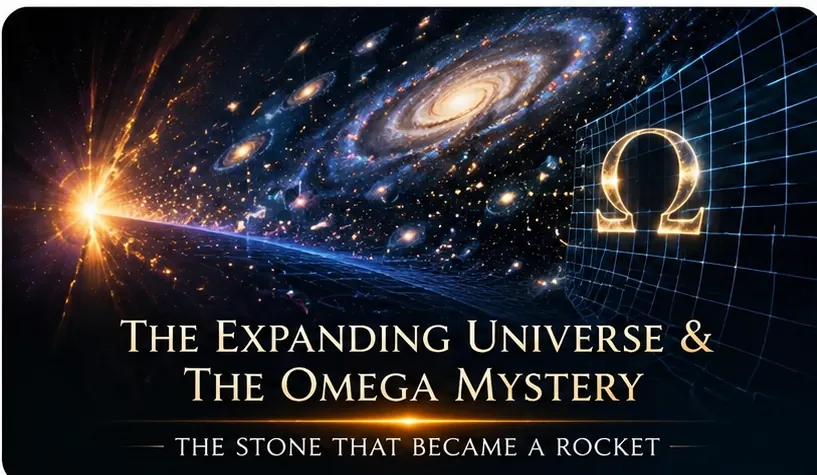
What if the universe did not merely escape gravity—but began to expand faster?
01 / THE STONE THAT BECAME A ROCKET
Why Is the Universe Speeding Up?
Throw a stone upward and Earth’s gravity slows it. For much of the twentieth century, astronomers expected cosmic expansion to decelerate under gravity too. Yet observations revealed a surprising fact: the expansion of the universe has been accelerating over the last several billion years.
The analogy is irresistible—a stone that becomes a rocket as it rises. But cosmic expansion is not galaxies flying through empty space from a central explosion. On very large scales, the distances between unbound galaxies increase as space itself expands. Gravity still shapes stars, galaxies and clusters; the accelerating expansion is a phenomenon of the large-scale universe.
02 / HUBBLE’S REVELATION
The Universe Was Never Standing Still
In the 1920s, observations by Edwin Hubble and others helped establish that distant galaxies generally show recession related to their distance. Georges Lemaître had independently connected expanding-universe solutions of Einstein’s equations to observations. The relationship is now called the Hubble–Lemaître law.
The image of dots separating on an inflating balloon helps explain why distant galaxies can recede faster without placing us at the center. Einstein had introduced a cosmological constant into general relativity; the familiar claim that he later called it his ‘biggest blunder’ is historically disputed.
03 / THE DISCOVERY THAT CHANGED THE FUTURE
1998: The Acceleration Surprise
Two independent research teams used distant Type Ia supernovae to measure cosmic distances. These explosions can serve as standardized candles after accounting for variations in their observed brightness and other properties; they are not perfectly identical light bulbs.
The data indicated that the expansion of the universe had accelerated rather than simply slowed throughout recent cosmic history. Saul Perlmutter, Brian Schmidt and Adam Riess received the 2011 Nobel Prize in Physics for this discovery. The observations raised a formidable question: what accounts for the acceleration?
04 / THE NAME FOR WHAT WE DO NOT KNOW
Dark Energy
In the standard cosmological model, roughly 68–70 percent of the present-day cosmic energy budget is assigned to dark energy, about a quarter to dark matter, and roughly five percent to ordinary matter. These are model-dependent estimates, not a literal inventory of objects we can directly see.
The simplest dark-energy model is a cosmological constant, Λ, whose energy density remains approximately constant as space expands. That means the total dark-energy contribution associated with an expanding volume grows, but it does not mean scientists have discovered a rocket-like force that gets stronger in the usual mechanical sense. The underlying physics remains unknown.
05 / THE OMEGA MYSTERY
What Does Ω = 1 Really Mean?
Cosmologists use Ω to compare a component’s energy density with the critical density. The total density parameter, Ω_total, is close to one in current observations, consistent with spatial geometry that is very nearly flat.
In a universe containing dark energy, the simple schoolbook rule ‘Ω above one means Big Crunch, below one means endless expansion’ is not generally valid. Geometry and fate are not determined by Ω_total alone; the contents of the universe and how their energy densities evolve matter too. A spatially flat universe can accelerate indefinitely, and a closed universe need not necessarily recollapse.
06 / WHY SO FLAT?
The Fine-Tuning Question
The near-flatness of the observed universe has inspired the flatness problem: in simple non-inflationary descriptions, a universe remaining close to flat today seems to require an unusually special early condition. Cosmic inflation offers a widely studied mechanism that can drive observable spatial curvature toward near zero.
Inflation is influential and supported indirectly by several cosmological observations, but its exact mechanism is unconfirmed. A multiverse is sometimes discussed in broader theoretical contexts; it is not an established explanation for the observed value of Ω. Nor can we calculate a precise ‘one-particle difference’ that would have prevented our existence.
07 / THE UNIVERSE’S THREE POSSIBLE ENDINGS
Freeze, Rip or Crunch?
If dark energy behaves like a positive cosmological constant, accelerated expansion continues and distant unbound galaxies become increasingly isolated. Over immense timescales, star formation declines and the cosmos approaches a cold, dilute future often called the Big Freeze or heat death.
A Big Rip is possible in some models with sufficiently extreme phantom dark energy, but is not a prediction of the standard cosmological constant model. A Big Crunch requires different cosmic dynamics, such as a future reversal of expansion. The universe’s ultimate fate depends on the nature and evolution of dark energy, which observations are still testing.
08 / THE NEW OBSERVATIONAL QUESTION
Could Dark Energy Change With Time?
Recent large-scale galaxy surveys, including DESI results reported in 2024 and 2025, have sharpened interest in whether dark energy might evolve. Some combinations of datasets have shown intriguing preferences for evolving dark energy, but these have not established a discovery and require further confirmation.
This is why cosmology remains alive with uncertainty. A measurement that once seemed to settle the broad future of the universe may instead be the opening of a deeper question: is the acceleration driven by a truly constant vacuum energy, a changing cosmic field, or something not yet understood about gravity?
09 / THE LAST QUESTION
What Is Expanding Inside You?
There is a human metaphor hidden in the mathematics. Gravity gathers. Cosmic expansion separates. Our lives, too, can contain forces of attachment and the desire to discover new horizons. But the metaphor must not be mistaken for a physical law of the mind.
The universe does not ask us to choose between gravity and dark energy. Both belong to its story. Perhaps our own task is not to defeat the things that hold us, but to decide which connections to preserve and which boundaries to cross. The cosmos expands; the question is whether our curiosity does too.
QUESTIONS AT THE EDGE OF COSMOLOGY
Six Questions the Universe Has Not Answered
QUESTION 1
What is dark energy really made of—if it is made of anything?
QUESTION 2
Why is the observable universe so nearly spatially flat?
QUESTION 3
Could dark energy change its behavior as the universe ages?
QUESTION 4
Does the shape of the universe determine its fate?
QUESTION 5
Will distant galaxies eventually vanish beyond our cosmic horizon?
QUESTION 6
Is the accelerating cosmos revealing a new property of gravity?
The Stone and the Sky
The stone thrown into the air comes home because it belongs to Earth’s gravity. The universe is not a stone, and its expansion is not an ordinary flight. Still, the image captures the shock of the discovery: a cosmos that seemed destined to slow instead revealed an accelerating horizon.
Perhaps our greatest mistake is expecting the universe to behave like the objects we hold in our hands.
If the universe keeps making room for the unknown, how much room are you making for wonder?
Scientific Context & Further Reading
The figures are approximate and model-dependent. A nearly flat universe does not by itself determine whether expansion continues forever. Evolving dark energy remains a research question, not a confirmed discovery.
Nobel Prize in Physics 2011 — Accelerating Universe · NASA — Dark Energy and Dark Matter · DESI Collaboration



