
Quantum Entanglement vs Einstein — The Spooky Connection Across Space
What if the deepest mystery is not how fast a message travels, but how two distant measurements can share a single quantum…
DARK PAGE / THE UNSEEN / QUANTUM MYSTERIES
QUANTUM ENTANGLEMENT
VS EINSTEIN
The Spooky Connection Across Space
Two particles. A universe between them. A connection no classical story can fully explain—and a speed limit that refuses to break.
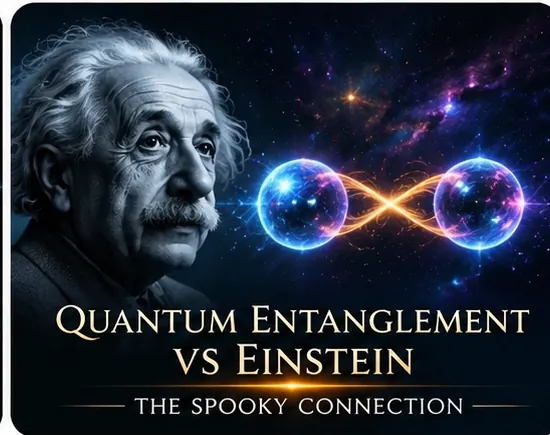
What if the deepest mystery is not how fast a message travels, but how two distant measurements can share a single quantum story?
01 / THE IMPOSSIBLE CONNECTION
Two Particles, One Unfinished Story
Imagine two particles prepared together, then separated by a vast distance. Each measurement yields an unpredictable result. Yet when scientists later compare their records, patterns emerge that cannot be reproduced by any theory satisfying the usual assumptions of local hidden variables. The particles do not behave like two ordinary coins whose faces were simply decided in advance.
Albert Einstein famously objected to the unsettling implications of quantum theory, calling the phenomenon “spooky action at a distance.” But the most important twist is this: entanglement does not let anyone transmit a controllable message faster than light. The mystery is not a broken speed limit. It is a kind of correlation that challenges our classical picture of separate things.
02 / WHAT IS ENTANGLEMENT?
A Relationship That Cannot Be Split
An entangled pair has a joint quantum state that cannot be described as two independent states, one for each particle. Measuring each particle separately can produce apparently random outcomes; the structure appears when corresponding results are compared.
The popular image of one particle instantly forcing the other to change is not an experimentally established physical mechanism. Quantum theory predicts correlations across different possible measurement settings without supplying a usable faster-than-light signal. Entanglement can involve photons, electrons, atoms and even carefully controlled larger systems.
03 / EINSTEIN’S CHALLENGE
Could Nature Have Hidden Instructions?
In 1935, Einstein, Boris Podolsky and Nathan Rosen argued that quantum mechanics seemed incomplete if it could not assign certain properties to distant systems without disturbing them. The EPR argument pressed a question about locality, physical reality and the completeness of quantum description.
Einstein hoped a deeper account might explain the correlations without mysterious distant influence. His broader commitment to relativity was not disproved by the later experiments: relativity’s prohibition on faster-than-light signaling remains intact.
04 / THE TEST THAT CHANGED THE DEBATE
John Bell Puts Philosophy on Trial
In 1964, physicist John Bell derived inequalities obeyed by a broad class of local hidden-variable models. Quantum mechanics predicts that suitably chosen measurements on entangled particles can violate those limits.
This turned a philosophical disagreement into a laboratory question. A Bell-inequality violation does not prove that a signal traveled instantly or that every imaginable hidden-variable theory is impossible. It rules out the relevant combinations of locality and assumptions used in deriving the inequality.
05 / THE EXPERIMENTS
From Aspect to the 2022 Nobel Prize
Experiments led by Alain Aspect in the early 1980s provided influential tests of Bell inequalities. Later work improved detectors, separation and timing. In 2015, several teams reported landmark tests that simultaneously closed major detection and locality loopholes under standard experimental assumptions.
The 2022 Nobel Prize in Physics honored Alain Aspect, John Clauser and Anton Zeilinger for experiments with entangled photons, establishing violations of Bell inequalities and pioneering quantum information science. The results strongly support quantum predictions; they do not show that Einstein’s speed limit has been surpassed.
06 / THE RULE THAT STILL HOLDS
Why You Cannot Send a Message to the Moon
Suppose Alice and Bob share entangled particles. Alice measures hers on Earth; Bob measures his far away. Bob’s local results look random, regardless of Alice’s choice. Only after they exchange ordinary classical information can they identify the extraordinary correlations.
This is the no-signaling principle, often expressed through the no-communication theorem. Quantum teleportation also requires a classical message, so it cannot send information instantaneously. Entanglement is strange precisely because it links statistics without providing a faster-than-light telephone.
07 / THE TECHNOLOGY OF THE STRANGE
From Quantum Networks to Secure Keys
Entanglement is a practical resource in quantum information science. It underpins quantum teleportation protocols, helps some quantum computing approaches and is used in forms of quantum cryptography and network research. Not every quantum key-distribution protocol requires entanglement, and quantum computers are not universally millions of times faster than classical computers.
China’s Micius satellite enabled landmark space-based quantum communication experiments, including distribution of entangled photon pairs between distant ground stations in 2017. Researchers are now exploring quantum repeaters and networks, although a large-scale general-purpose quantum internet remains a technological challenge.
08 / WHERE PHYSICS ENDS AND POETRY BEGINS
Can Love Be Entangled?
A parent thinking of a child, two friends calling at the same moment, or two lovers feeling close across oceans: these experiences can be profound. But there is no established evidence that quantum entanglement transmits thoughts, prayers or emotions between people. Biological systems obey quantum physics, yet that fact alone does not demonstrate such effects.
As metaphor, entanglement offers a beautiful language for connection. As physics, it has a precise mathematical and experimental meaning. Keeping those meanings distinct allows wonder to survive without turning coincidence into a scientific claim.
09 / THE FINAL PARADOX
Does Distance Separate Everything?
Relativity teaches that causes and signals obey a light-speed boundary. Quantum mechanics teaches that the world can contain correlations stronger than our ordinary local pictures allow. Both lessons can be true at once. The universe is not obliged to fit the images we carried into the laboratory.
Perhaps the unsettling question is not whether distance is an illusion. It is why a universe with strict limits on communication can still possess such deep relationships between distant measurements. What does it mean for two things to be separate? And how much of separation belongs to the world—and how much to the way we describe it?
QUESTIONS FROM THE EDGE OF REALITY
Six Questions That Stay With You
QUESTION 1
If two outcomes are individually random, how can their shared pattern be so precise?
QUESTION 2
Can a relationship be real even when neither side carries a predetermined answer?
QUESTION 3
What does ‘separate’ mean when the whole has properties its parts do not?
QUESTION 4
If entanglement cannot send a message, why does it feel like a message from nature?
QUESTION 5
Can we accept that a phenomenon is real before agreeing on what it means?
QUESTION 6
Does the universe hide its deepest connections—or are we asking the wrong questions?
The Distance Between Two Truths
Einstein was right that the universe does not offer us an instant cosmic telephone. Quantum experiments were right to reveal correlations that defy classical local explanations. Neither truth has to be discarded for the other to astonish us.
Perhaps this is the real gift of the paradox: it teaches us to distrust easy pictures without distrusting evidence. Space can be immense. Correlations can be profound. And mystery can remain, even after the experiment succeeds.
If distance cannot erase a quantum correlation, what else have we mistaken for separation?
Scientific Notes & Further Reading
Entanglement does not demonstrate faster-than-light communication or telepathy. Bell tests reject local hidden-variable accounts under their stated assumptions. Quantum interpretations remain debated.
Nobel Prize in Physics 2022 · Stanford Encyclopedia: Bell’s Theorem · Stanford Encyclopedia: Quantum Entanglement and Information



