
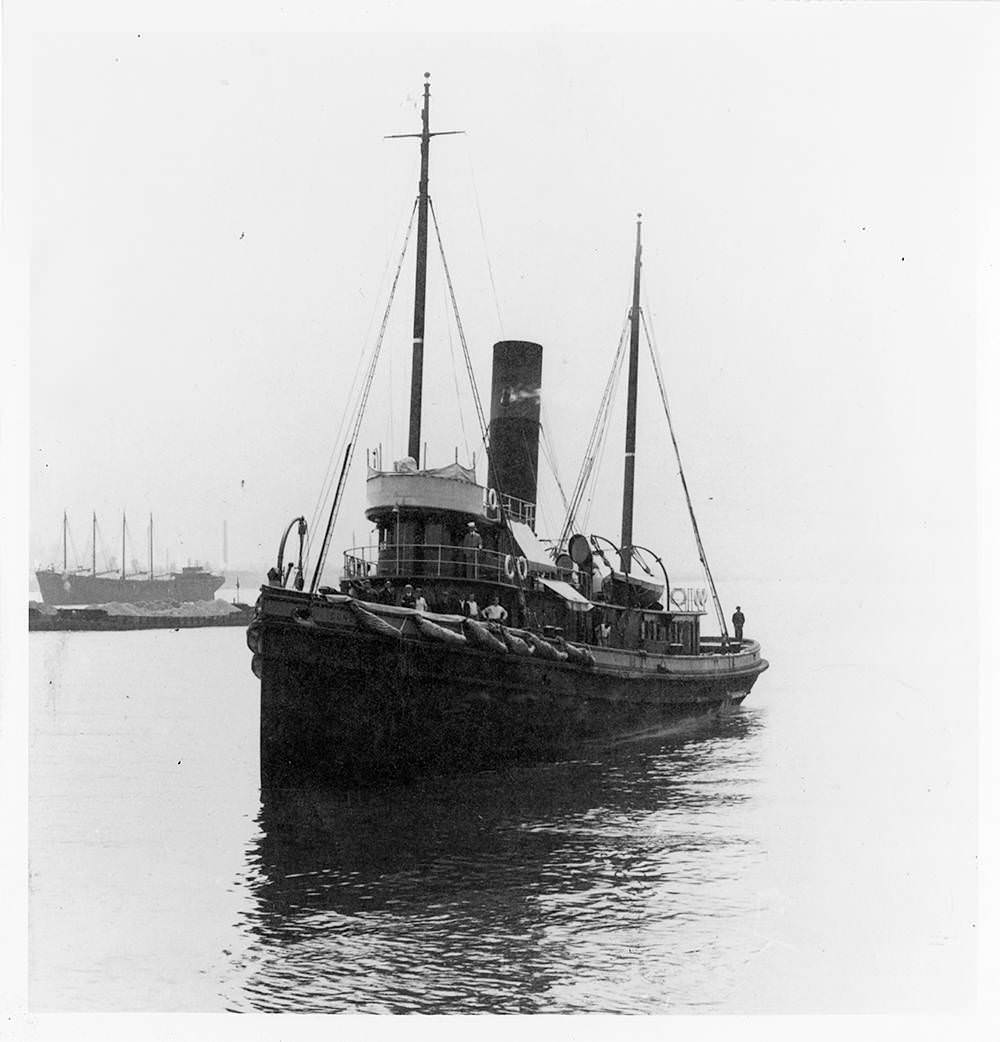

On 25 March 1921, a small United States Navy tug left California with 56 sailors aboard. It was supposed to cross the Pacific. Instead, it disappeared almost immediately—and the ocean kept its secret for nearly a century.
A ship built for work, not legend
The USS Conestoga was not a glamorous passenger liner. Launched in 1903 and delivered in 1904, she had originally hauled coal barges for a railroad company. The Navy acquired her in 1917, during the First World War, and put her to work towing vessels, transporting supplies and supporting naval operations. Her practical design and modest size made her easy to overlook in histories dominated by battleships. But a ship’s significance is not measured by its size, and the lives aboard her were no less valuable.
After wartime service in the Atlantic and around the Azores, Conestoga was assigned to the Pacific. Her destination was American Samoa, with a planned stop at Pearl Harbor. The route seemed straightforward on paper: leave Mare Island, near San Francisco, head west across the ocean, and continue toward her new station.
25 March 1921: departure into uncertainty
Conestoga sailed from Mare Island Naval Yard on 25 March 1921. The Navy expected her to reach Pearl Harbor by 5 April. She never arrived. There was no verified distress call, no confirmed final message and no survivor who could describe the last hours. In an age before modern satellite tracking, a missing ship could leave investigators with little more than a departure date, a proposed route and an immense stretch of water.
The Navy searched for the vessel. A lifeboat bearing the letter C was reported in the eastern Pacific, but it did not resolve the disappearance. Officials eventually declared Conestoga and her 56 crew members lost on 30 June 1921. The absence of a known wreck made the case especially haunting: relatives could mourn the dead, but they could not point to a confirmed resting place.
The danger of a persuasive assumption
For decades, the working assumption was that the tug had gone missing somewhere along her projected route toward Hawaii. This was understandable, but it was not evidence that she had travelled far into the Pacific. The last known departure point and the intended destination described a plan, not a proven track.
That distinction became crucial. Maritime mysteries often grow around what cannot be observed. In the vacuum, dramatic possibilities multiply: sabotage, a strange storm, a hidden collision, even supernatural explanations. Yet a mystery does not become more accurate merely because an explanation is exciting. Without wreckage or reliable eyewitness testimony, the fate of Conestoga remained unresolved.
An unexpected discovery close to California
In September 2014, researchers working with NOAA’s Maritime Heritage Program in the Greater Farallones National Marine Sanctuary investigated an unidentified sonar target off the California coast. A remotely operated vehicle examined the remains of a steel-hulled, steam-powered ocean-going tug approximately 170 feet long.
At first, the wreck was simply an unknown ship. Its dimensions, machinery and surviving features were compared with historic vessel records. Researchers revisited the overlooked possibility that Conestoga had never made it far from the Golden Gate. In 2015, further examination, including evidence associated with a naval gun, strengthened the identification. NOAA confirmed the wreck as USS Conestoga.
The finding transformed the geography of the case. The tug had not vanished halfway to Hawaii: she lay near the coast from which she had departed. The wreck was identified more than nine decades after the loss, but the discovery did not provide a complete eyewitness account of the sinking. The final sequence of events still has to be reconstructed from physical clues, historical records and environmental conditions.
How underwater archaeology tests a story
Finding a shipwreck is not the same as identifying it. Marine archaeologists look for combinations of characteristics: hull length, construction, propulsion, fittings, equipment, alterations and location. A single resemblance can mislead; several independent matches can form a strong identification. Sonar helps locate an object, while underwater cameras and remotely operated vehicles make closer examination possible without requiring divers to enter dangerous wreckage.
Conestoga also illustrates a broader scientific principle. When new evidence conflicts with a long-held assumption, the assumption must change. The projected voyage toward Pearl Harbor once directed attention outward into the Pacific. The wreck’s actual location redirected the historical narrative back toward the departure coast.
Fifty-six people, not a puzzle
It is tempting to describe the discovery as the solution to a riddle, but the word ‘solution’ has limits. Identifying the wreck answers where the ship ended up and restores a measure of certainty to its history. It does not undo the loss or tell us precisely what each sailor experienced. The Navy crew included engineers, cooks, seamen, machinists and officers—people with families and lives outside the ship.
NOAA’s memorial work places their names alongside the archaeological story. That is an important corrective to the usual language of maritime mystery. The wreck is not merely an intriguing object on the seabed; it is a protected military grave and a place of remembrance.
What the Conestoga teaches us
The most remarkable aspect of this story is not an exotic theory about the sea. It is the ordinary fragility of knowledge. A vessel can disappear in familiar coastal waters, and an assumption about where it must have travelled can shape the search for generations. Better technology matters, but so does the willingness to question an apparently sensible narrative.
For 94 years, the USS Conestoga was missing. Then sonar, underwater archaeology and careful historical comparison brought the ship back into the record. The ocean had not offered an explanation in words. It had preserved evidence—and researchers finally knew where to look.
Sources and image credit
NOAA Office of National Marine Sanctuaries, USS Conestoga — 100 Years Since Departure (official chronology, crew records, discovery and identification).
NOAA Maritime Heritage Program, Three Miles from Safety: The Story of USS Conestoga (archaeological overview and historical imagery).
Image: Historical photograph of USS Conestoga, credited to the U.S. Naval History and Heritage Command, NH 89793, reproduced by NOAA. A historical vessel photograph, not an image of the 1921 sinking. U.S. federal government archival imagery; verify any item-specific rights statement before reuse.



