Amr Ayyar — Ten New Adventures | Dark Page Kids
A world of clever disguises, enchanted kingdoms and extraordinary questions. Discover the hero who wins with his wits, not his…
DARK PAGE KIDS • ILLUSTRATED BOOK
Amr Ayyar: Ten New Adventures
A world of clever disguises, enchanted kingdoms and extraordinary questions. Discover the hero who wins with his wits, not his sword.
Contents
- Preface: A Book for Curious Children
- 1. The Boy Who Played with Questions
- 2. The City Where the Walls Laughed
- 3. The King’s Disguise and the Fortress of Fear
- 4. The Garden That Could Speak
- 5. Grandmother’s Story and the Sleeping Queen
- 6. The Jar That Held an Army
- 7. The Mirror That Reflected the Heart
- 8. Grandmother’s Halwa and the Fortress Won Without a Battle
- 9. The Balloon That Blinded Everyone
- 10. The Boy Beneath the Throne
- Epilogue: You Can Be Amr, Too
Editorial review copy. The English adaptation and illustration placement remain subject to final comparison with the original Urdu manuscript.
Preface: A Book for Curious Children
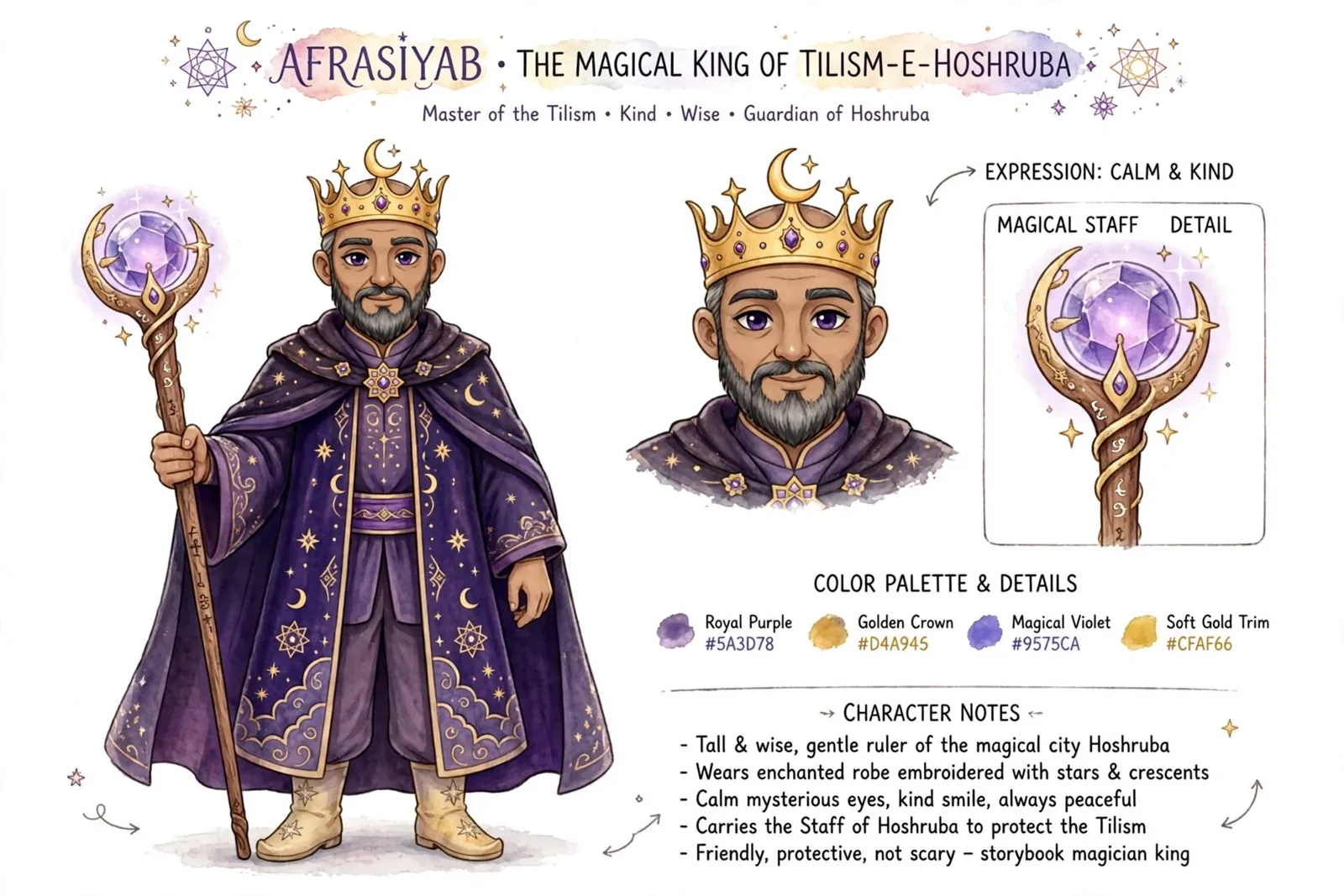
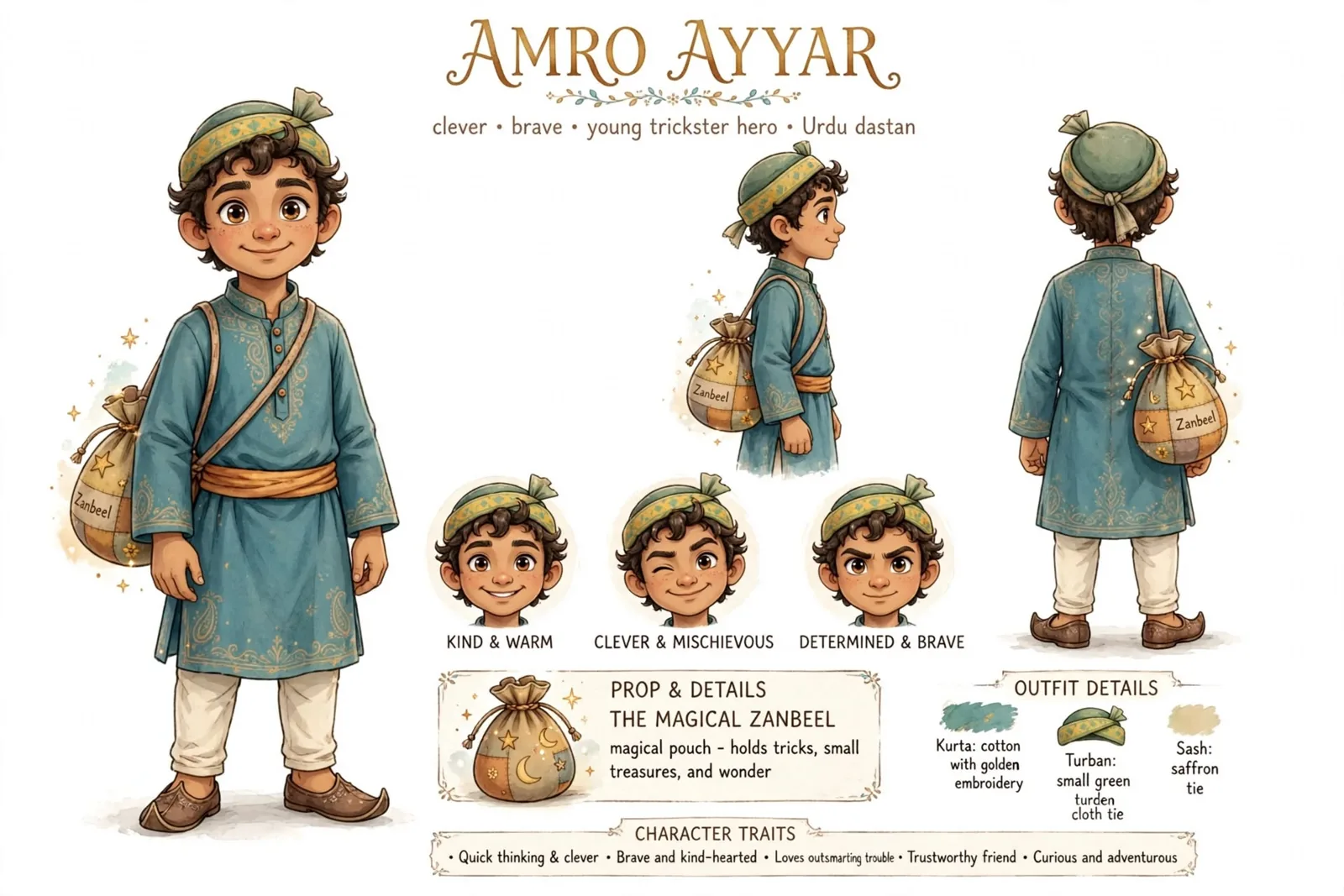
Children, have you ever imagined owning a bag large enough to hold the entire world? Would you put your bicycle inside it? Your school? Perhaps even the moon? Amr Ayyar had such a bag. It was called the Zanbil. Amr was an ayyar: clever, brave and true-hearted. He won not with a sword, but with his wits. These stories are for children who dare to ask questions.
Who Was Amr Ayyar?
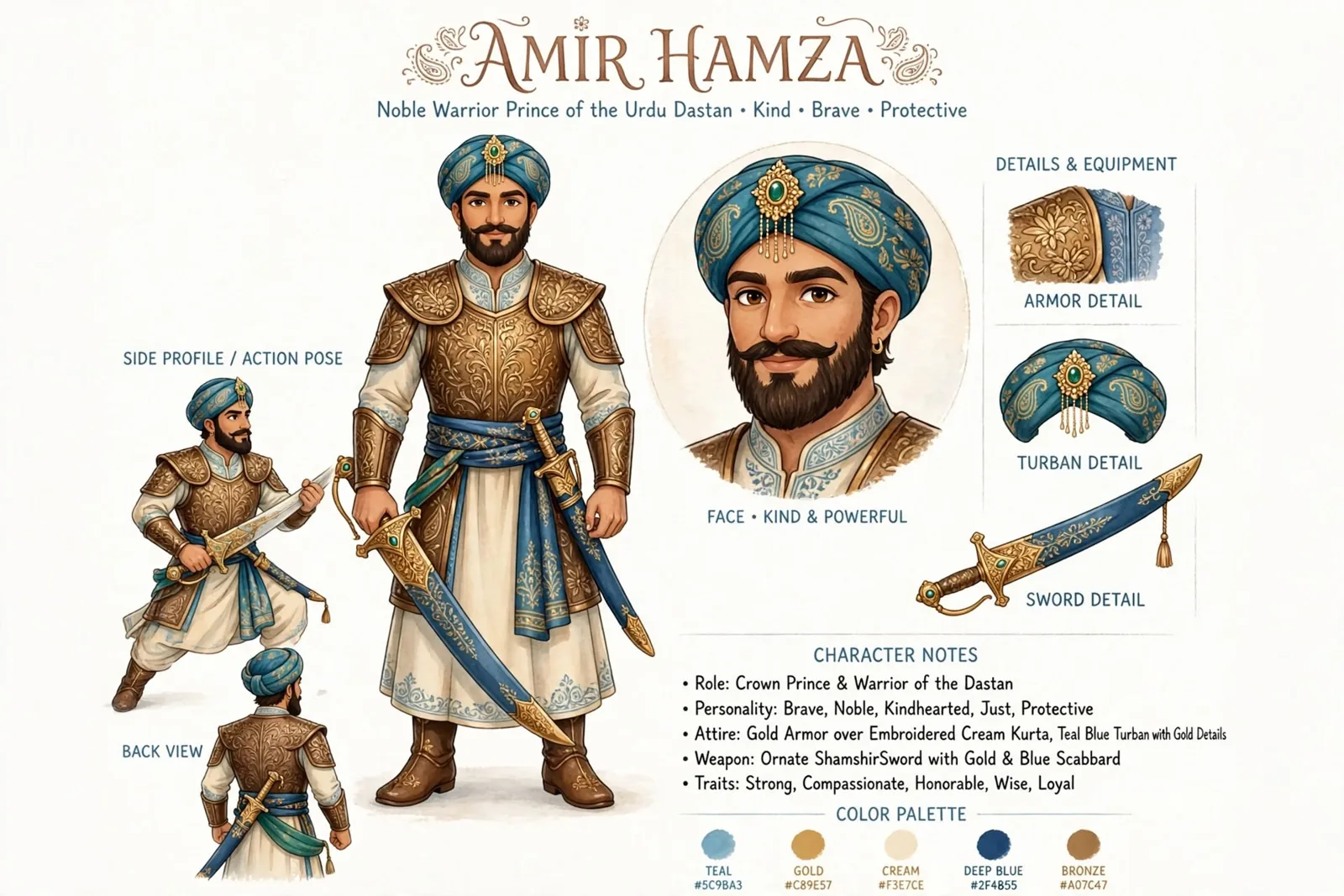
Amr ibn Ayyar is one of the most beloved figures in the Dastan-e-Amir Hamza. Amir Hamza was a mighty warrior, but when a problem could not be solved by force, he turned to Amr. Where others saw a fortress to attack, Amr saw a gate to understand—and a guard whose heart might hold the key. He had three remarkable qualities: he asked questions, he could disguise himself to see life through other people’s eyes, and he carried the magical Zanbil.
The Zanbil and the Gift of Kindness
The Zanbil looked like an ordinary cloth bag, yet it could hold almost anything. In the old tales it is associated with the Prophet Sulayman (Solomon). Its true purpose was not to collect treasure but to help others: bread for the hungry, medicine for the sick, a key for the trapped, or a story for the frightened. Your own heart can be a Zanbil, too. Fill it with hatred and it becomes small; fill it with love and it has room for the world. Amr also had the Suleimani Langot, a magical garment that let him run like the wind—not to win races, but to reach people who needed help.
Welcome to Tilism-e-Hoshruba
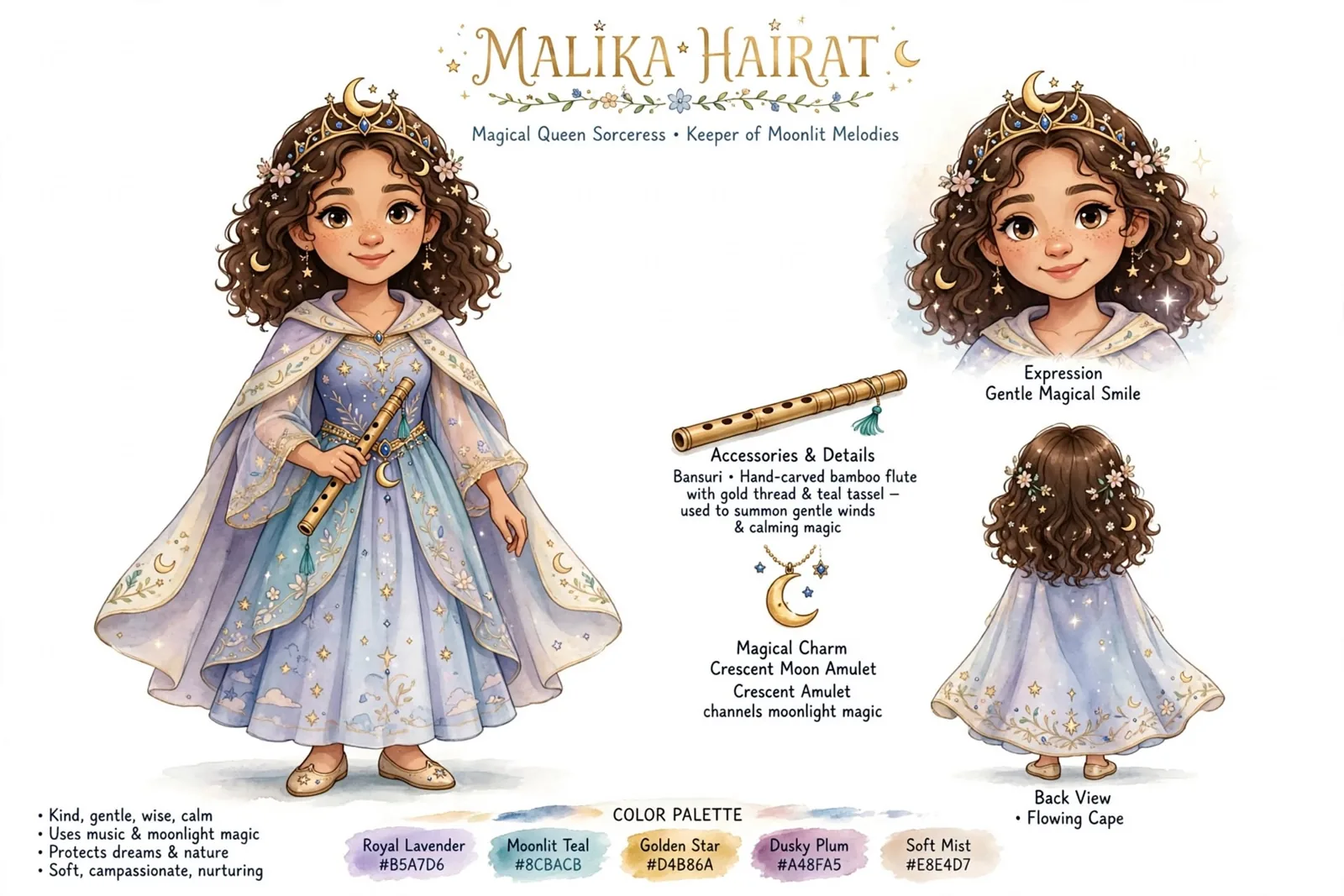
Amr’s adventures take place in Tilism-e-Hoshruba, a realm where walls talk, trees walk and enchanted doors guard their secrets. Afrasiyab, its formidable sorcerer-king, can stand for the fears that make us say, “I can’t.” Queen Hairat’s enchanted flute can remind us how easily hours slip away while we watch a screen; her magical kohl reminds us to look for the truth. Today’s phones, games and videos can feel like enchantments of their own. When a clip claims to show something impossible, ask whether it is real or edited. When an advert promises wonders, ask for evidence. The greatest magic is the courage to think.
Why Do We Still Need Amr Ayyar?
‘But these stories are so old,’ you may say. ‘Why do we need Amr when we have cartoons, games and YouTube?’ We have answers at our fingertips. We can ask a search engine or ChatGPT almost anything. Yet we must still ask a more important question: ‘Is that answer true?’ Amr did not simply accept every answer. He examined it and searched for the root of every enchantment.
When someone shows you a video and cries, ‘Look, a ghost!’ ask whether it is real or edited. When an advertisement promises that a particular food will make you extraordinarily strong, ask whether there is evidence. When somebody tries to frighten you by saying, ‘You’ll fail unless you do this,’ remember Amr: ‘I will not surrender to fear. I will think.’
Your Ten Questions
The ten adventures ask whether your heart can be as generous as the Zanbil; whether you look for the root of a problem instead of becoming angry; whether you face your fears; whether you can hear the suffering of trees; whether you have a story to share; whether you recognise your own fear; what you see in the mirror; whether kindness can open a fortress; whether you can think clearly when appearances deceive you; and whether you dare to look beneath the throne.
These are old adventures retold for children living today. The Zanbil becomes a picture of the human heart, the enchanted city resembles the world of screens, Afrasiyab becomes fear, Queen Hairat’s flute recalls the endless chime of a phone, and the magical fog reminds us of misleading news. The stories are not merely about a distant world. They may also be about yours.
A Promise Before the First Adventure
Ten stories await you, and each ends with a question. Promise to think about each one for yourself before asking someone else or searching online. Do not open Google straight away; try to find your own answer first. That was Amr’s greatest gift: he thought for himself. If you keep that promise, you too can be Amr. Now imagine a small boy walking into a forest, a question in his mind and a search for truth in his heart. That boy is Amr. And perhaps that boy is you.
Story One: The Boy Who Played with Questions
The Boy with the Zanbil
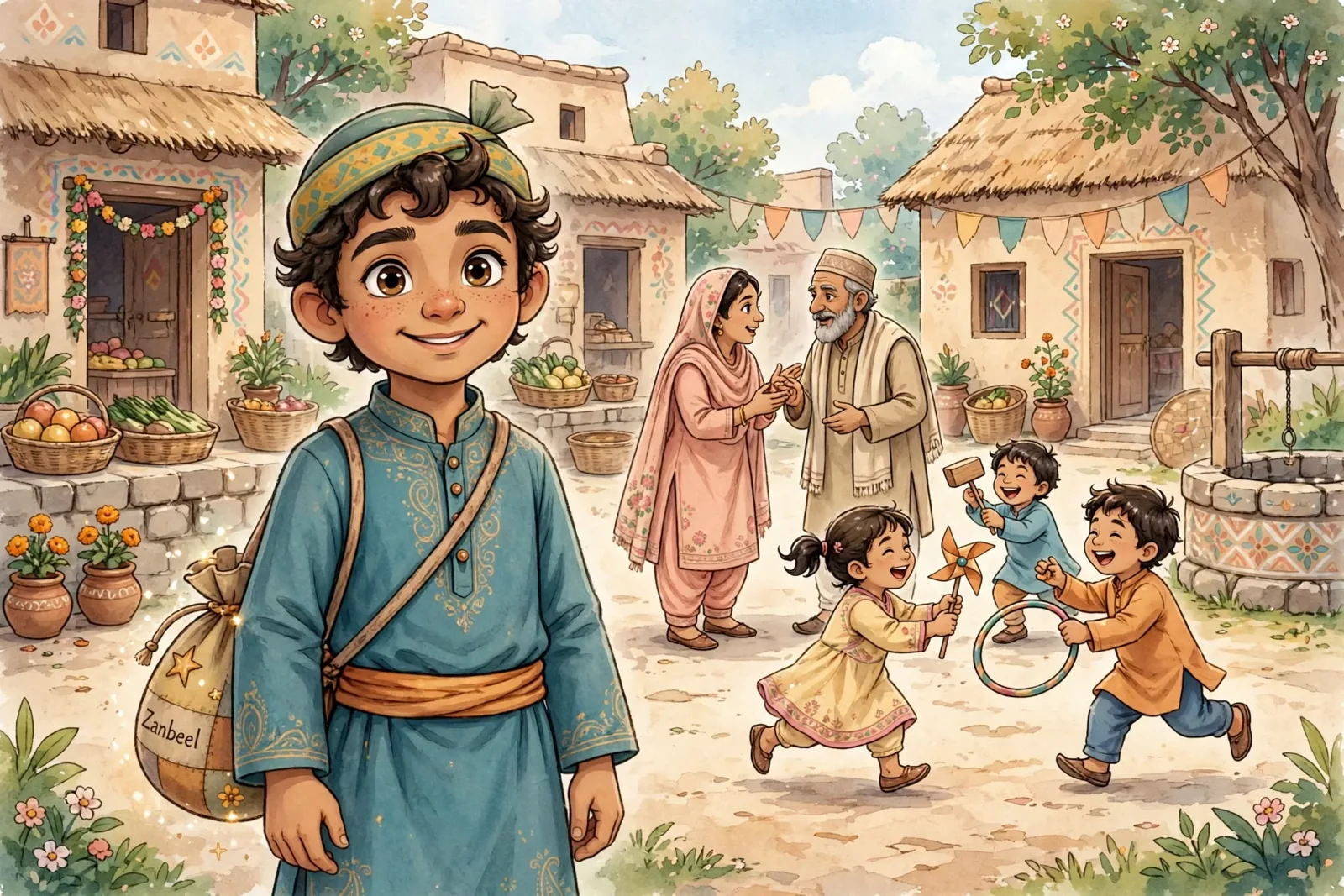
Long, long ago, before mobile phones, electric lights or school bells, villages were small, roads were dusty and the night sky glittered with more stars than anyone could count. In one such village, a boy was born. His family named him Amr.
When his mother first held him, she noticed something unusual in his eyes. Most babies cried and then fell asleep. Amr cried, stopped and looked around, as though he were wondering, ‘What is this world? Where have I arrived?’
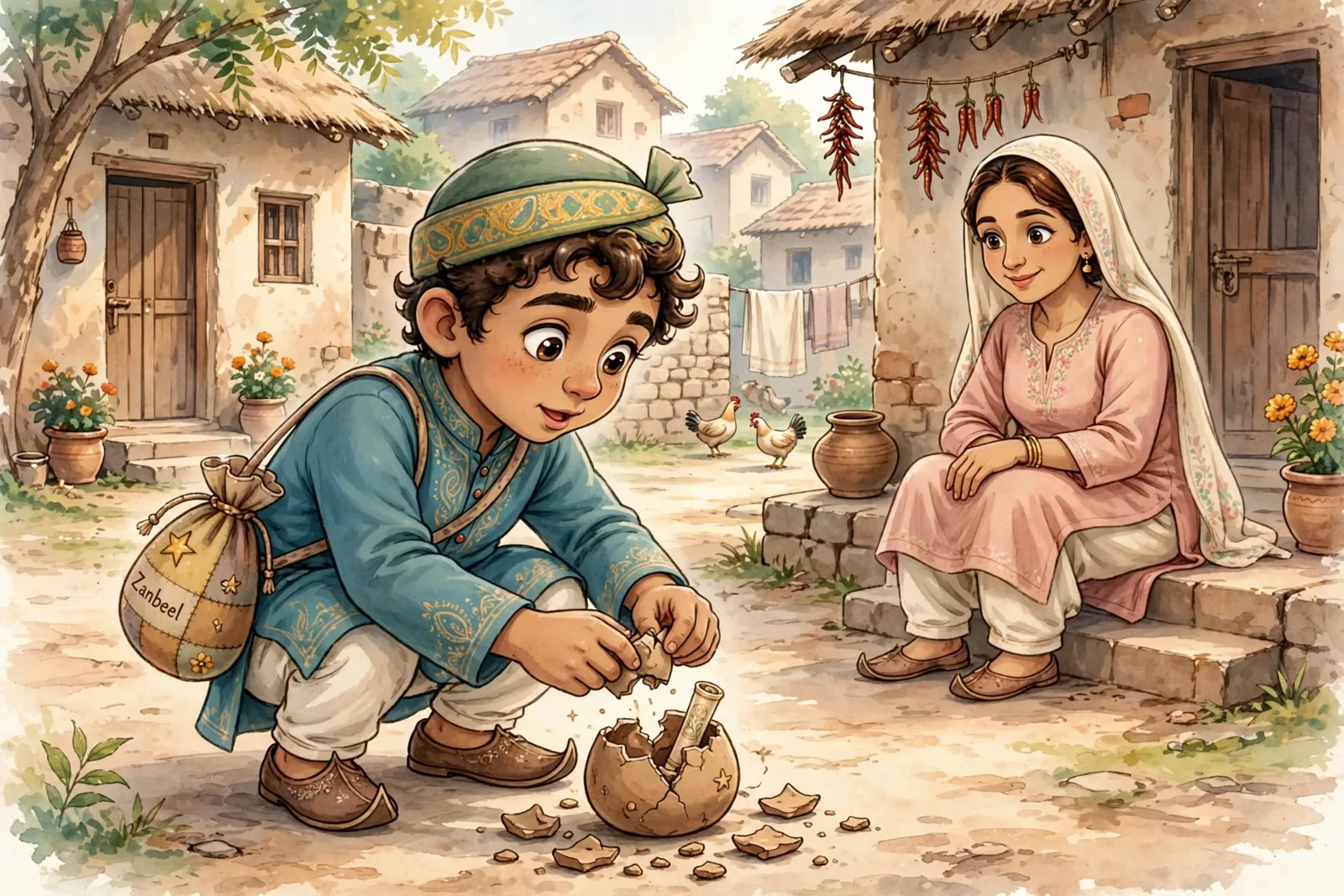
As he grew, the other children made horses, houses and swords out of clay. Amr joined them, but instead of making a toy, he took one apart. ‘Amr! You’ve broken your toy!’ his mother exclaimed. ‘I haven’t broken it, Mum,’ he replied. ‘I’ve been finding out what’s inside.’ ‘It’s only clay,’ she laughed. ‘But what’s inside clay?’ he asked. ‘And where did the clay come from?’ His mother fell silent. She had no easy answer.
His questions grew with him. ‘Dad, why can birds fly when we can’t? Is it because we have no wings, or because we haven’t been brave enough to try?’ His father replied, ‘God gave birds wings and gave us hands.’ ‘Then what can we make with our hands?’ Amr asked. ‘Could we make wings?’ His father laughed, and so did the neighbours. ‘That boy will grow into either a great scholar or a great ayyar!’ they said.
An ayyar was someone who relied on intelligence rather than a sword, knew how to change disguises, faced difficulties bravely and searched for the truth. Amr loved the word. ‘I’ll be an ayyar,’ he declared.
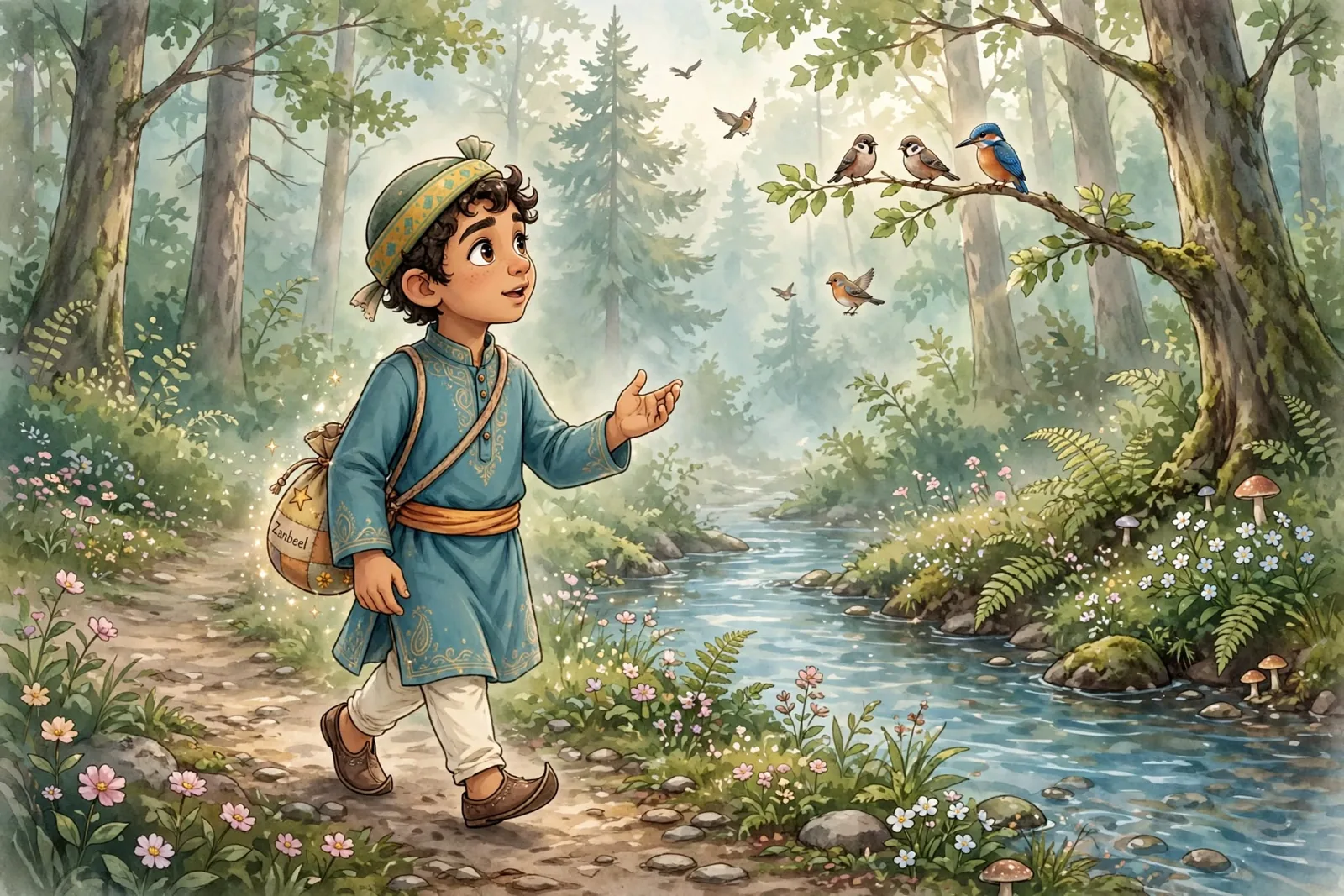
One misty morning, with birds singing in the trees, Amr told his mother, ‘I’m going into the forest.’ ‘Whatever for?’ she asked. ‘I want to find out whether trees sleep at night or stay awake.’ She gave him some bread and told him not to be late.
On his way, he came to a clear stream. Looking at his reflection, he asked, ‘Water, where are you going?’ The stream did not answer. It simply flowed onwards. ‘You don’t speak, but you never stop,’ Amr said. ‘Perhaps that’s your answer.’
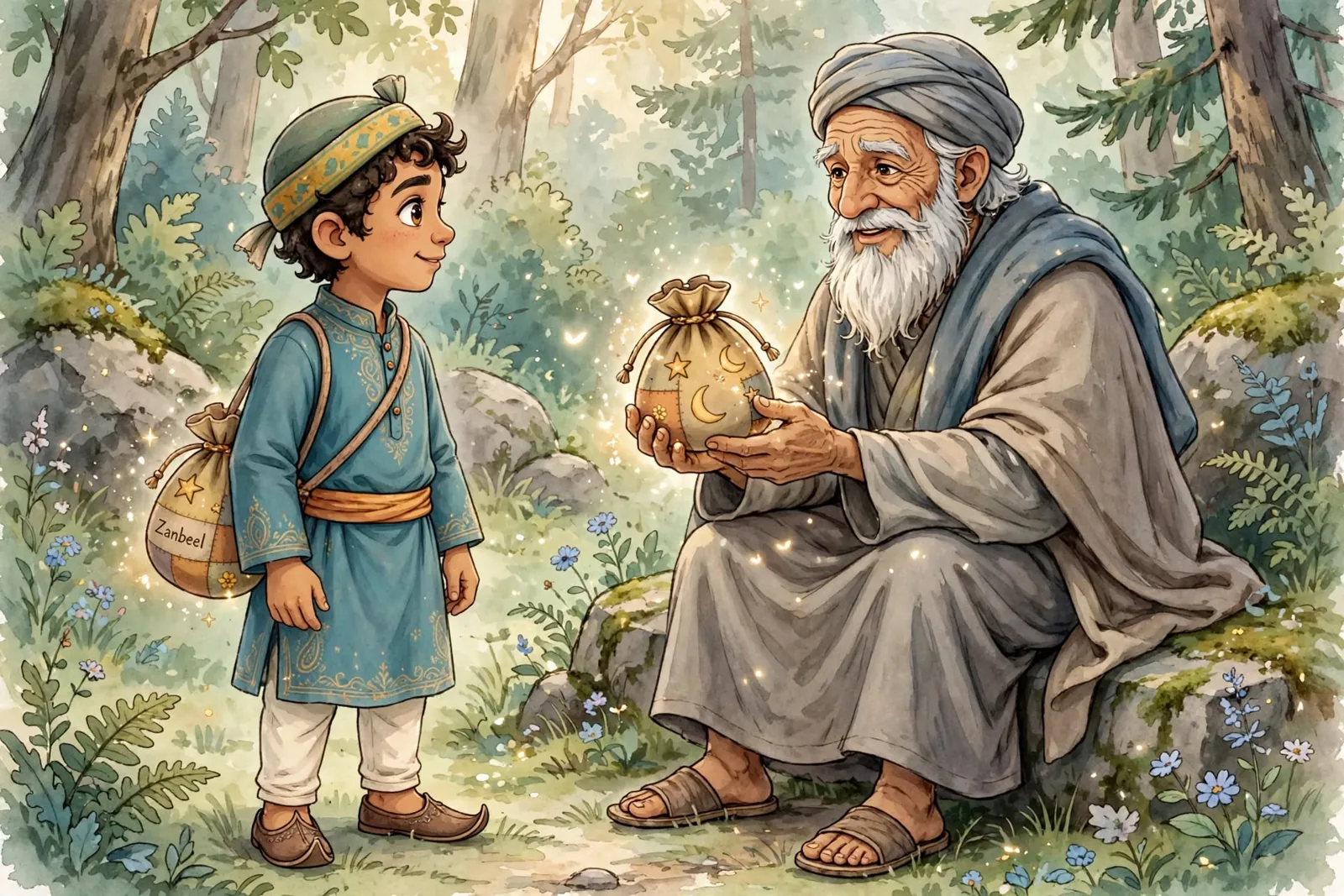
The forest grew thicker. Tall branches reached towards the sky, flowers scented the air and a cuckoo called somewhere in the distance. Suddenly, Amr stopped. An old man sat on a stone, drawing a line in the earth. His beard was white as cotton, his clothes worn but clean, and his eyes shone like stars.
‘Salaam!’ said Amr. The old man looked up and smiled, warmly as a grandmother offering fresh halwa. ‘Are you searching for something, my boy?’ ‘Yes,’ Amr answered. ‘I’m looking for the truth.’ ‘The truth? It is in the tree, in the water and in your own heart. Where have you been looking?’ ‘Everywhere! I asked a bird and it answered by flying. I asked the water and it answered by flowing. Now I’m asking you.’
The old man laughed and drew a little cloth bag from his lap. It looked perfectly ordinary: faded fabric, a small knot and nothing more. ‘Here,’ he said, handing it to Amr. The bag was astonishingly light in Amr’s hands. ‘But it’s empty!’ said the boy. ‘Empty? Put your hand inside.’
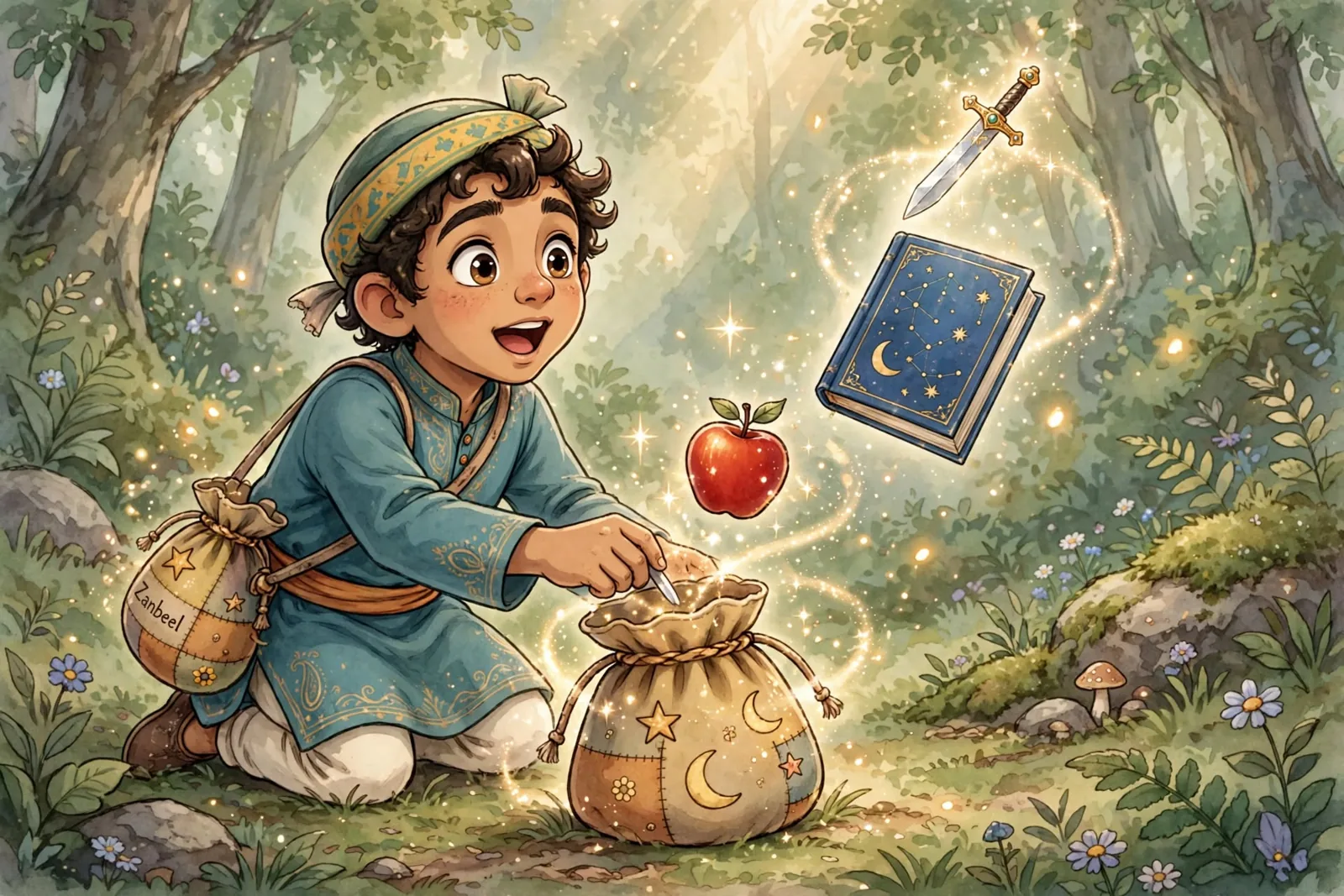
Amr reached in and pulled out a bright red apple, fresh as if it had just been picked. Its scent filled the forest. He stared into the bag: it still appeared empty. He tried again and drew out a blue book decorated with golden lines. Inside were pictures of the stars. On his third attempt, he found a little shining sword, surprisingly light in his hand.
‘How can all those things fit into such a tiny bag?’ he cried. ‘Because it isn’t an ordinary bag,’ said the old man. ‘It is the Zanbil of the Prophet Sulayman, peace be upon him.’ ‘The great prophet whom Allah gave power over the wind?’ Amr asked. ‘The very same. He made this Zanbil so that it could hold everything in the world. But remember: it is given only to someone who uses it to help others, never to steal.’
‘To help others?’ Amr repeated. ‘Yes. Fill it with gold and it will become full. Put bread in it and it will never be empty. Place someone’s sorrow inside and that sorrow will grow lighter. The wonder of the Zanbil is not how much it can hold. The wonder is what you choose to put into it.’
Amr fell quiet, as though a door had opened inside his heart. What would he put in the bag? His bicycle? His toys? Or bread for a hungry child? The old man seemed to read his thoughts. ‘Your heart is a Zanbil too, my boy. Fill it with hatred and it will shrink. Fill it with love and it will grow large enough to hold the whole world.’
Then the old man handed him a second gift: a plain, softly glowing piece of cloth. ‘This is the Suleimani Langot. Wear it and you will run as fast as the wind.’ ‘But why should I run so fast?’ Amr asked. ‘I don’t need to win a race.’
‘Not to win races,’ said the old man. ‘So that when someone is in trouble, you can reach them first. If there’s a fire in the village, be the first to bring water. If a child falls, be the first to help them up. Speed is not simply a power. It is a responsibility.’
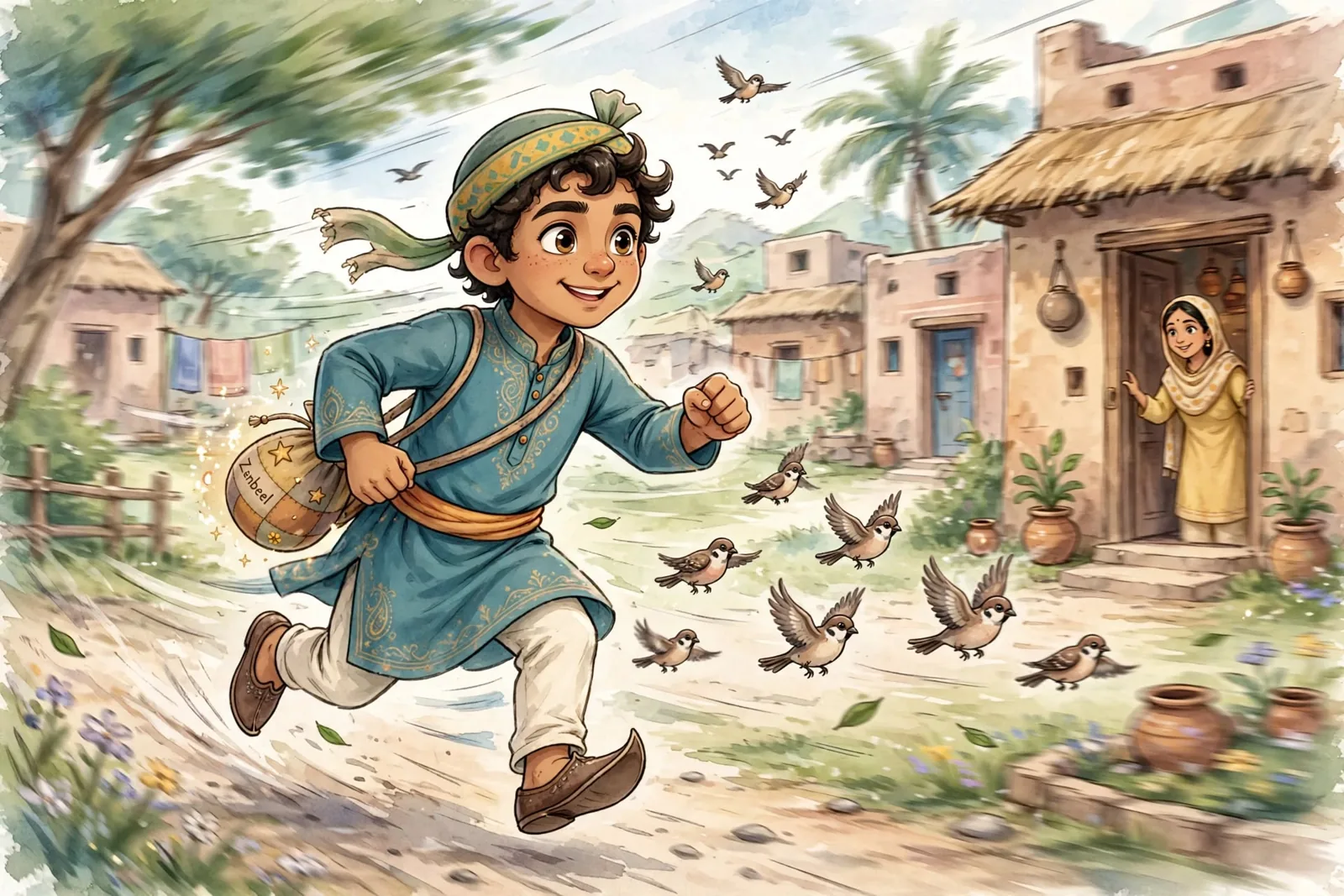
Amr put on the magical garment and felt as if wings had sprouted from his feet. He ran so swiftly that the trees blurred behind him, the wind whistled in his ears and birds flew alongside him. In no time at all he reached his village.
His mother was waiting at the door. ‘Amr! How did you get home so quickly?’ ‘Mum,’ he said, ‘I’ve put my question into the Zanbil. Now my questions will never run out.’
From that day, Amr was no ordinary village boy. He had become Amr Ayyar. Whenever someone needed help, he was there. If a goat went missing, he found a clue in the Zanbil. If somebody was hungry, he brought out bread. If someone was frightened, he sat beside them and told a story.
‘What an extraordinary boy,’ the villagers said. ‘Such a small bag—and such a big heart.’ Each night Amr looked up at the stars and wondered: ‘If my Zanbil can hold the whole world, can my heart hold the whole world too?’ In the adventures ahead, he would begin to discover the answer.
Think like Amr: If your heart could hold the whole world, what would you choose to put inside it?
Story Two: The City Where the Walls Laughed
Fight the root of the problem, not its magic.
Perhaps you have heard of Amir Hamza. He was a mighty warrior. His sword was so heavy that two men were needed to lift it; his army was so vast that the earth trembled when it marched; and his horses were so swift that even the wind seemed to fall behind. But one day Amir Hamza found himself trapped in a place where a sword was no use at all.
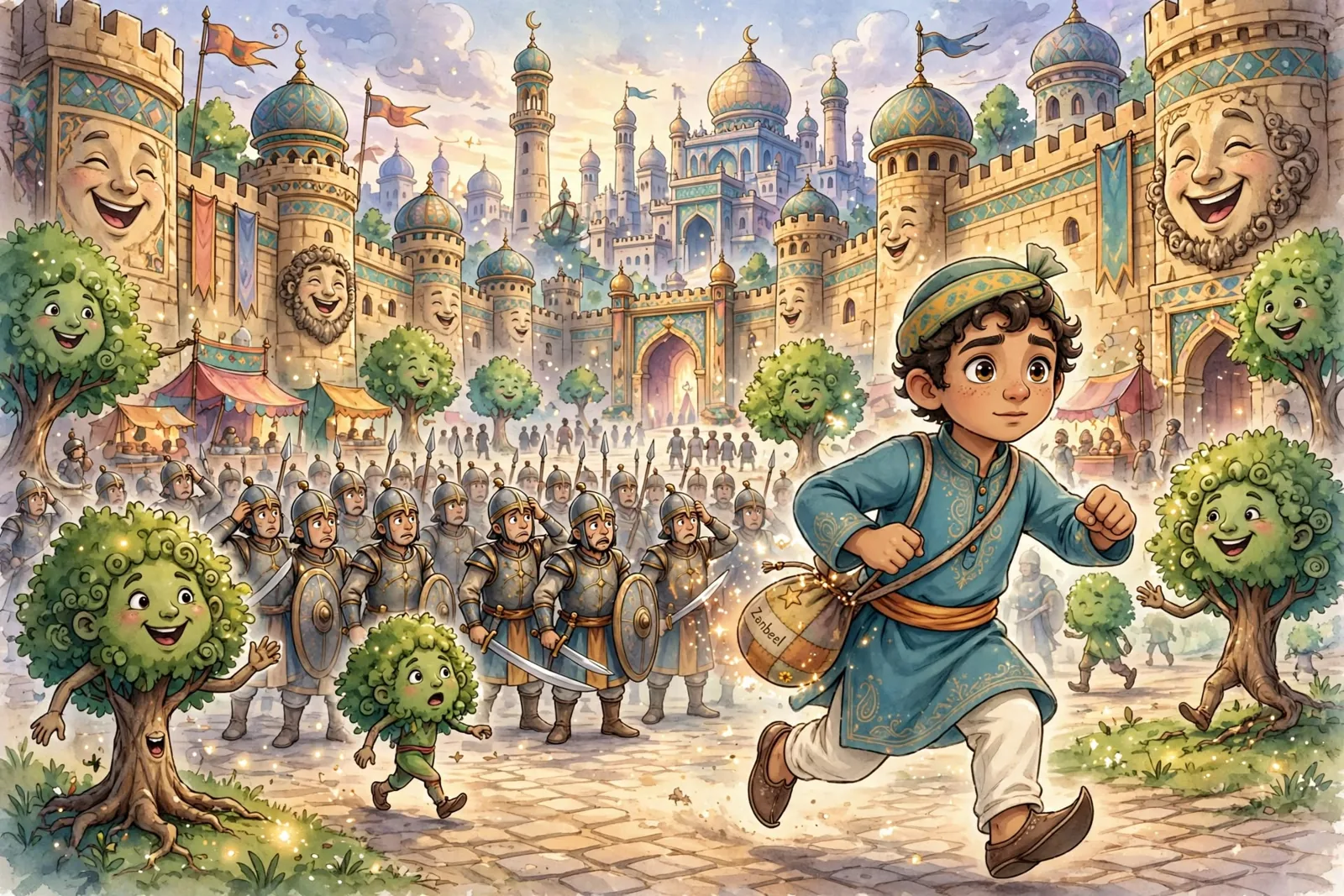
The place was called Tilism-e-Hoshruba. It was no ordinary city, but an enchanted one. Its walls could speak. Whenever a soldier approached, a wall would shout, ‘Oi! Where do you think you’re going?’ The startled soldier would retreat. Its trees could walk. A soldier might sit in the shade, only to discover a moment later that the tree had moved away. ‘But it was here a moment ago!’ he would cry. The gates were stranger still: they opened only for someone who knew magic. To everyone else, they turned to stone.
‘Attack!’ commanded Amir Hamza. Swords flashed, drums thundered and horses charged. But the instant a sword struck the wall, it burst out laughing. ‘Ha, ha, ha! That tickles!’ The soldiers stared. Their blades could not break the wall; they only made it laugh. Amir Hamza fired a cannon. The cannonball bounced straight back. ‘Hit me harder!’ the wall called. ‘I’m enjoying this!’
Amir Hamza was troubled. ‘What are we to do?’ he asked his minister. ‘We have conquered the greatest fortresses. What sort of fortress refuses to break?’ ‘Your Majesty,’ replied the minister, ‘this fortress is not made of stone. It is made of magic. You cannot break magic with a sword.’ Amir Hamza looked towards the sky. ‘Then who will come to our aid?’
At that moment a cloud of dust appeared in the distance. A man was running towards them so fast that the wind itself seemed exhausted in his wake. His clothes were plain. He carried no sword. On his shoulder hung a little Zanbil. It was Amr Ayyar.
‘Salaam, Your Majesty! I’ve arrived,’ Amr said. ‘Amr! How did you know we were trapped?’ asked Amir Hamza. Amr smiled. ‘When the walls begin laughing, Your Majesty, it’s usually time to call for Amr.’ From the battlements, the sorcerers roared with laughter. ‘What can that little fellow do? He hasn’t even got a sword!’ Amr heard them but did not reply. He knew that people who spent too much time laughing at others could be caught off guard.
‘Your Majesty,’ he said, ‘an army won’t open this fortress. We must open it with our minds.’ ‘With our minds? How can a mind open a fortress?’ ‘Every lock has a key, and every enchantment has a root. Rather than strike the lock, we’ll find the root.’
Night fell. The moon rose and the soldiers pitched their tents. Everyone slept except Amr. Sitting on a stone, he studied Tilism-e-Hoshruba. The walls were still talking. The trees were still walking. The gates remained shut. ‘What is this city standing on?’ he wondered. ‘A house stands on the ground. A tree grows in soil. What supports this place?’
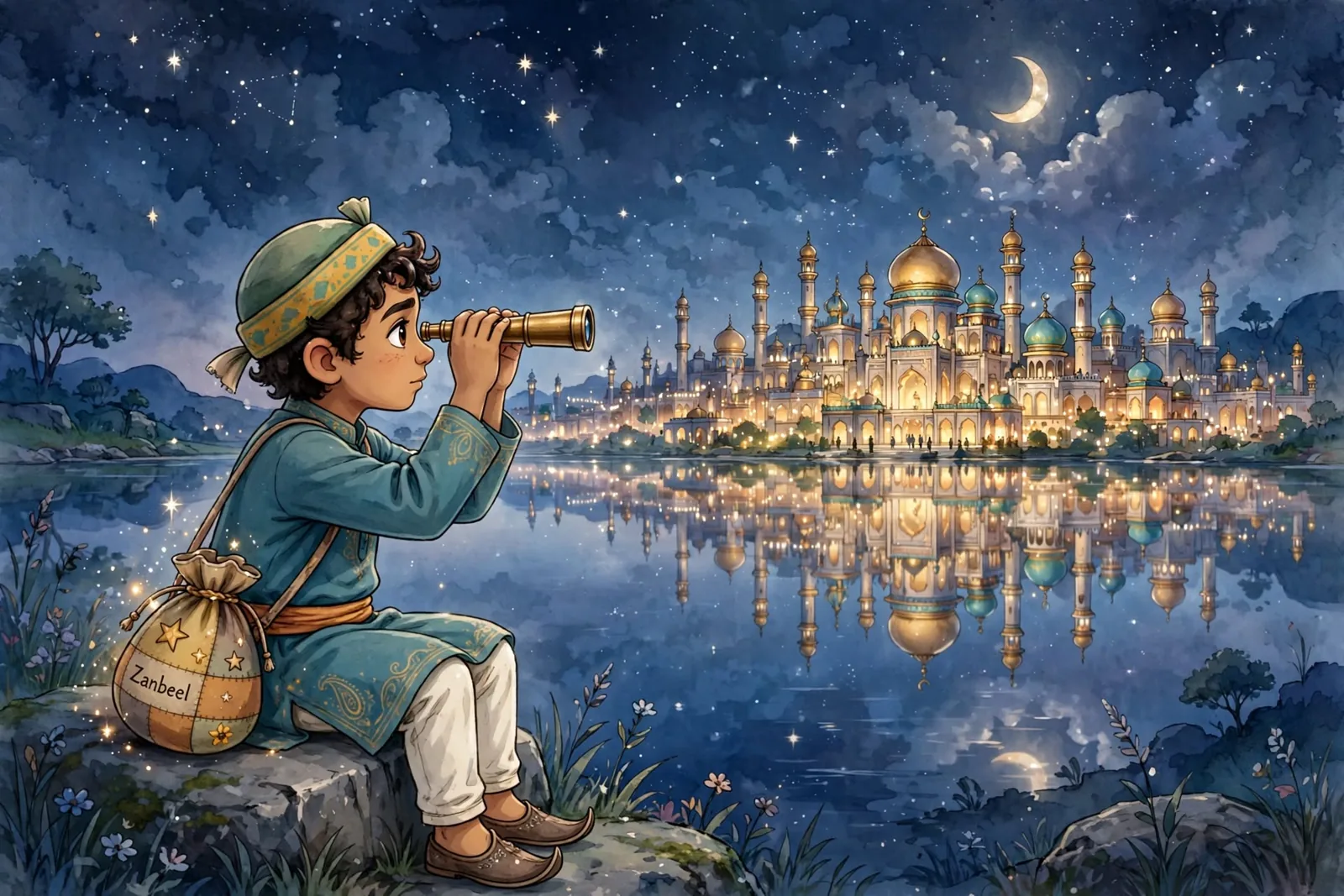
He took a little telescope from his Zanbil and looked closely. Beneath the whole city lay an enormous mirror, so vast that the entire city appeared upon its shining surface. ‘Aha!’ thought Amr. ‘The city rests on a mirror. The mirror shows people a false picture, making each person seem greater than they are. That is why the walls laugh and the trees move. The mirror is the source of the enchantment. Break it, and the spell will break too.’
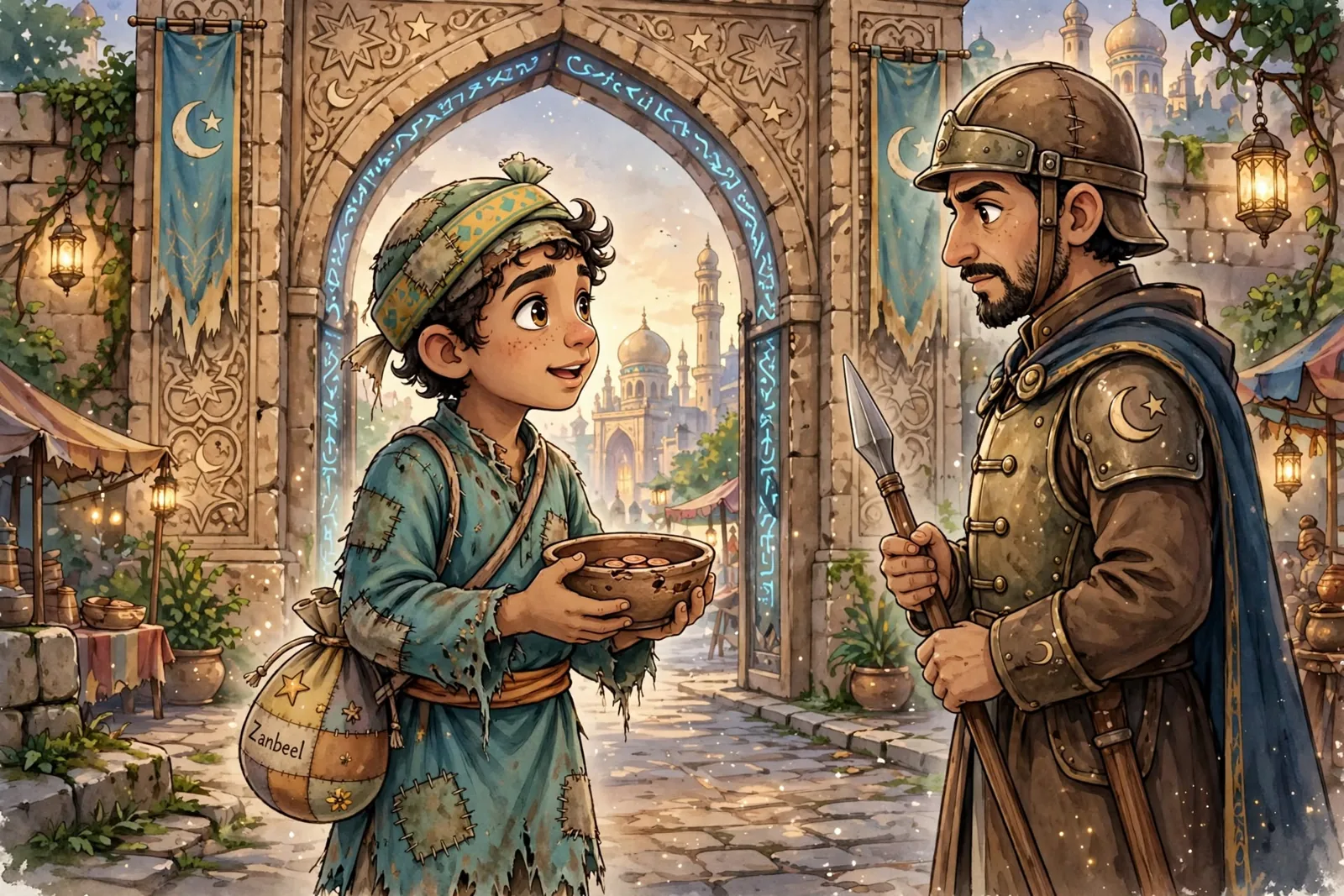
At dawn, Amr disguised himself as a faqir. He put on ragged clothes, an old cap and carried a begging bowl. At the city gate he called, ‘For the love of Allah, spare something for a hungry man!’ The guard looked down at him. ‘We don’t give alms here. We give magic.’ ‘Then teach me magic,’ Amr replied. ‘I’d like to learn.’
The guard laughed. ‘You? Learn magic? You’re only a faqir!’ ‘A faqir knows the greatest magic of all,’ said Amr. ‘The magic of hunger, the magic of thirst and the magic of patience.’ The guard liked that answer. ‘Very well. Come inside. I’ll show you the city.’
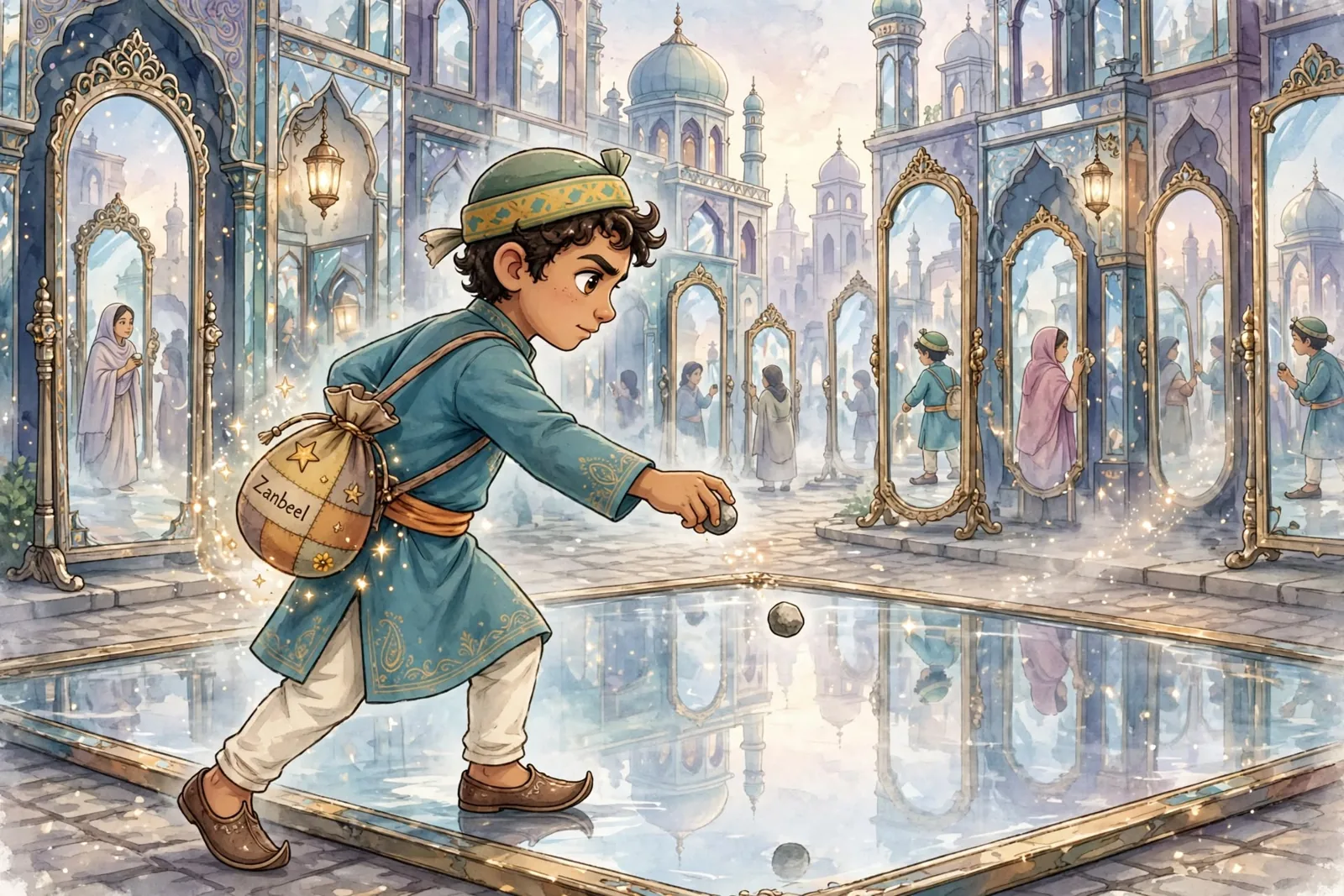
Inside, Amr found an even stranger sight. Mirrors lined every street. Everyone gazed at their own reflection. ‘How beautiful I am!’ said one person. ‘How powerful I am!’ declared another. ‘How important I am!’ cried a third. Amr understood. ‘They are trapped by their own reflections. They look only at themselves and never at one another. That is the city’s real enchantment.’
He walked to the great mirror spread beneath the city. Reaching into his Zanbil, he drew out a small stone, an ordinary pebble such as you might find in any street. He threw it against the mirror. CRACK!
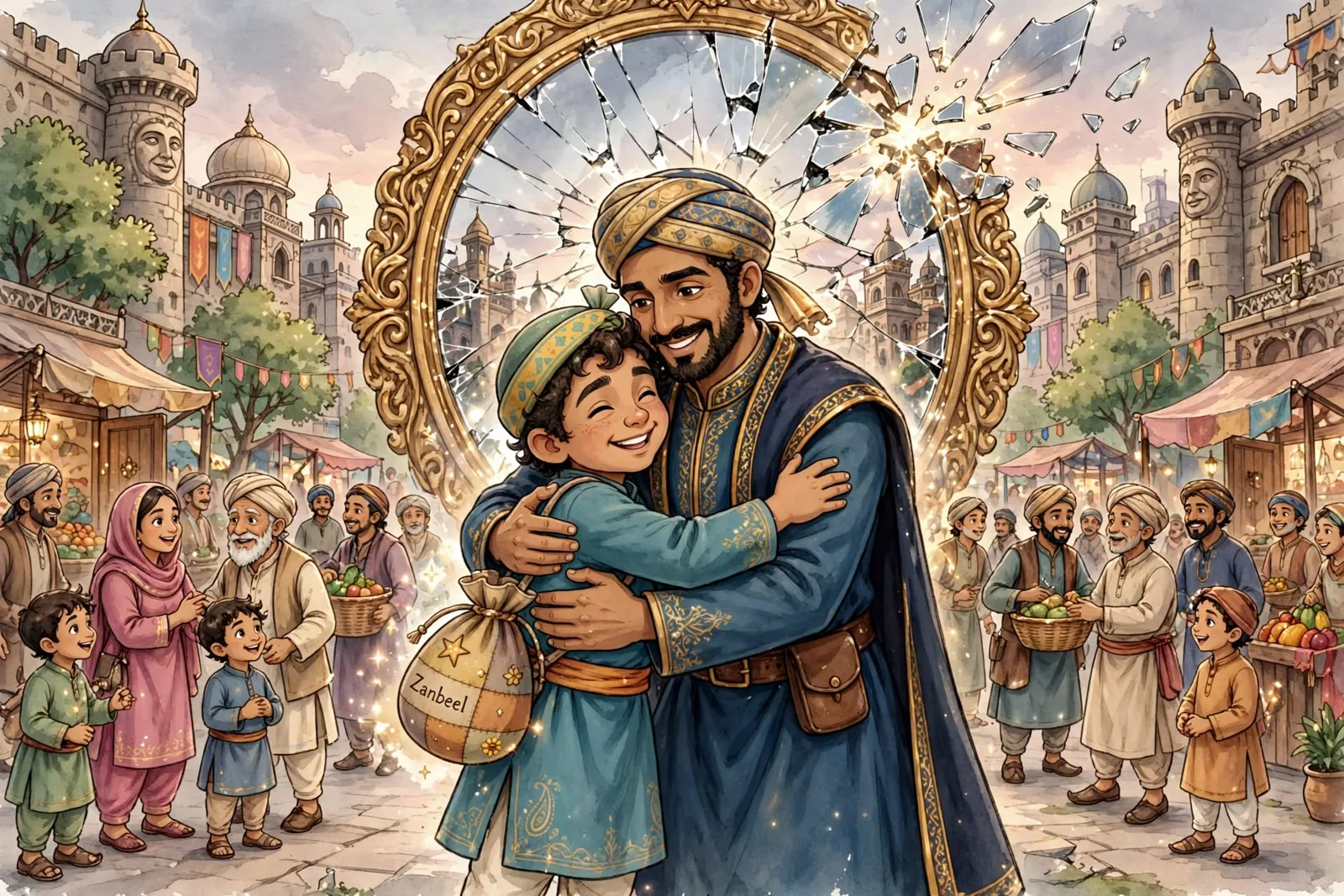
The mirror shattered. The entire city shook. The walls fell silent. The trees stopped walking. The gates swung open. For the first time, the people who had been staring at their reflections looked at one another. ‘Oh!’ they exclaimed. ‘You’re here too! We thought we were the only ones!’
Amir Hamza’s army entered the city, but nobody drew a sword. There was no one to fight. The people were smiling at one another. Amir Hamza embraced Amr. ‘How did you do it? We used swords and cannons to no effect, yet you opened the whole city with one little stone.’
‘Your Majesty,’ Amr replied, ‘I did not fight the magic. I found its root. The mirror made everyone see only themselves. Once it broke, they could see one another. And when people truly see one another, the enchantment loses its power.’
‘You’ve taught us something important today,’ said Amir Hamza. ‘Every difficulty has a root,’ said Amr. ‘The person who finds it can succeed. The person who merely grows angry will fail.’ From that day, Amir Hamza gave his army a new order: ‘Think first. Draw your sword only afterwards.’
And children, that lesson matters today. There is a Tilism-e-Hoshruba in the world around you, too: on your phone, your computer and your television. There are mirrors there as well—your photographs, your videos, your likes. Sometimes you can become so absorbed in your own reflection that you forget to notice anyone else.
But put your phone down and look at the people beside you. Ask a friend, ‘How are you really feeling?’ Ask your mum, ‘Are you tired? Can I help?’ Then the mirror begins to crack, and the enchantment begins to fade.
Amr broke his mirror with a pebble. You can break yours with a question: ‘Why am I looking only at myself? Why am I not looking at other people?’ The child who asks that question has become Amr.
Think like Amr: When was the last time you put your screen aside and really noticed someone else?
Story Three: The King’s Disguise and the Fortress of Fear
Those who face their fears can overcome them.
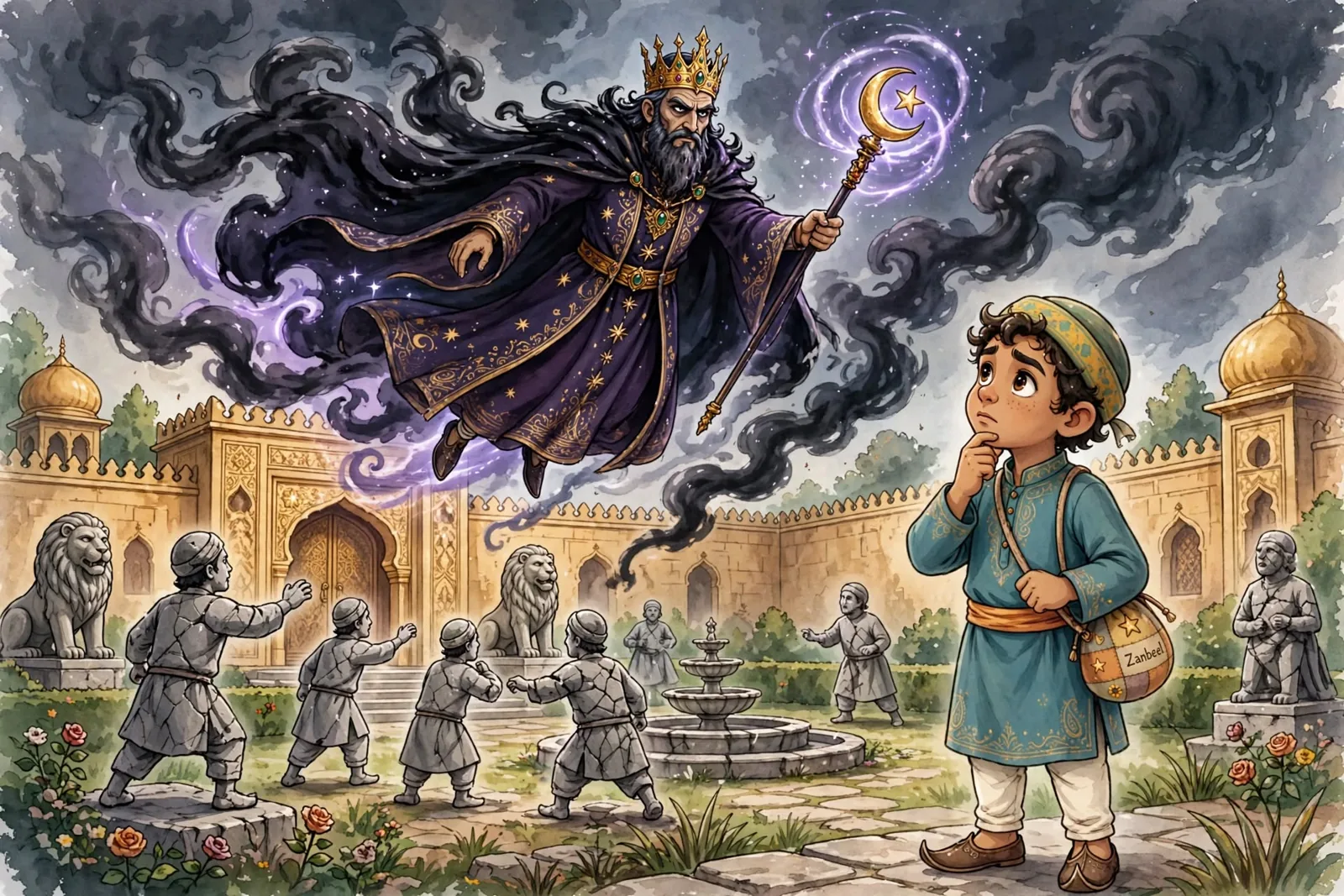
Even the children of Tilism-e-Hoshruba trembled at the name of Afrasiyab. He was the ruler of that enchanted realm and its most powerful sorcerer. He could fly through the air, his black cloak billowing like a storm cloud. With a sweep of his hand he could turn stone to gold; with a single gesture he could turn a hundred people into statues. He displayed those statues in his garden.
His vast palace had golden walls. Two living lions guarded its entrance, silenced by his magic. Sorcerers came to his court every day, but nobody dared speak loudly or ask a question in the king’s presence.
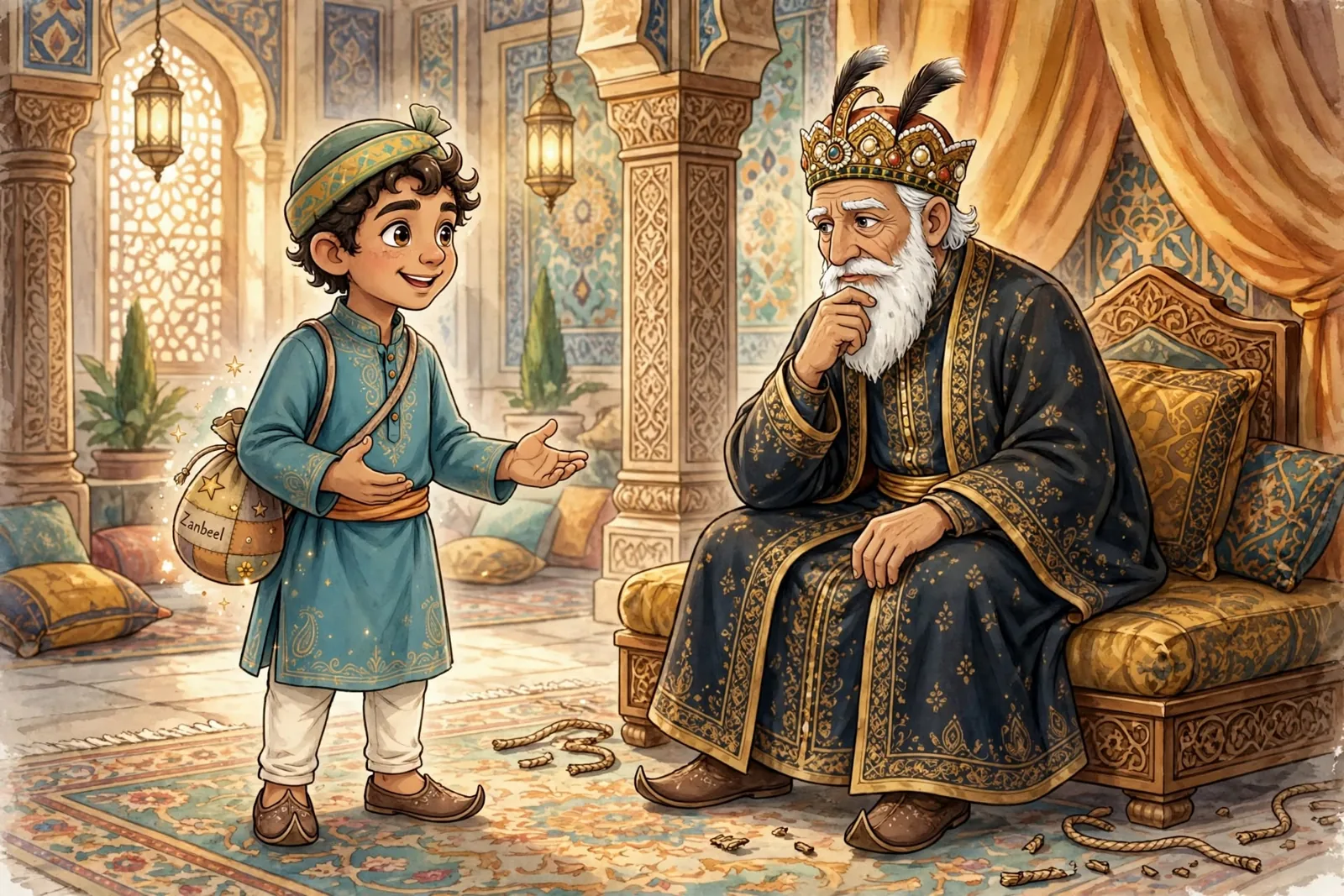
One day, from his throne, Afrasiyab announced, ‘Whoever captures Amr shall receive half my treasure!’ The court fell silent. Half the treasure was an astonishing reward. ‘Amr broke the enchanted mirror,’ the king continued. ‘He opened my city’s gates, and now anybody may come and go. I want him caught.’
Traps appeared throughout the city. Sorcerers patrolled every street carrying ropes that could fly through the air and tie up a person by themselves. Magical locks sealed the doors and would open only at Afrasiyab’s command. Enchanted eyes watched from every window. Frightened parents kept their children indoors. ‘Don’t go out!’ they warned. ‘Afrasiyab’s sorcerers will catch you.’
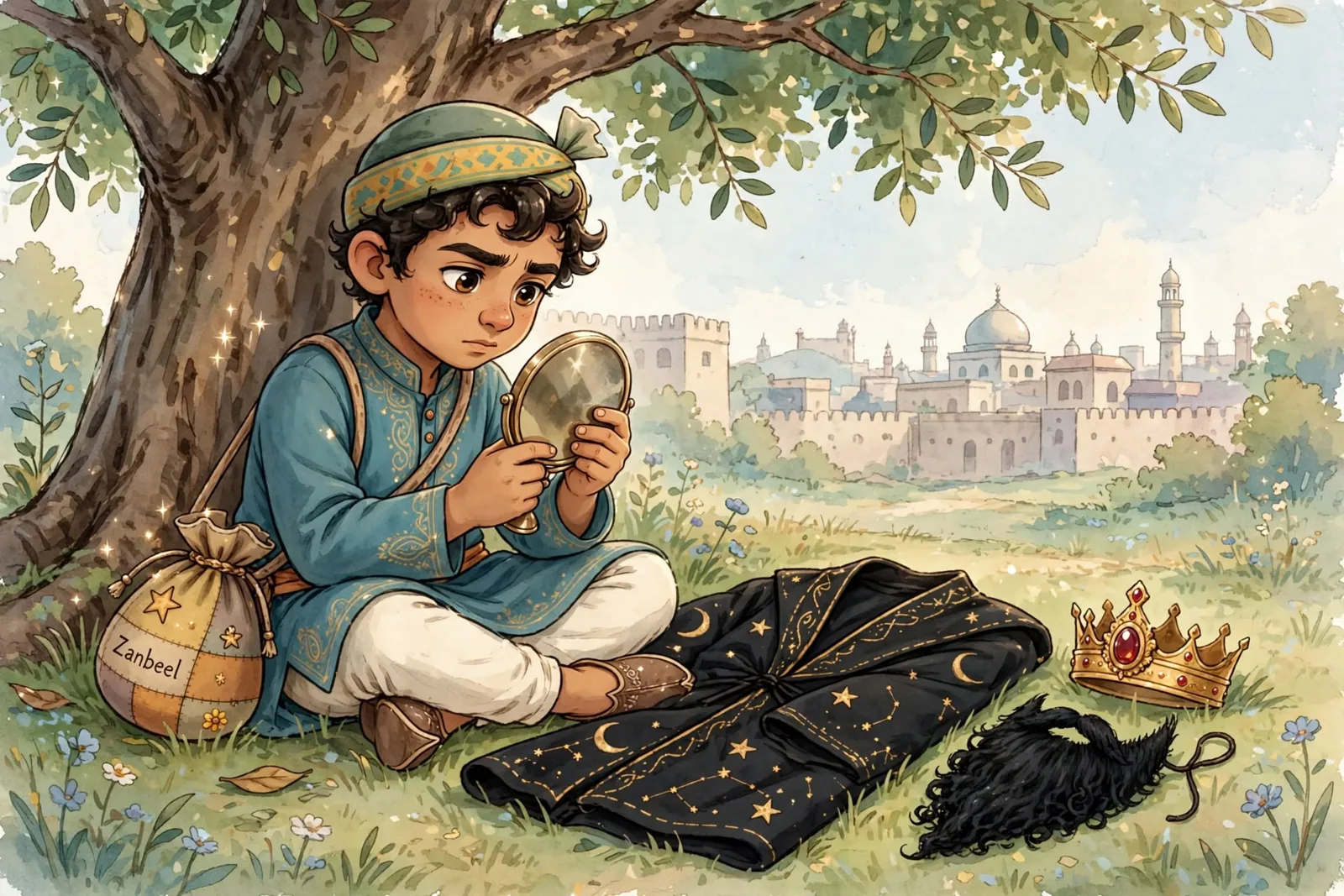
But where was Amr? He was sitting beneath a tree outside the city. He drew a small mirror from his Zanbil and looked at himself. ‘Afrasiyab wants to catch me,’ he thought. ‘He is more powerful than I am. He has magic, an army and treasure. What have I got? Only my mind.’
Then he made an extraordinary decision. ‘If Afrasiyab wants to catch me, I’ll become Afrasiyab!’ Yes: Amr decided to disguise himself as the king.
From the Zanbil he produced a golden crown with a red jewel, just like Afrasiyab’s. He fixed a long black beard to his chin, with a tiny knot at its tip. He put on a black cloak embroidered with golden stars. Finally, he practised the king’s deep, commanding voice. ‘I am Afrasiyab!’ he boomed. The resemblance was remarkable.
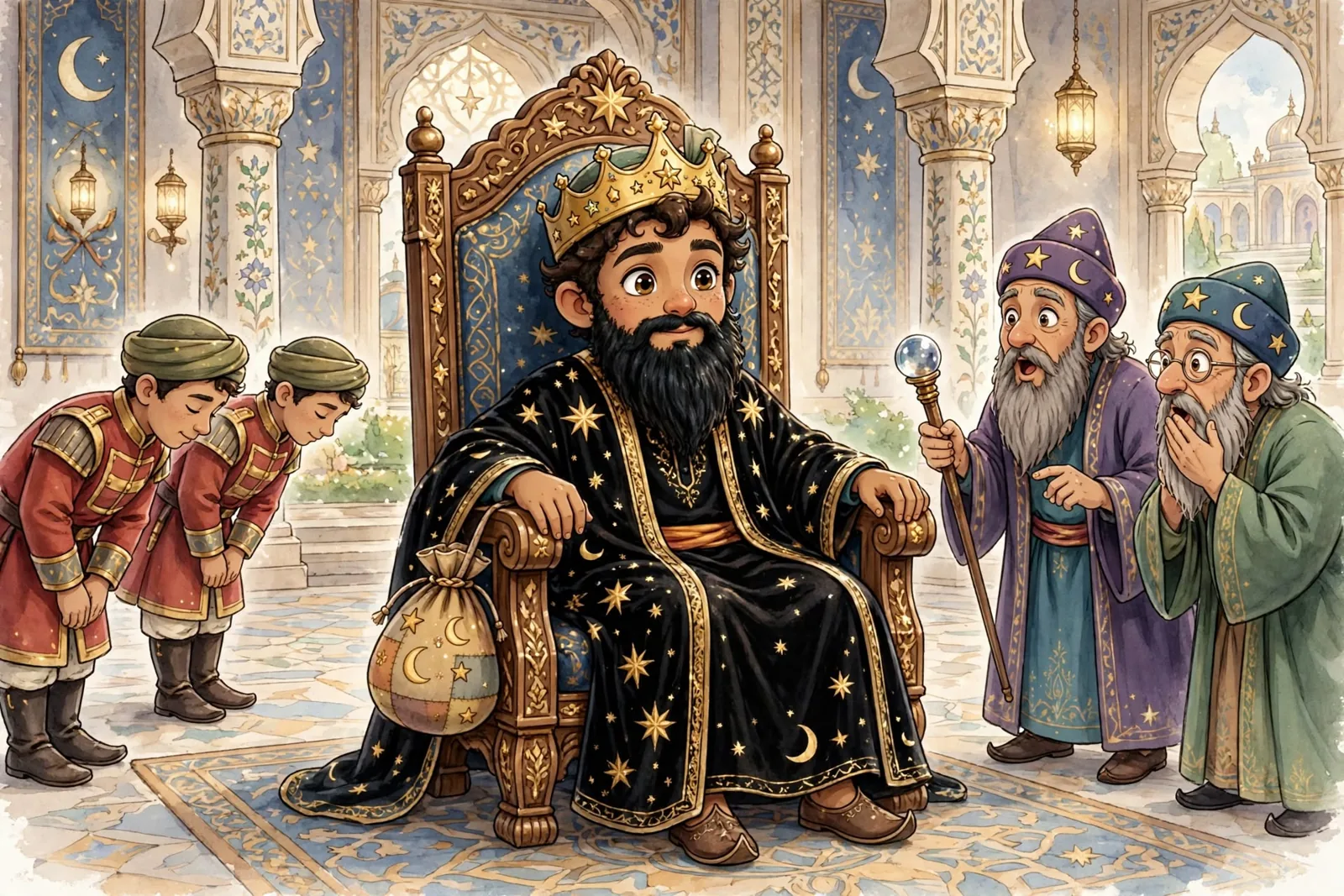
He walked straight to the palace. The two lions bowed their heads, believing their master had returned. The guards saluted. ‘Your Majesty! Where have you been? We’ve been waiting for you.’ ‘Inspecting the city,’ Amr replied in his new voice. The gates opened, and he strode inside.
The assembled sorcerers rose at once. ‘Your Majesty! What are your orders?’ Amr settled upon the throne. ‘Listen carefully. From today, nobody is to capture Amr.’ The sorcerers stared at one another. One ventured, ‘But, Your Majesty, you promised half your treasure to whoever caught him.’ ‘I’ve changed my mind,’ said Amr. ‘Amr is my friend.’
The sorcerers were bewildered. Yesterday the king had been Amr’s enemy; today he called him a friend. ‘Perhaps His Majesty has a fever,’ whispered an elderly sorcerer. ‘Perhaps he’s learnt a new spell,’ suggested another. Amr wanted to laugh, but kept his face perfectly solemn.
Just then the real Afrasiyab arrived. He flew down from the sky, gathered his cloak and landed outside the palace. The guards stopped him. ‘Halt! Who are you?’ ‘I am Afrasiyab!’ he roared. ‘The king of this palace! Get out of my way!’ ‘No,’ replied a guard. ‘You’re an impostor. The real king is inside.’
‘I am the real king! The one inside is false!’ Afrasiyab shouted. But the guard insisted that the king had already entered wearing his crown, beard and cloak. Afrasiyab’s face turned red. He drew his magical staff. ‘I’ll turn you to stone!’ The guard was frightened, but still refused to open the gate.
Inside, Amr heard the commotion. Rising from the throne, he called, ‘Who’s making that racket outside? Seize the impostor!’ The sorcerers rushed out. Afrasiyab chanted a spell and fire shot from his hands. The sorcerers stumbled back, and the furious king forced his way into the court.
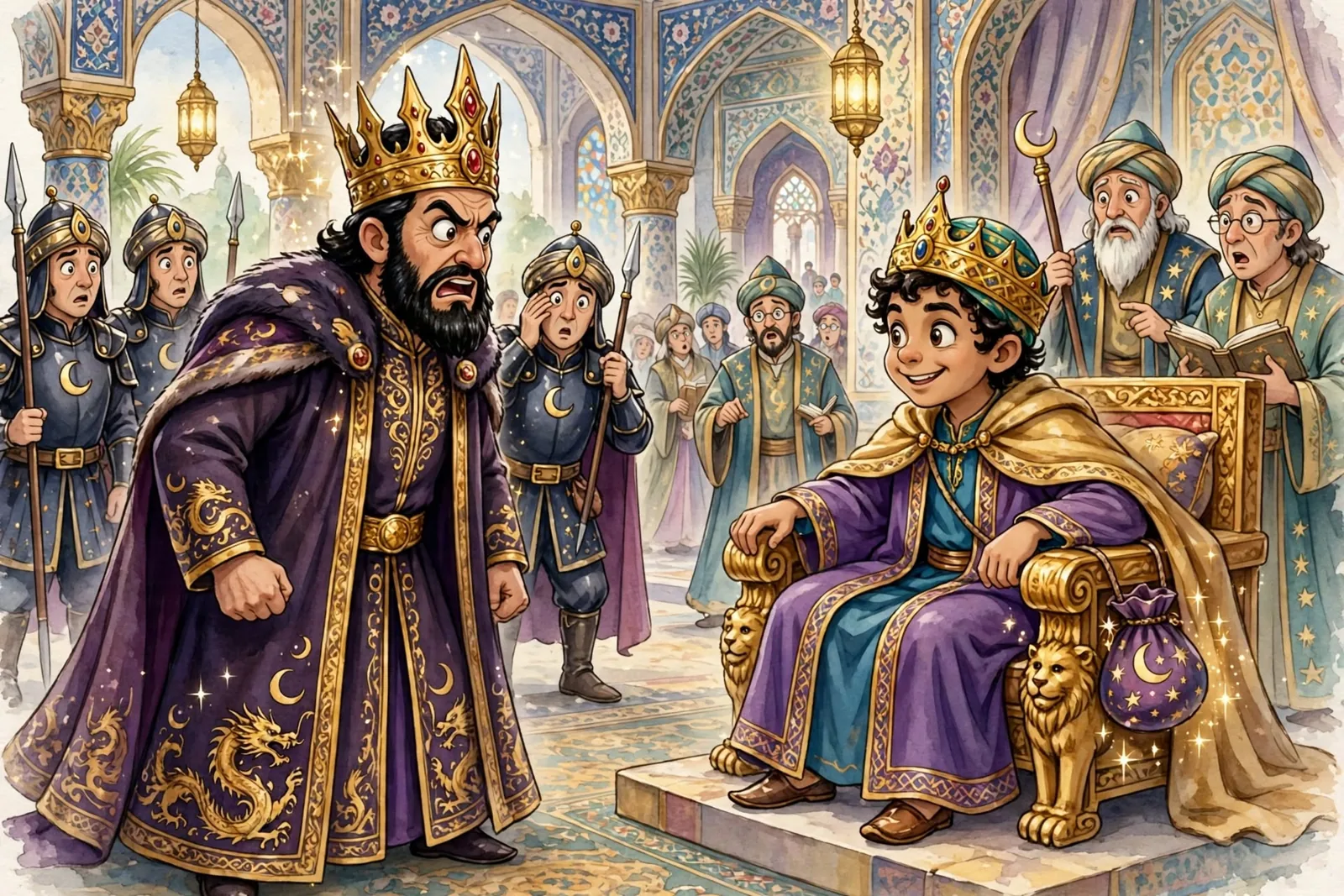
Now two Afrasiyabs faced each other: one sitting on the throne, the other standing below it. The court was utterly silent. Everyone looked from one to the other. Nobody knew which was real.
‘You’re Amr!’ cried the king. ‘And you’re Afrasiyab,’ replied Amr. ‘Why have you disguised yourself as me?’ demanded the king. ‘I haven’t merely copied your appearance,’ said Amr. ‘I’ve exposed your fear. Your people are so afraid of you that they cannot even recognise you. If they were not frightened, they would know who you were.’
Afrasiyab cast a spell. Amr’s hands were bound. The king pulled away the false beard and removed the crown. There stood Amr as himself: a small man in simple clothes, with the Zanbil over his shoulder.
‘Now I’ll turn you to stone!’ Afrasiyab declared. But Amr smiled. ‘King, you may capture me, but you cannot capture my thoughts. You may tie my hands, but you cannot tie up my questions. You may turn my body to stone, but you cannot turn an idea to stone.’
Afrasiyab stopped. He had never heard anyone speak like that. He had turned thousands of people into statues, but never a question. Could a question be more powerful than magic? ‘What is this idea of yours?’ he asked.
‘There is no enchantment greater than fear,’ Amr answered, ‘and no power greater than thought. You have ruled by making people afraid. I have helped set them free by thinking.’
For the first time, Afrasiyab began to wonder whether intelligence could be greater than force. He untied Amr’s hands. ‘Go. Today you are free. But remember, I shall catch you again.’
‘King,’ replied Amr, ‘you may catch me. But as long as children keep asking questions, Amr will live.’
And children, that is still true today. Your own Afrasiyab is fear. It appears before an exam, in a dark room, or whenever you tell yourself, ‘I can’t do it.’ The more you fear it, the larger it seems, until you can scarcely see yourself. The more carefully you think, the smaller it grows.
Ask yourself, ‘Why am I frightened? What lies at the root of this fear?’ Amr wore the king’s disguise to show that even a terrifying ruler was only a person. Fear, too, wears a disguise. When you take that disguise away, fear begins to lose its hold.
So the next time you feel afraid, don’t change who you are. Challenge the disguise your fear is wearing. Ask it, ‘Who are you?’ You will discover that behind your fear there is only a question—and that you already have the answer.
Story Four: The Garden That Could Speak
The Woodcutter’s Axe and the Golden Apples
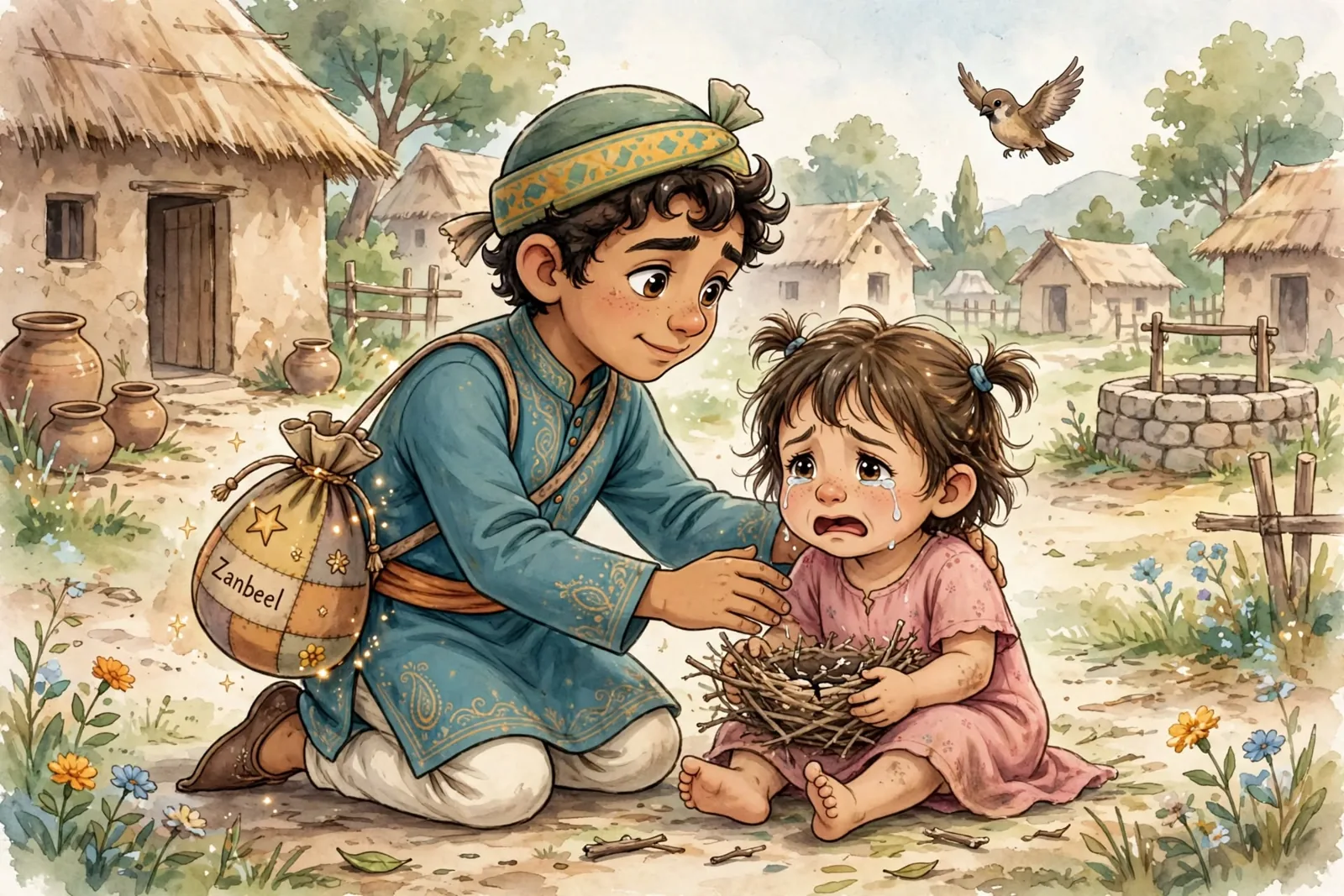
One day Amr Ayyar was passing through a village when he saw a little boy crying. In his hand was a broken twig from a bird’s nest. ‘My bird has flown away,’ the boy said. ‘Its nest is broken.’
‘How do you know the bird is sad?’ Amr asked. ‘It told me,’ replied the child, ‘but I couldn’t understand its language.’ Amr began to wonder. If only he could understand birds, trees and the wind!
An elderly traveller passed by. ‘Amr,’ he said, ‘if you wish to learn the language of birds, go to the sorcerers’ garden.’ ‘Which garden?’ asked Amr. ‘Behind Tilism-e-Hoshruba lies a forbidden garden. Its fruit allows anyone who eats it to understand every language: birds, trees and even the wind. But the garden is guarded by enchanted thorns. Whoever enters is turned into a thorn. The sorcerers have imprisoned the garden because they do not want anyone to hear it speak.’
‘If you imprison a garden, it will die,’ Amr said. ‘Exactly,’ the traveller replied. ‘That is why the garden is crying, though nobody can hear it.’ Amr made up his mind to go there.
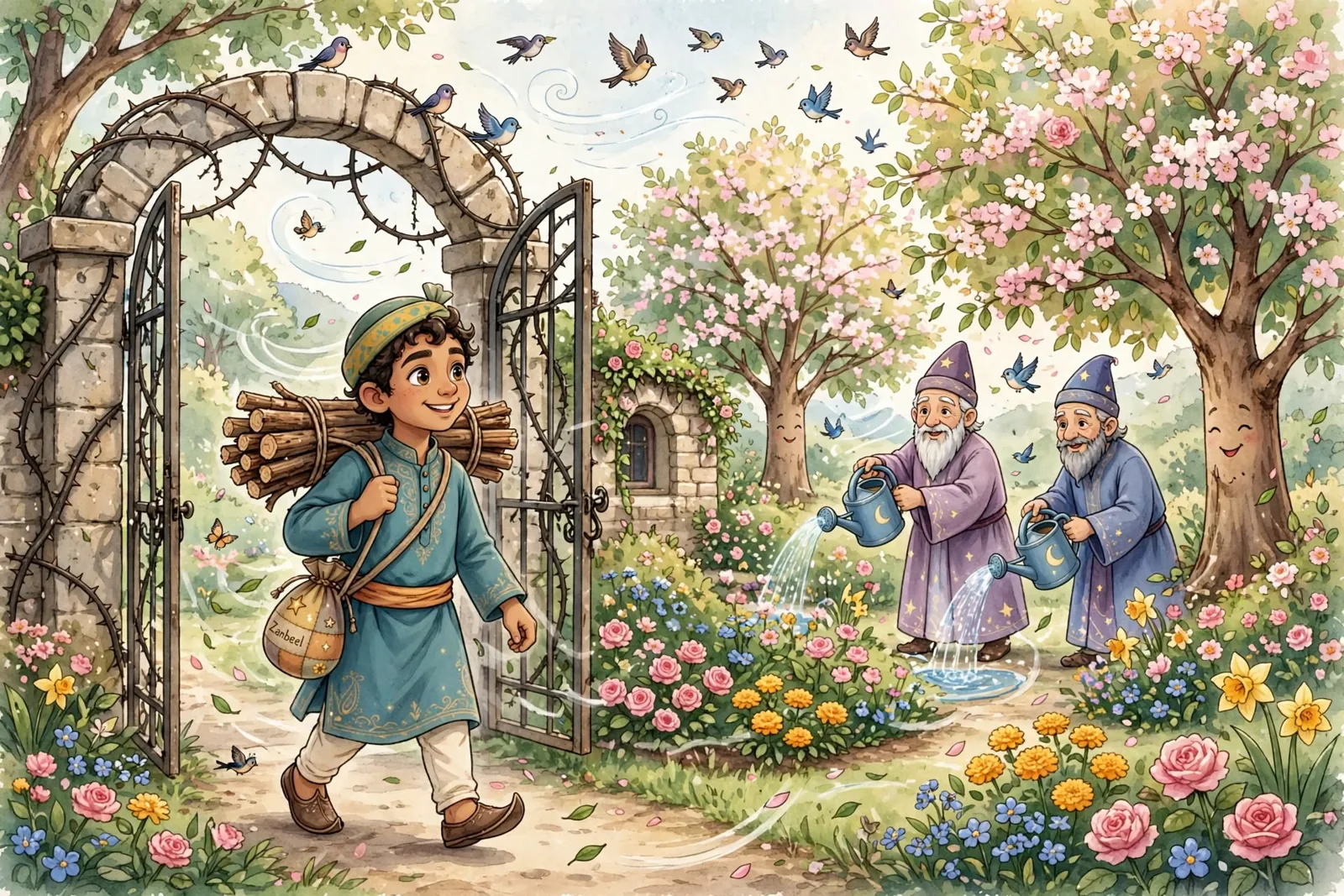
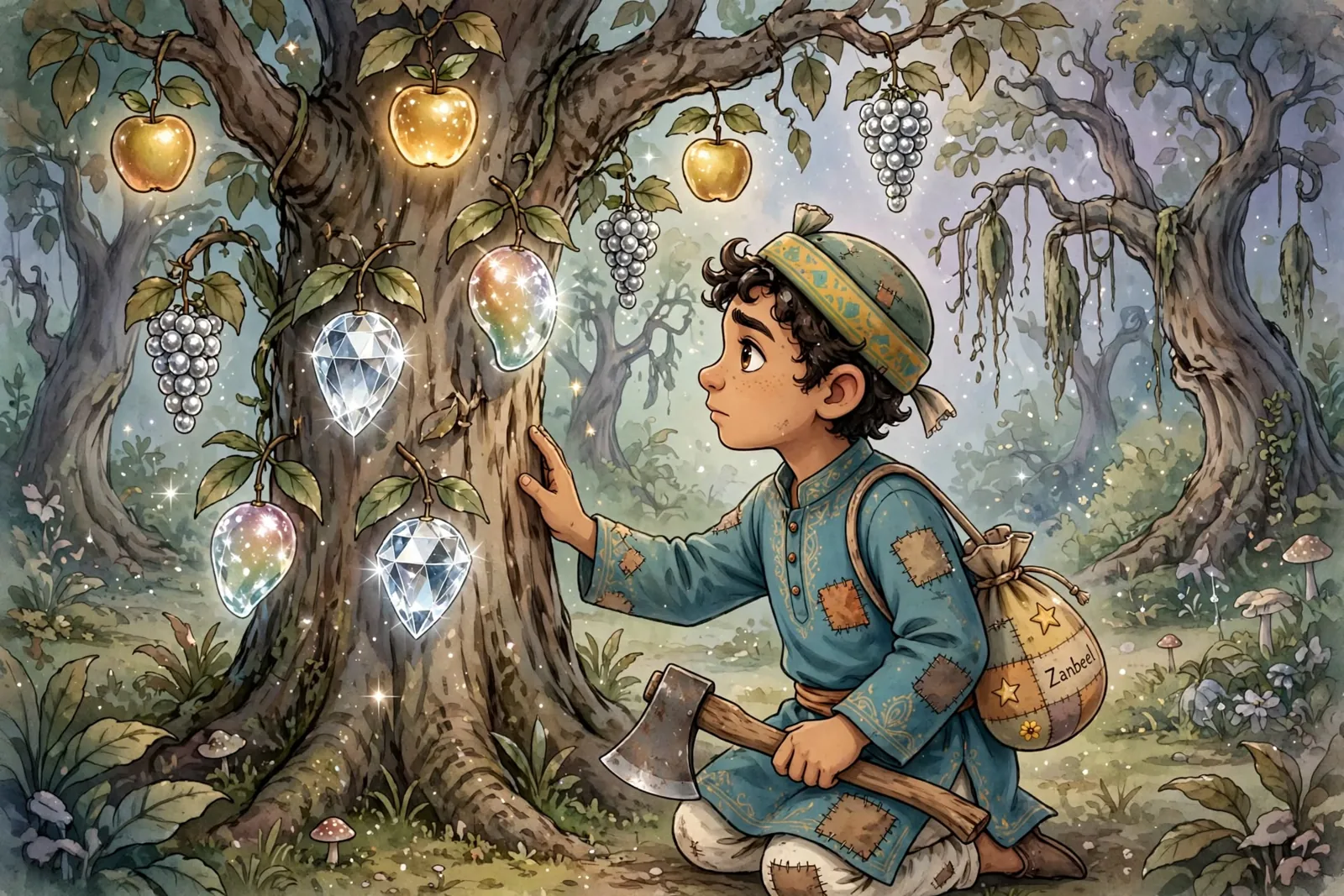
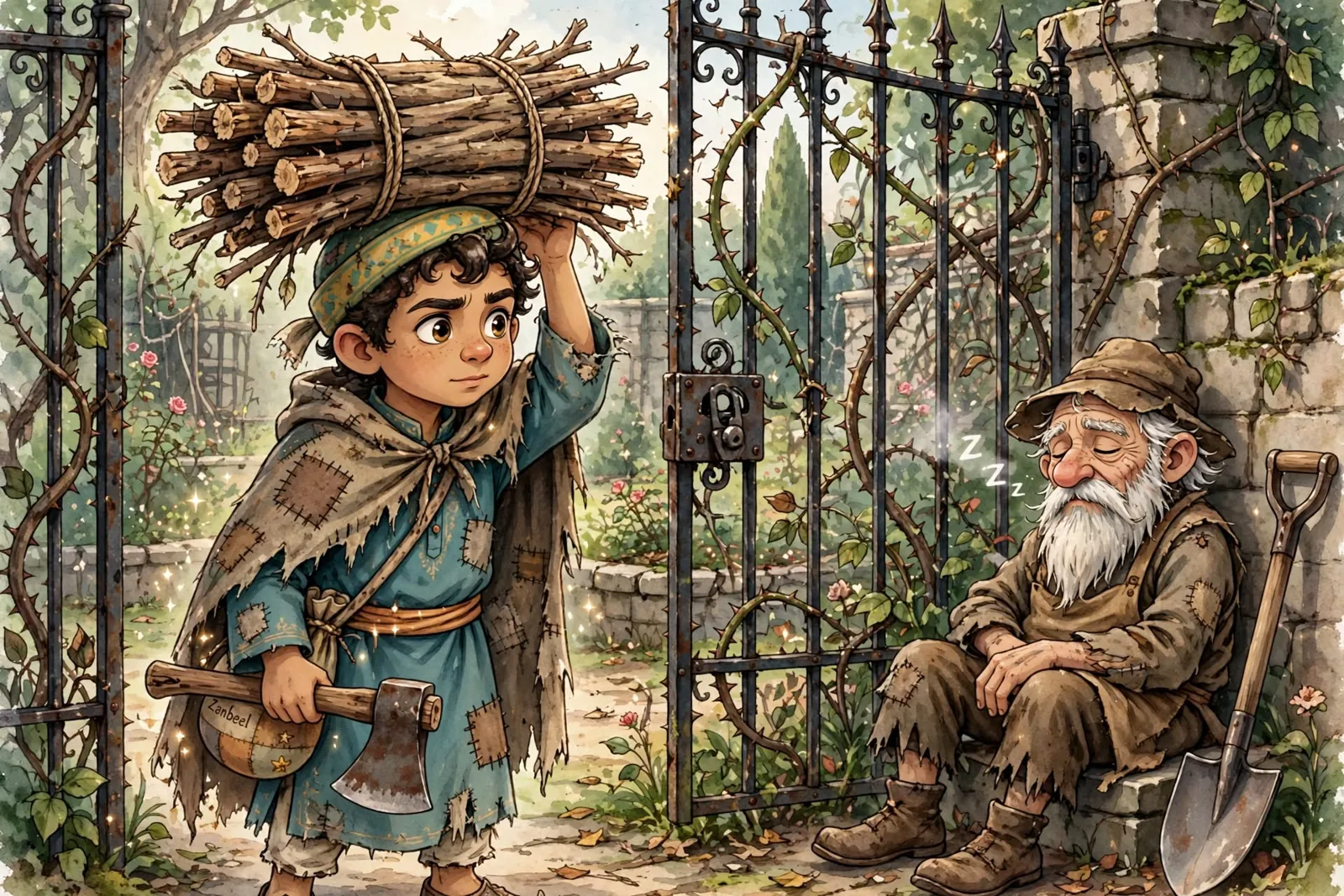
The next morning he disguised himself as a poor woodcutter. His clothes were torn. His shirt had three patches, and one leg of his shalwar was shorter than the other. He carried a bundle of dry sticks on his head, with tiny twigs sticking out in every direction. In his hand he held an old axe. Its handle was slightly broken, but its blade was sharp. He looked poor indeed.
The garden’s iron gate was covered in long, glittering thorns. Beside it stood a sleepy-eyed gardener with a long beard. ‘Salaam,’ said Amr. ‘I need firewood. My children are hungry and there’s no fire at home.’
‘Don’t go inside,’ warned the gardener. ‘There’s magic in there. Anyone who enters becomes a thorn.’ ‘Brother,’ replied Amr, ‘what magic is greater than hunger? When a child is hungry, even their crying feels like a thorn. Please let me have a little firewood. I’ll take it from near the entrance.’
The gardener felt sorry for him. ‘Very well. You may go in for a short while. But don’t pick any fruit.’ Amr entered, and his eyes widened at the sight before him.
Golden apples hung from the branches, shining so brightly that even the sunlight seemed pale beside them. There were silver grapes, each one polished enough to show your reflection, and mangoes like glittering diamonds. But there were no birds. Not a single sparrow sang. No breeze stirred the leaves. The whole garden was silent, as though someone had stolen its voice.
‘They’ve decorated this garden with gold,’ Amr thought, ‘but they’ve taken away its freedom to speak.’ He approached a tree. ‘Brother Tree, how are you?’ No answer came.
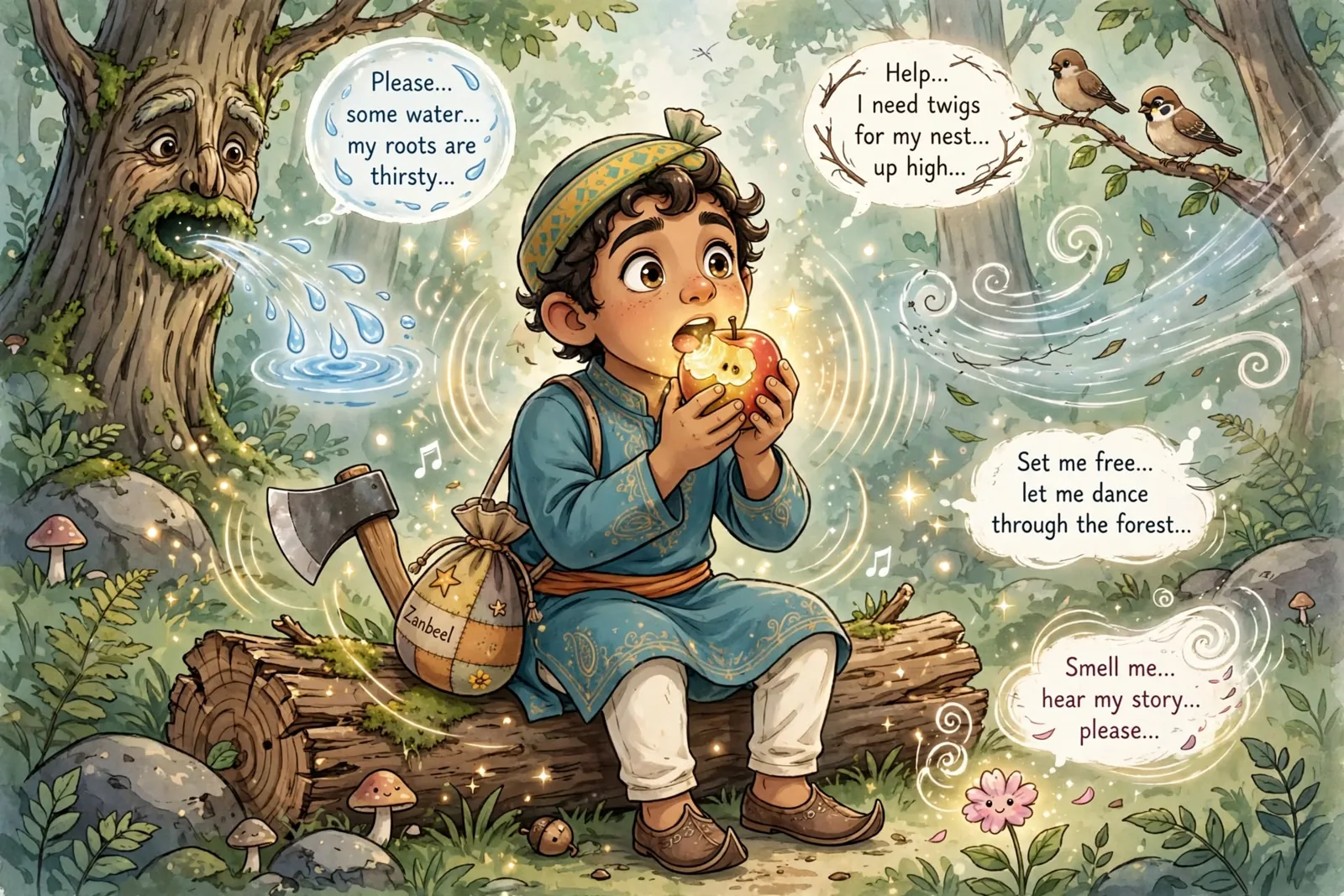
Amr reached for a golden apple. The moment he plucked it, he thought he heard a whisper close to his ear. He took a bite. Suddenly, the world changed. He could hear everything.
‘I need water,’ said the tree. ‘I haven’t had a drink for three days. My roots are drying out.’ Far away, a bird cried, ‘My nest has broken. Where will my chicks go?’
‘I’m tired,’ sighed the wind. ‘I’m trapped in this garden. I want to go out into the fields and visit the children.’ A flower whispered, ‘Nobody notices me. Everyone looks at the golden apples. Nobody stops to smell my scent.’
Tears filled Amr’s eyes. ‘I thought magical fruit only gave people power,’ he said. ‘But this fruit gives pain as well. When you eat it, you can hear everyone else’s sorrow.’
He touched the tree gently. ‘Why are you crying? You live in a garden of gold.’ ‘What use is gold to me?’ the tree replied. ‘I cannot eat it or drink it. I need water, air and birdsong, not gold.’ Amr realised how cruelly the sorcerers had treated the garden. They had covered it in treasure while taking away the things that kept it alive.
Just then the sorcerers arrived, magical wands in their hands. ‘Who’s there? Who picked an apple?’ they demanded. ‘I did,’ said Amr. ‘I’m a woodcutter.’ ‘Do you know this garden is forbidden? We’ll turn you into a thorn!’
‘Then turn me into a thorn,’ Amr replied. ‘But first tell me why you’ve imprisoned this garden.’ ‘Because it belongs to us,’ said a sorcerer. ‘The fruit is ours.’
‘If it belongs to you,’ Amr asked, ‘why haven’t you watered it? Why haven’t you listened to its voice? You’ve made it golden, but you haven’t kept it alive. A garden grows from soil, not gold.’
The sorcerers were astonished. Never before had they seen anyone weep for a garden or speak to a tree. ‘How can you hear the tree?’ one asked.
‘I ate the apple,’ Amr said, ‘and I heard every voice. Then I understood: you haven’t merely imprisoned the garden. You’ve imprisoned its voice.’ The sorcerers fell silent.
‘Set the garden free,’ Amr continued, ‘and I’ll leave of my own accord. I don’t want a golden apple. I only want the garden to speak again.’
The sorcerers looked at one another. Something strange stirred in their hearts. It felt as though someone had slipped a little piece of the apple into their ears. Suddenly, they too could hear the tree’s voice. ‘We thought gold was everything,’ admitted one. ‘We never realised a garden needed water.’
They opened the gate, removed the thorns and watered the thirsty earth. Before long a breeze began to blow. Birds returned, flowers released their fragrance, and the tree said, ‘Thank you, Amr!’
Amr picked up his bundle of sticks and walked out, once more a poor woodcutter to anyone watching. But inside his heart he carried the language of birds.
And children, the lesson is still true. There is a garden before you today: our Earth, the park near your home, the tree in your school playground. If you only take from it—fruit, flowers, wood—one day it may fall silent. But if you listen and care, it will speak again.
Ask a tree whether it needs water, and imagine it blessing you. Promise a bird that you will not break its nest, and imagine it singing for you. Ask the wind whether it is tired, and feel it brush your face as it passes. You may not hear their words with your ears, but you can learn to hear their needs with your heart.
Amr ate a golden apple, but he did not gain gold. He gained pain: the ability to hear another creature’s suffering. And pain, the story tells us, can be the greatest magic of all. Whoever truly hears the pain of others begins to understand their language.
So next time you visit a park, stop for one minute. Look at a tree and ask, ‘How are you?’ Look towards a nest and wonder whether it is safe. Feel the breeze and ask where it has come from. You may not hear an answer aloud, but your heart may understand. And a child who has heard a tree’s voice with their heart will never want to cut it down.
Think like Amr: What could you do this week to help a tree, a bird or a small patch of green near your home?
Story 5: Grandmother’s Story and the Sleeping Queen
A Queen Without a Story
Even the greatest sorcerers in Tilism-e-Hoshruba trembled at the name of Queen Hairat. She was an expert at catching ayyars, and those she captured were locked in a chamber so deep beneath her fortress that sunlight never reached it. Only the sound of her flute travelled down there.
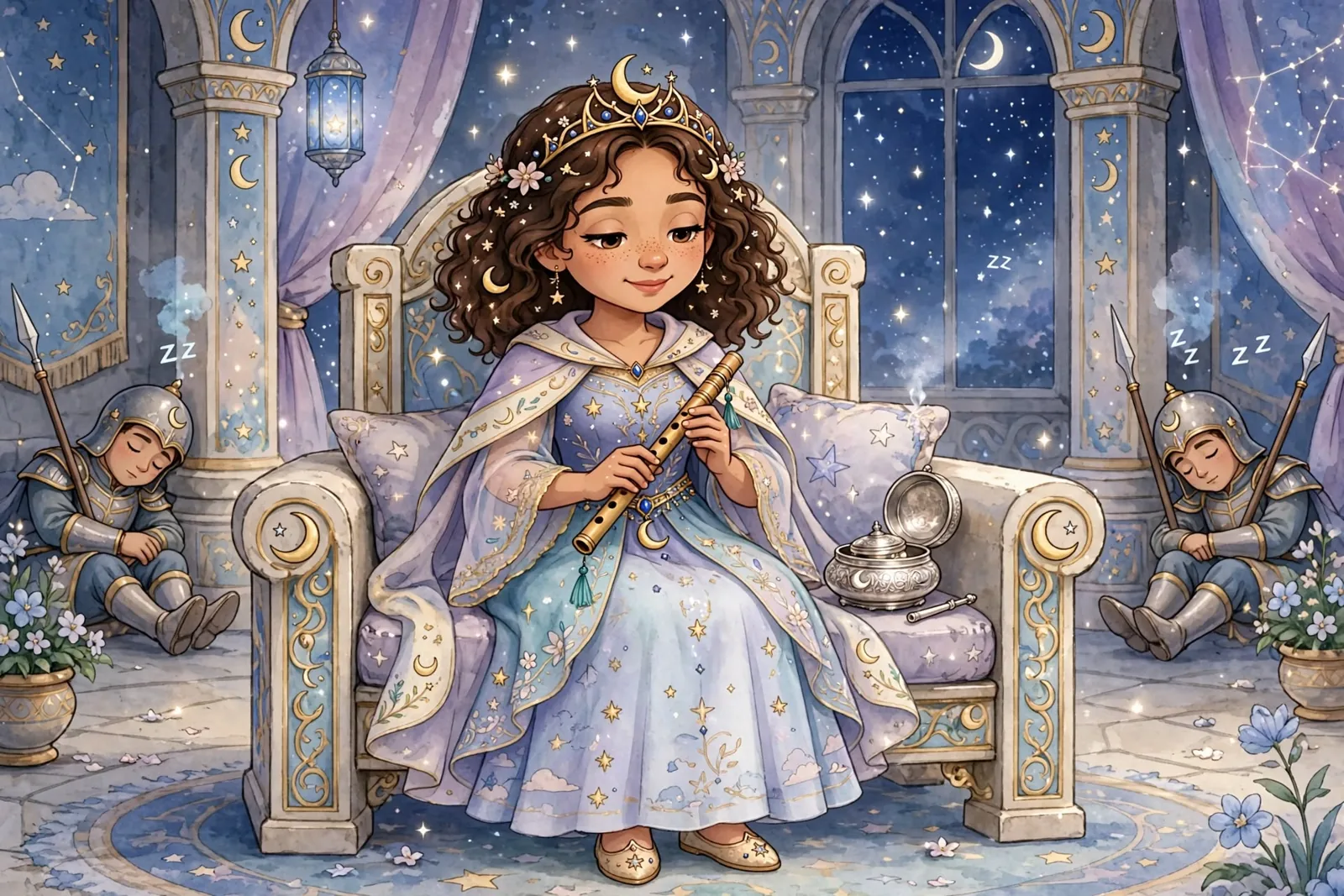
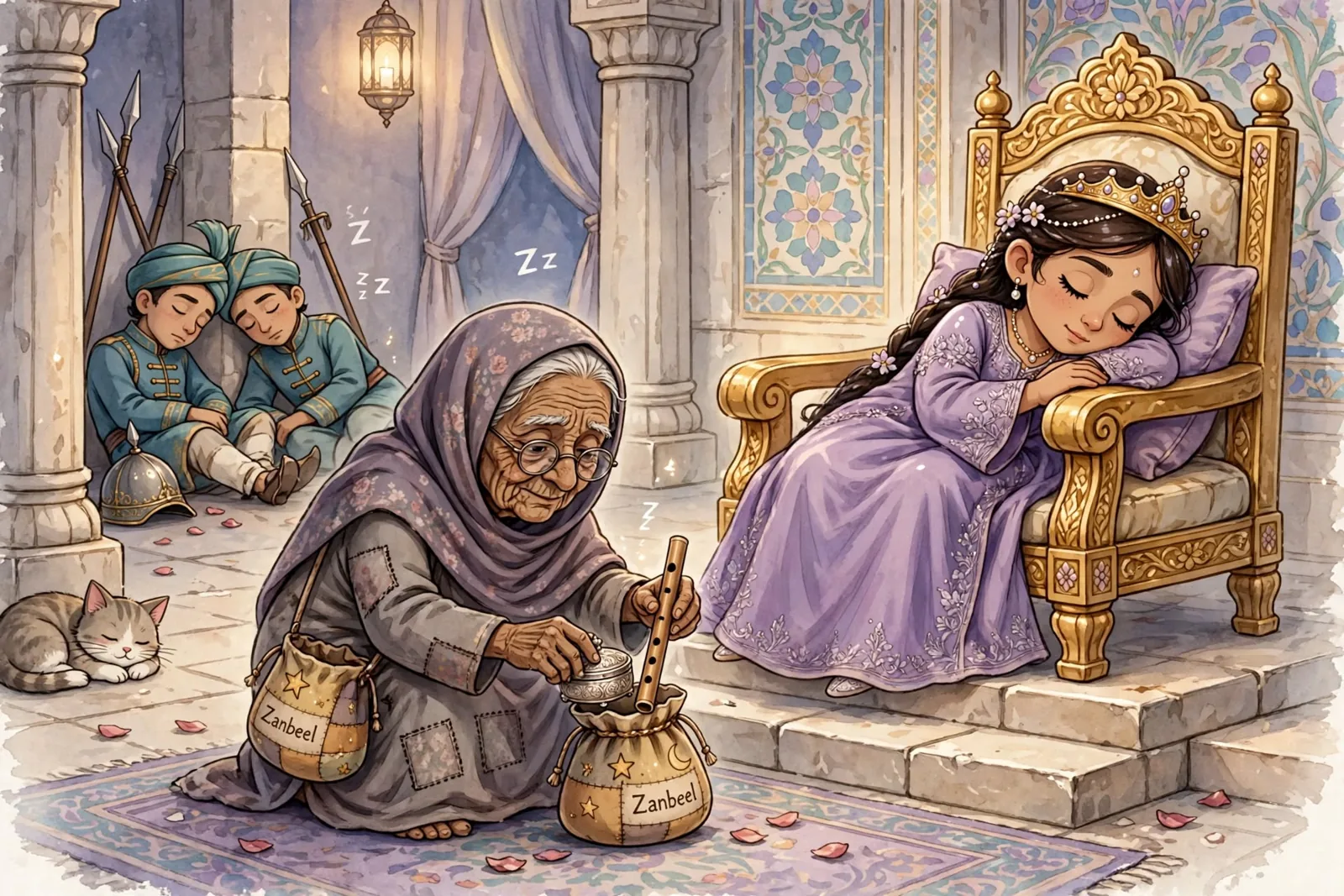
Queen Hairat possessed two extraordinary objects. The first was a wooden flute decorated with golden vines. Whenever she played it, everyone who heard the music fell asleep: guards, sorcerers, prisoners and even the birds perched in the trees. ‘Those who sleep ask no questions,’ the queen would say. ‘And those who ask no questions become my servants.’
The second object was a little silver box of magical black kohl. Whoever had the kohl placed in their eyes could not conceal the truth. The queen could force them to confess what they had stolen, what lies they had told, or what escape they were planning. ‘Your Majesty, I stole some bread,’ one might say. ‘Your Majesty, I told a lie,’ another would admit.
Yet Queen Hairat lacked something that no spell could provide: a story. Nobody had ever told her a bedtime tale. Her mother had not told her stories, nor had her grandmother. From childhood she had learnt to play the flute and use the kohl, but never to listen.
When Amr heard this, he wondered how he could take away the queen’s two magical objects. A sword would be useless against the flute: she would play a note and send him to sleep. Stealth would not help against the kohl: she could make him reveal the truth. Then he had an idea.
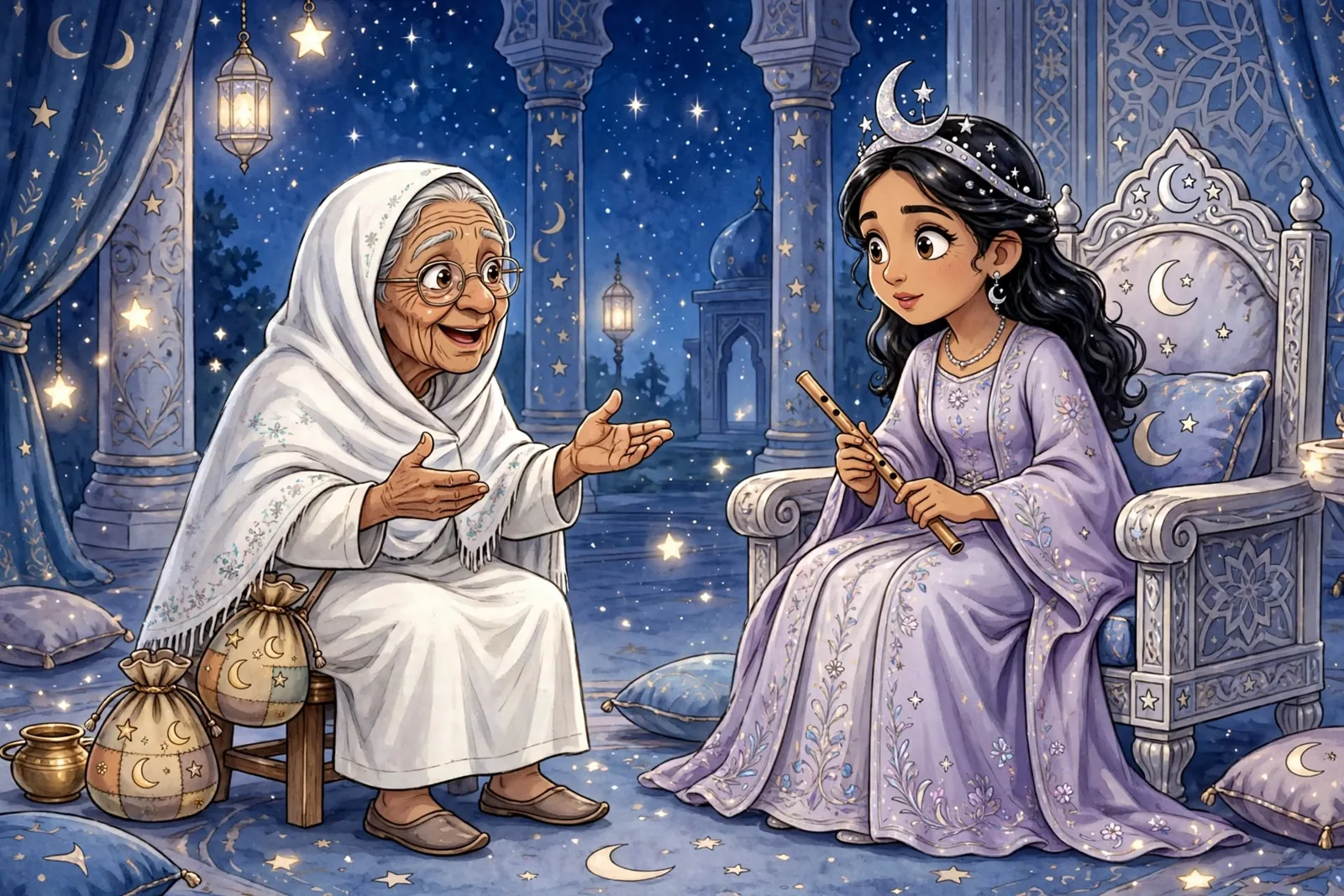
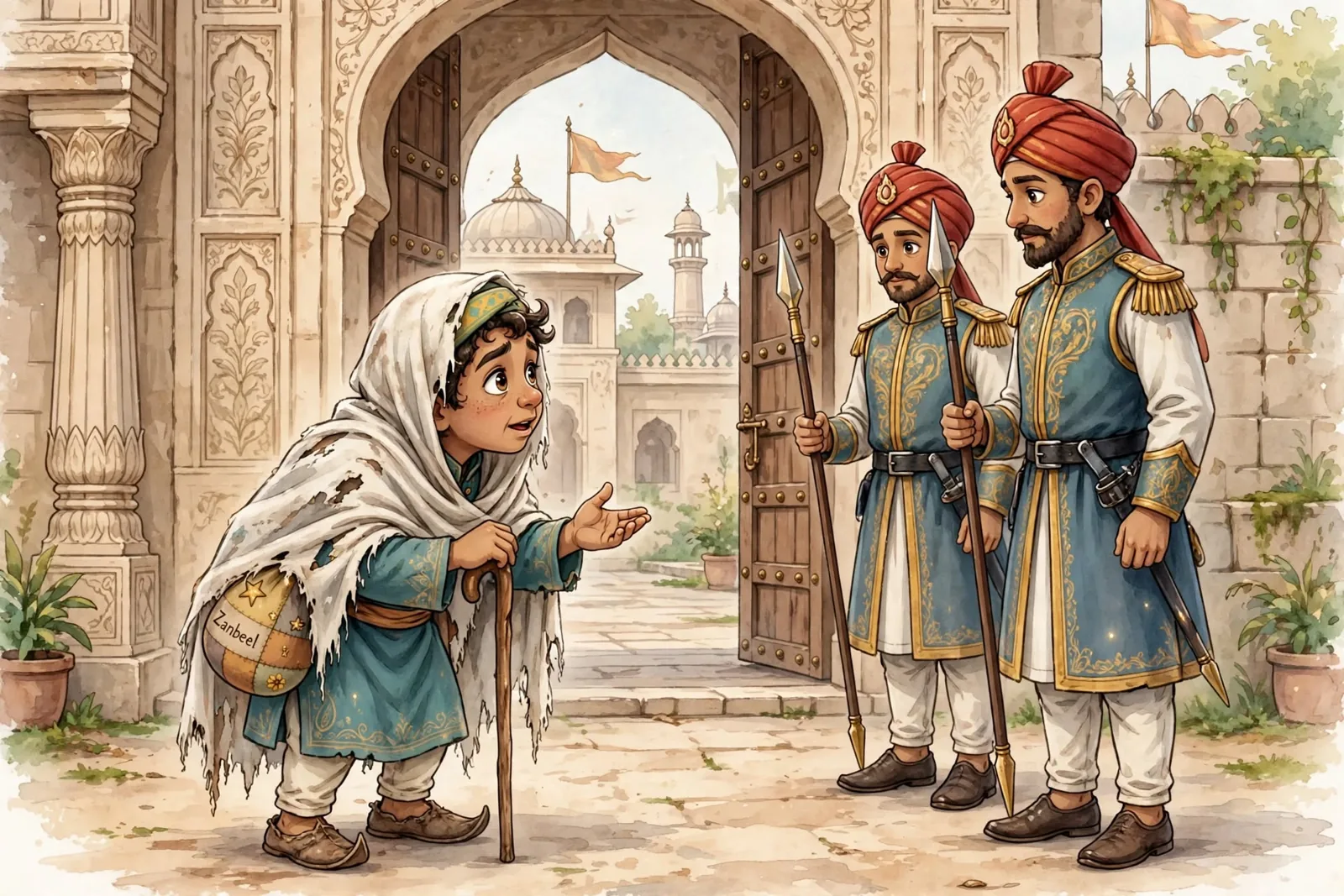
He disguised himself as an elderly grandmother. He bent his back, took a wooden stick with little knots along it, wrapped a white shawl around his head—one corner of the shawl was torn—and put on worn shoes. Even his voice became soft and grandmotherly. At the blue-walled palace, where stars were painted above the throne, the guards stopped him.
‘Who are you?’ they demanded. ‘My dear boys,’ said the old woman, ‘I’m the queen’s grandmother. I’ve come to tell her a story.’ The guards burst out laughing. ‘Our queen has no grandmother!’ ‘Everyone has a grandmother,’ the visitor replied. ‘Without a grandmother there is no story; without a story, something is missing from childhood.’
The guards reported the strange visitor to Queen Hairat. ‘I don’t need a grandmother,’ she declared. ‘I have my flute and my kohl.’ ‘But have you a story, my dear?’ the old woman asked. ‘Your flute sends people to sleep and your kohl makes them tell the truth. A story can wake something inside them.’
The queen had never heard such an answer. Curious at last, she allowed the old woman to sit on a low stool beside her throne. The visitor set her walking stick aside and straightened her shawl. Amr began: ‘Once there was a little girl who possessed everything: a golden palace, a silver throne and a magical flute. But she had no friends.’
‘Why would she need friends?’ Queen Hairat interrupted. ‘Because when she couldn’t sleep, a friend could tell her a story. When she was frightened, a friend could hold her hand. And when she was hungry, a friend could share her bread.’ The queen grew quiet. She had always eaten alone.
Amr continued. ‘Every night the girl played her flute until the whole palace slept. She thought that made her powerful. But when everyone was asleep, she was alone, staring at the ceiling and wishing someone would tell her a tale.’
‘And what happened next?’ the queen murmured, her eyelids growing heavy. ‘One day an old woman arrived with neither flute nor kohl. She had only a story. As the girl listened, she laughed for the first time. She discovered that laughter was sweeter than the sound of her flute.’
The queen’s flute slipped from her fingers and fell to the floor. Amr’s voice was as gentle as honey stirred into warm milk. ‘And that day the girl learnt that a flute which sends people to sleep does not make someone a ruler. A story which awakens people is what makes a true ruler.’
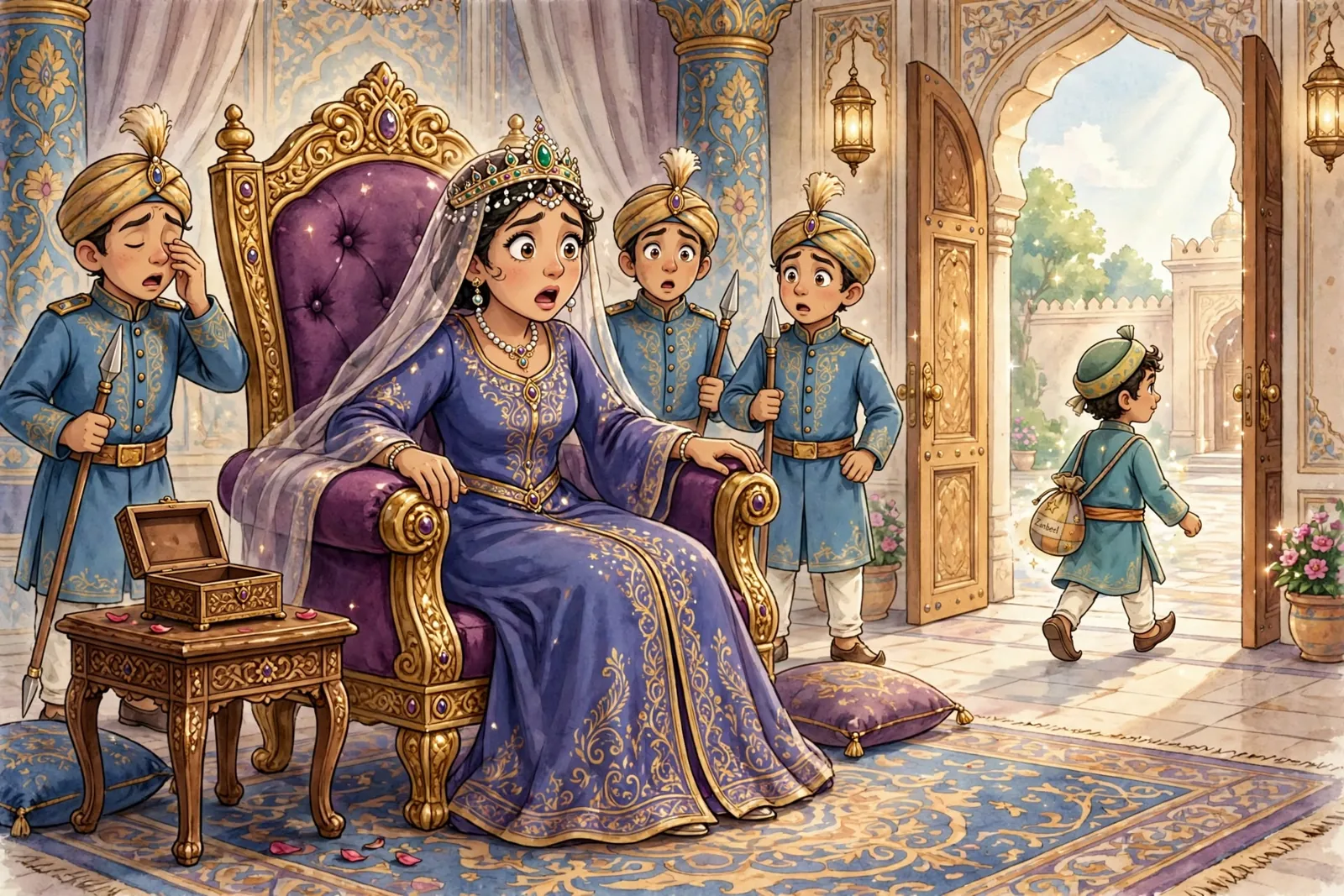
Queen Hairat fell asleep on her throne. Her crown tilted sideways, and her robe spread across the floor. Amr quietly picked up the fallen flute and placed it in his Zanbil. Then he took the little silver box of kohl and put that in his bag as well. He walked out of the court. The guards, too, had fallen asleep: not because the queen was playing her flute, but because the old woman’s story seemed to fill the palace with its own gentle music. A little later Queen Hairat awoke. She saw that both her flute and her kohl had vanished and cried out for her treasures. ‘Who was that? Where is my flute? Where is my kohl?’ she cried. A guard answered, ‘An old woman was telling a story.’ ‘It wasn’t a grandmother!’ she realised. ‘It was Amr. He sent me to sleep with a story!’ But Amr was already far away.
The queen’s kohl has a lesson for us, too. In the story it revealed the truth. Truth can free us, while a lie can become a prison of our own making. Queen Hairat had no stories, but you do. Your nani, dadi or mum may tell you one. A child who listens to stories keeps their imagination awake; a child who tells stories can move other people’s hearts. A flute may send people to sleep, but a story can awaken them. Children, the queen’s flute has a modern cousin: the endless ping of videos, games and notifications. You promise yourself five minutes, and suddenly an hour has gone. Yet a story shared by your grandmother, grandfather or someone you love can make you more awake to the world. Next time you want another video, perhaps ask for a story instead.
Think like Amr: Will you put aside your screen and ask someone in your family to tell you a story?
Story 6: The Jar That Held an Army
The Mirror of Fear
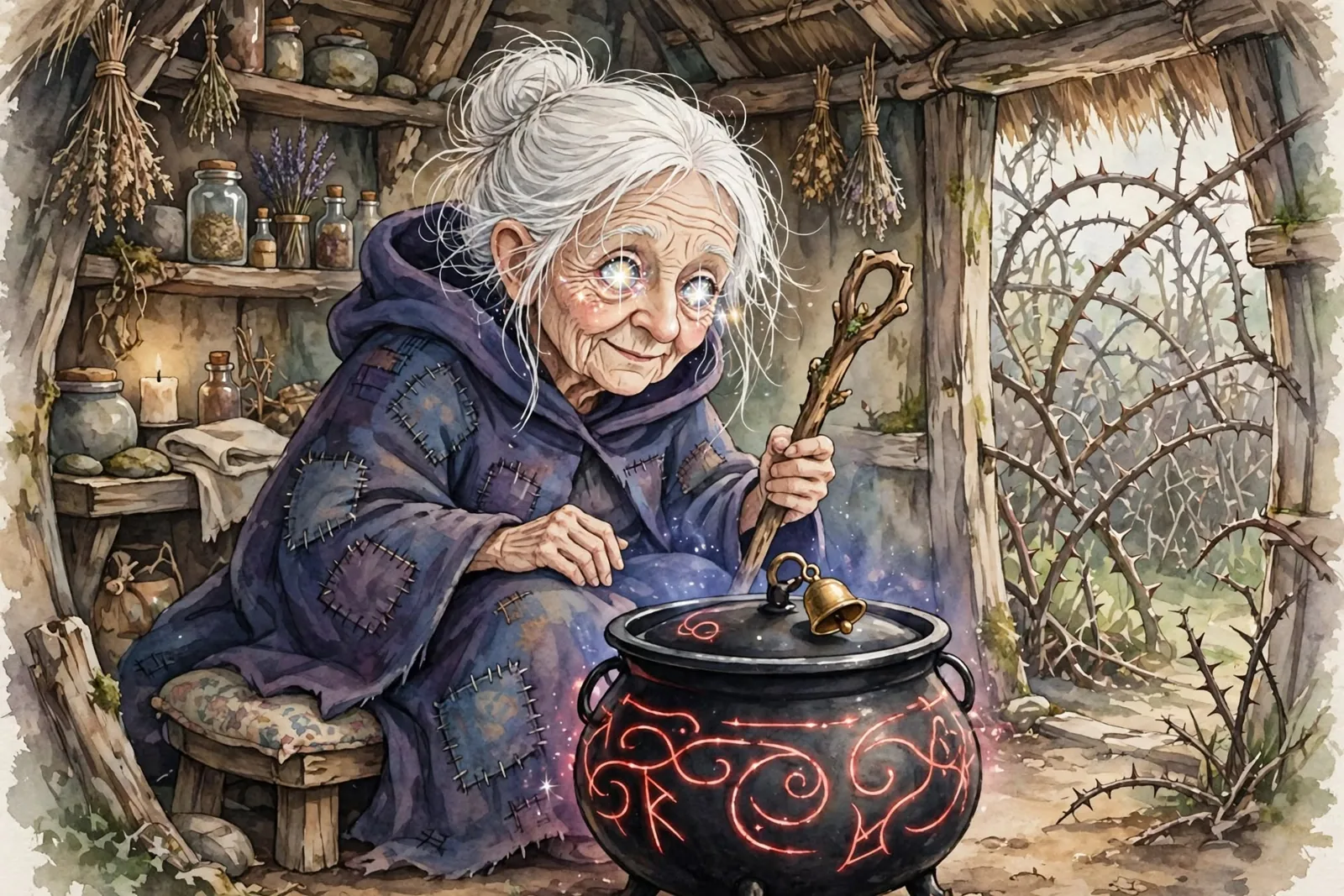
Outside a village stood a ramshackle hut belonging to an elderly sorceress. Her hair was white, her eyes glittered, and she always carried a staff. In the little garden outside her door there were no flowers, only thorns. Inside the hut she kept a far more frightening possession: a black jar marked with red lines and topped by a lid with a tiny bell.
Whenever the jar moved, its little bell rang: ting, ting, ting. When the sorceress opened it and recited a spell, an entire army could disappear into the jar. A hundred soldiers, a thousand soldiers—there was room for them all. From within came cries of ‘Let us out!’ But the sorceress simply closed the lid.
When Amir Hamza’s soldiers heard about the jar, fear spread through the camp. ‘What if she shuts us inside?’ they asked. ‘What use will our swords be against magic?’ Amir Hamza promised to fight, but Amr had another plan. ‘I’ll bring you the jar,’ he said, ‘and she’ll give it to me willingly.’
‘Willingly?’ exclaimed Amir Hamza. ‘Why would she do that?’ Amr smiled. ‘Because I’ll show her the fear she carries inside herself.’
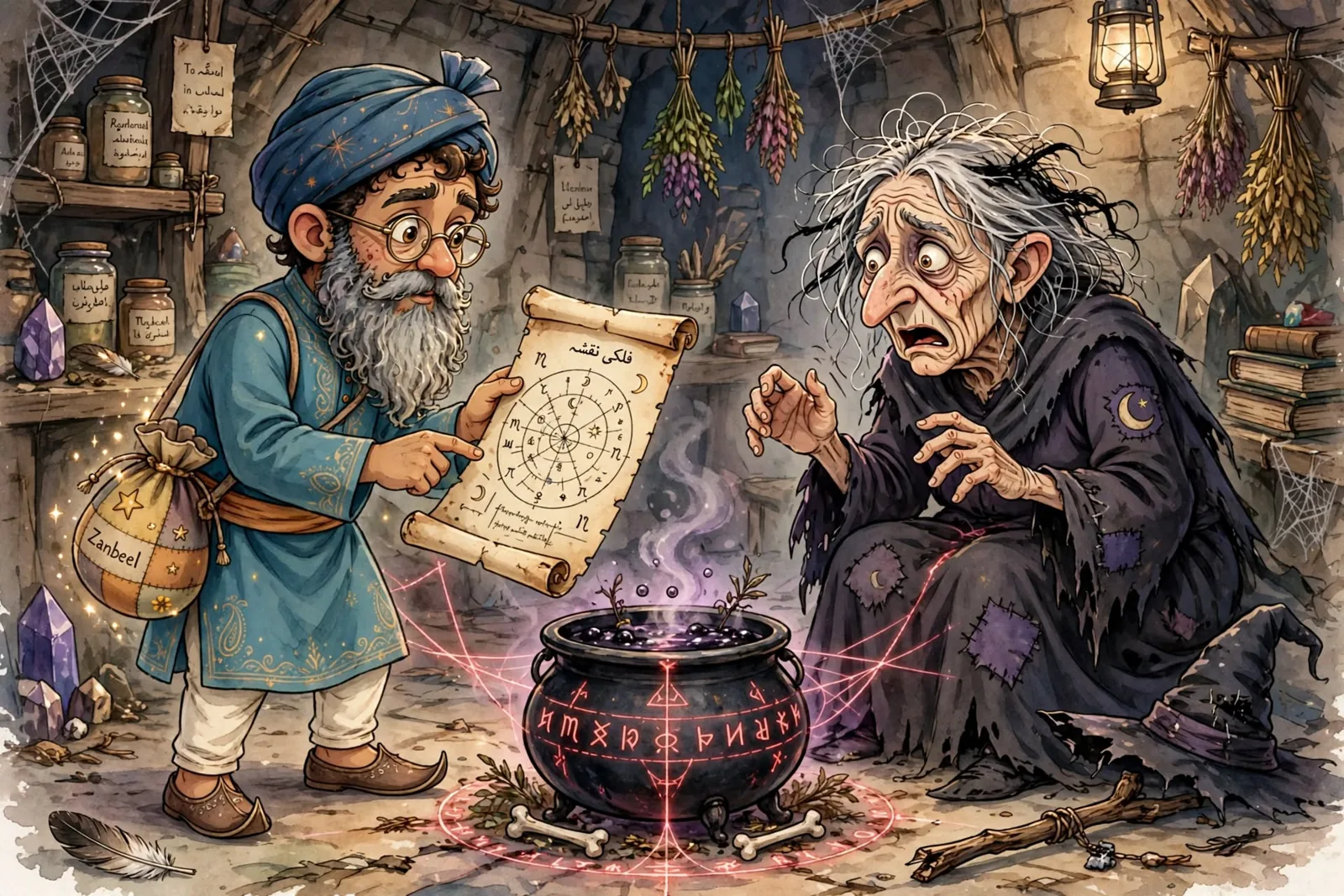
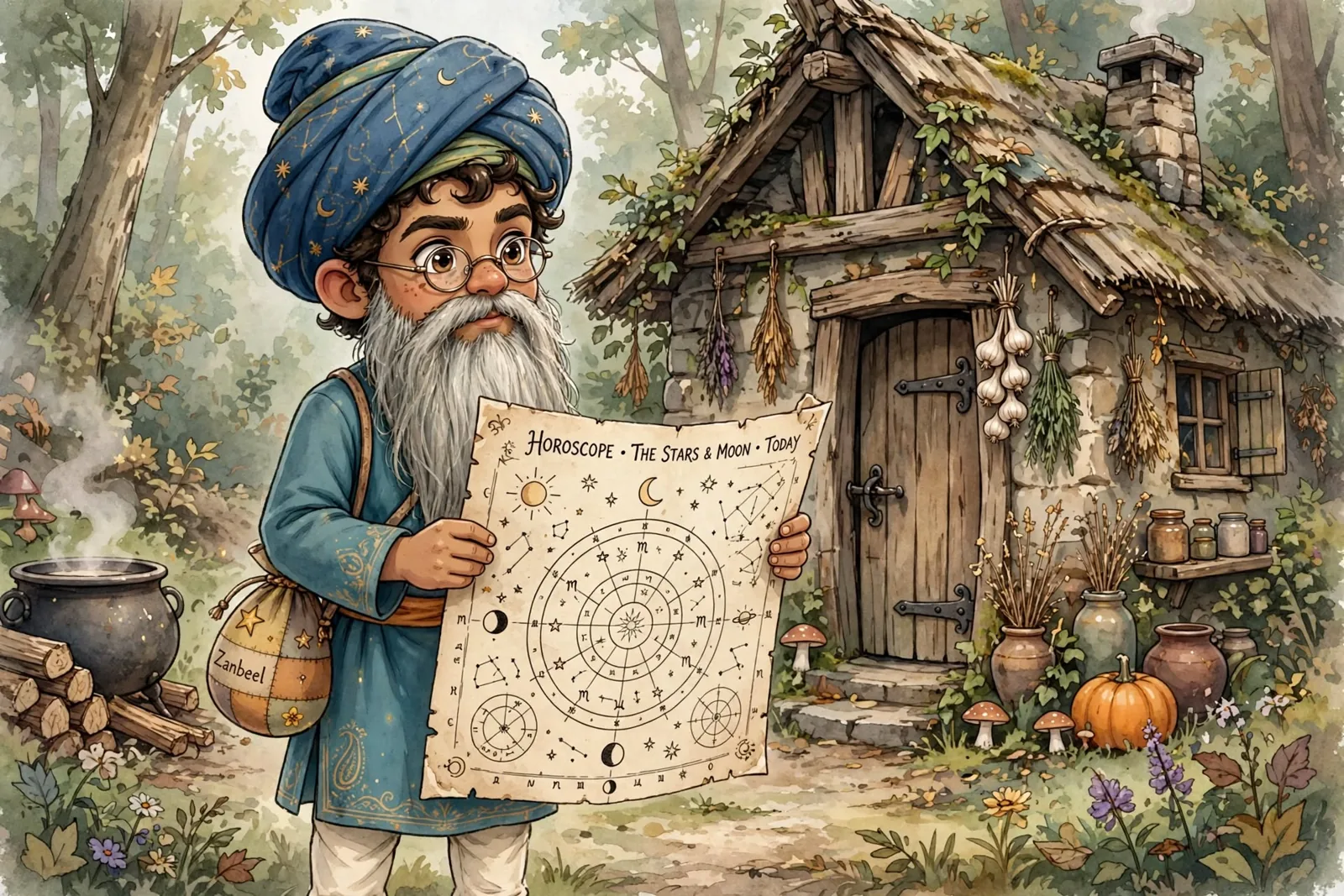
The following morning Amr disguised himself as an astrologer. He wore a beard so long it almost reached his knees, a blue turban. In his hand was a chart covered with stars, the sun and the moon. He approached the hut and announced that he had travelled from a distant land to read people’s fortunes.
‘I’ve seen your horoscope,’ he told the sorceress. ‘My horoscope?’ she cried. ‘When?’ ‘Last night I studied the stars,’ Amr said. ‘They told me of a sorceress living in this very hut, with a magical jar. And the horoscope says something terrible: this jar will cause your death.’
The sorceress turned pale. ‘How?’ she whispered. ‘The stars say that on the day this jar breaks, you too will be broken,’ Amr said gravely. ‘You have placed your life and all your power inside it.’ Her hands began to shake and her staff fell to the ground.
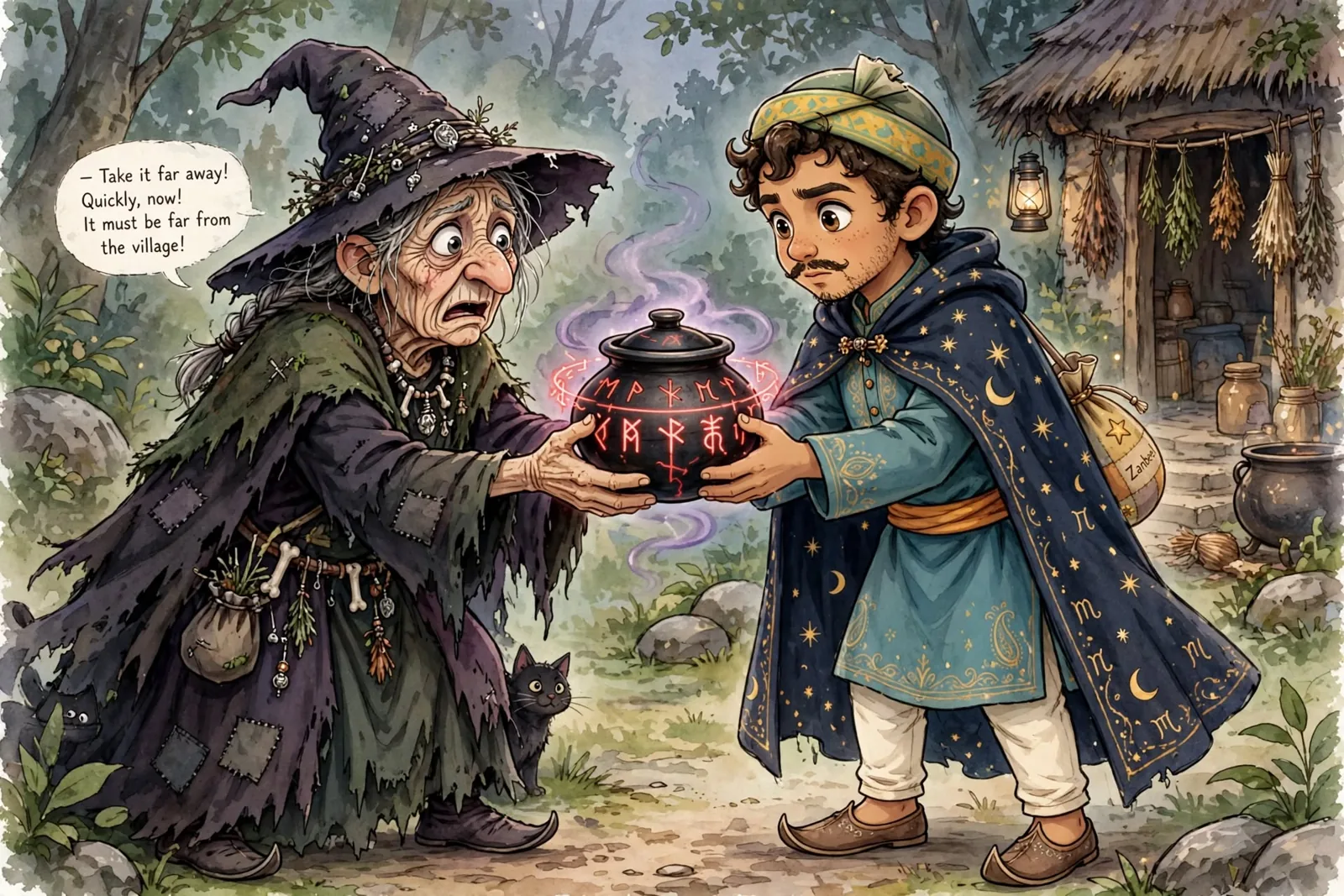
‘Should I throw it away?’ she asked. ‘Certainly not!’ said Amr. ‘If you throw it away, it might break. Give it instead to somebody who lives far away. If it breaks in a distant land, it will not harm you. I have come from a far-off country. Give it to me, and I shall take it home and keep it safe.’
Desperate to be rid of the thing she had once treasured, the sorceress thrust the jar into his hands. ‘Take it away! Quickly!’ Amr carried it to a tree beside the road and lifted the lid.
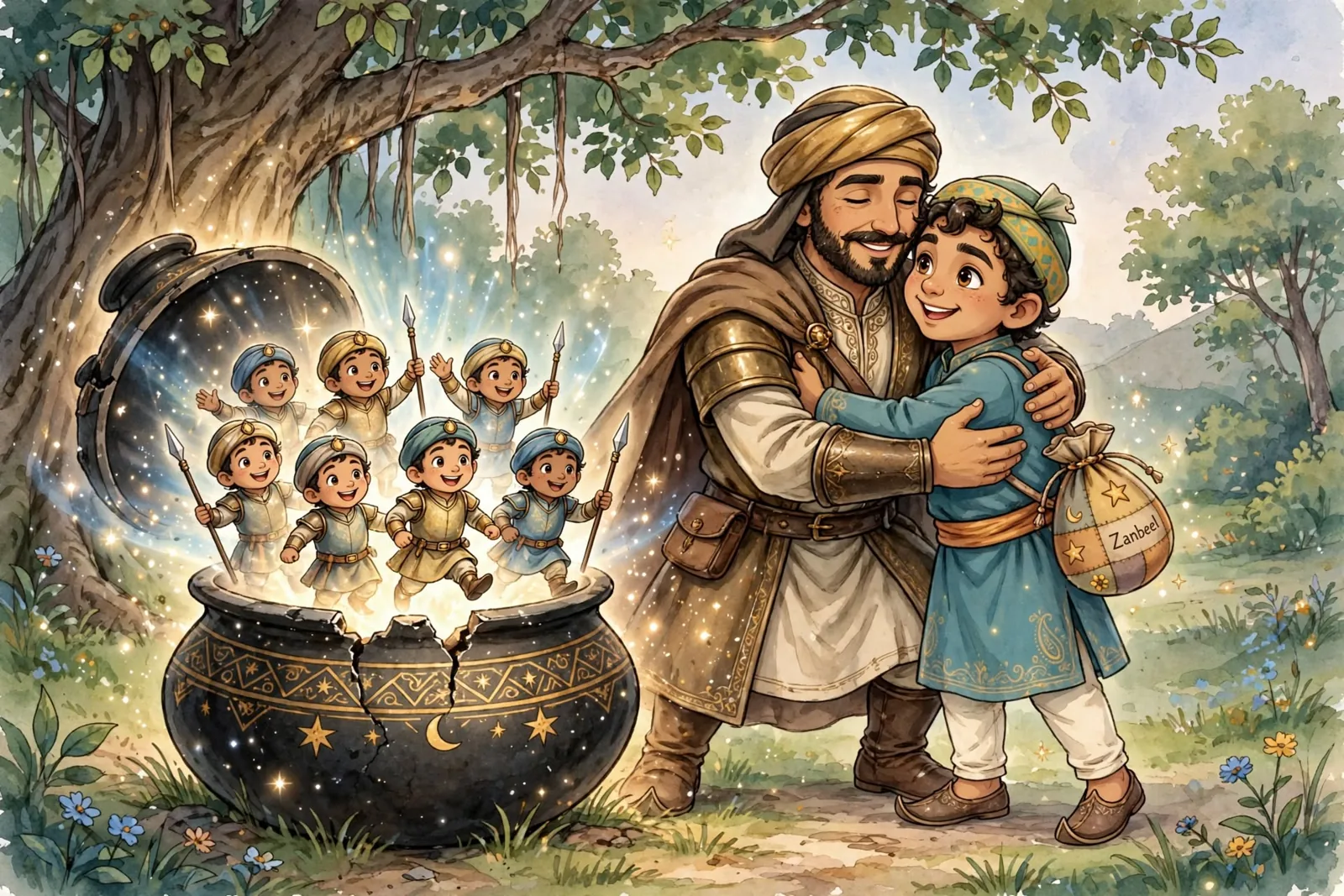
A light burst from the opening. One soldier climbed out, then ten, then a hundred, then a thousand. At last the whole imprisoned army stood free beneath the sky. ‘Long live Amr!’ they shouted. Amir Hamza embraced him.
‘How did you persuade her?’ Amir Hamza asked. ‘I didn’t threaten her,’ Amr replied. ‘I showed her her own fear. She thought the jar made her powerful, but she was terrified of losing it. In a way, she was imprisoned by it too.’
Children, anger can become a jar inside your heart. You may shut a friend inside it by declaring, ‘I won’t speak to them!’ You may shut your mum inside by saying, ‘I won’t eat my dinner!’ Or you may shut your teacher inside by insisting, ‘I’m not going to school!’ But have you thought about whom that jar really imprisons? When you cling to anger, you may stop laughing, playing or talking to friends. You can end up alone. The sorceress imprisoned an army in her jar, yet she was a prisoner of it too, forever frightened that it might break. Amr did not smash her jar; he showed her the fear that had imprisoned her. Next time anger takes hold, ask yourself, ‘Whom have I locked away?’ You may discover that you have locked away your own happiness. Open the lid safely: talk about what hurt you, listen, and make room for friendship again. The child who opens the lid of their jar of anger has become Amr.
Think like Amr: When you feel angry, who or what might you be keeping inside your own imaginary jar?
Story 7: The Mirror That Reflected the Heart
The True Mirror of Koh-e-Qaf
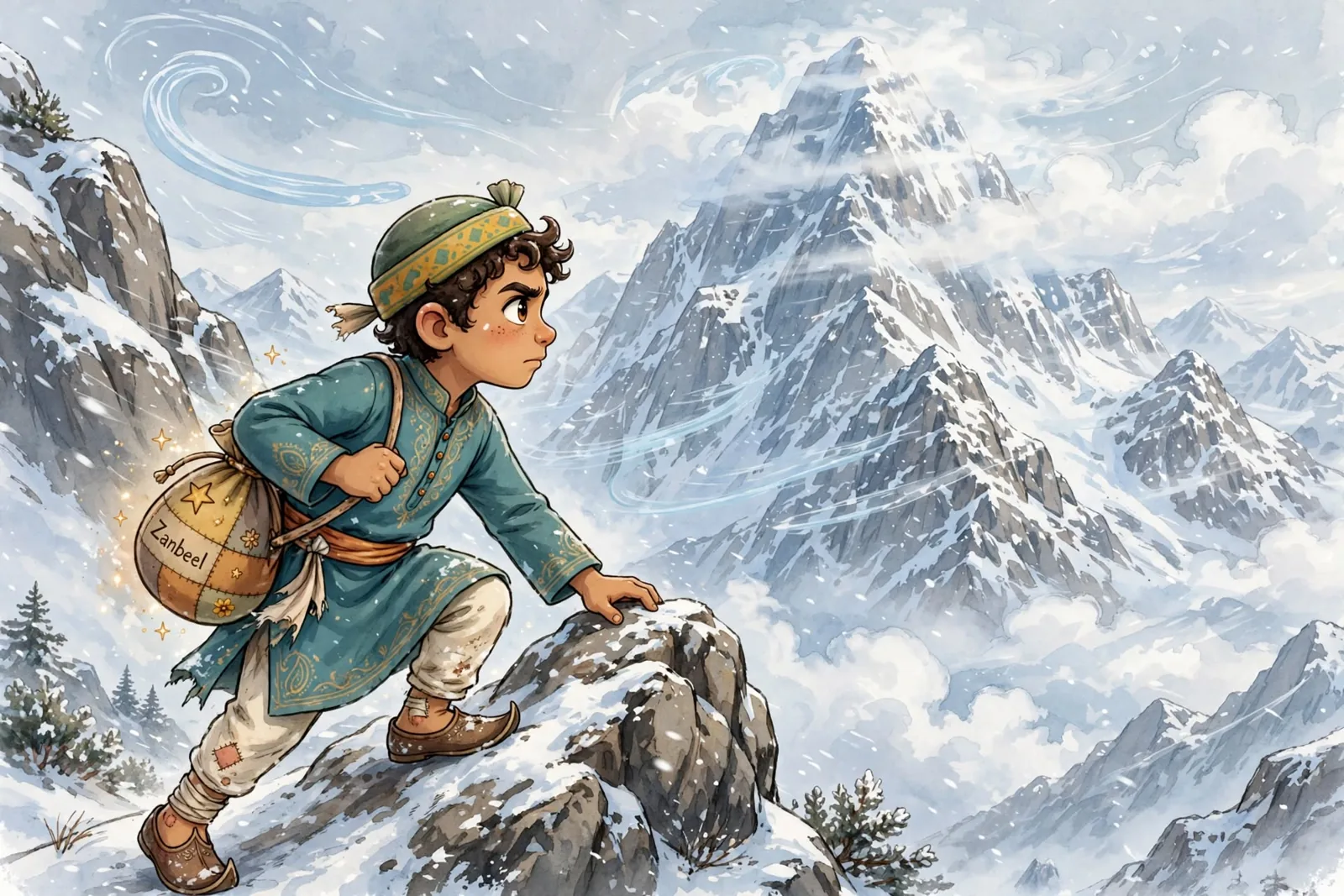
Far away stood the mountain of Koh-e-Qaf. Its peak rose above the clouds, and snow covered its slopes all year round. The wind was so cold that travellers could scarcely feel their fingers. Sorcerers lived there, guarding an extraordinary mirror.
An ordinary mirror shows your face, your hair and your clothes. The mirror of Koh-e-Qaf showed what lay beneath appearances. If someone arrived disguised as a king but was cowardly inside, the mirror revealed their fear. If a person dressed as a poor faqir possessed great courage, the mirror showed that courage. It could expose a disguise, but it could also reveal hidden strength.
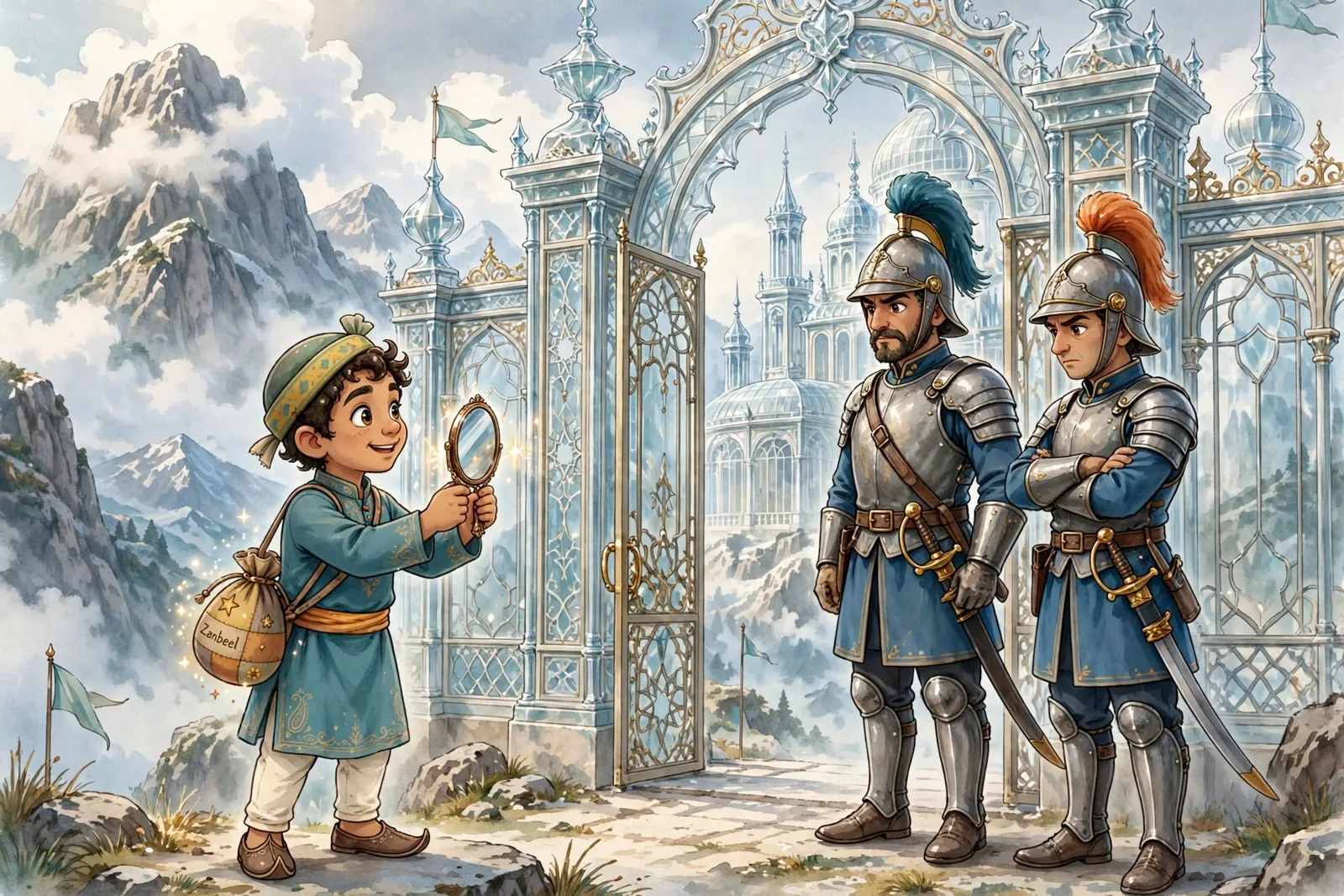
The sorcerers placed armed guards around it and forbade anyone to approach. Amr heard about the mirror and realised how useful it could be in a world filled with deceptive disguises. He crossed mountains, rivers and forests to reach Koh-e-Qaf. His feet grew sore and blistered, but he carried on.
At the summit stood a palace of glass, gleaming with light. Two guards blocked its entrance. ‘Nobody may see the mirror,’ they said. ‘I’ve not come to see a mirror,’ replied Amr. ‘I’ve come to sell one.’
He produced a small looking-glass from his Zanbil. ‘I’m a mirror merchant. Show me yours, and I’ll tell you whether it is genuine.’ The guards laughed. ‘Ours is the truest mirror in the world!’ ‘Then surely you won’t mind proving it,’ Amr replied.
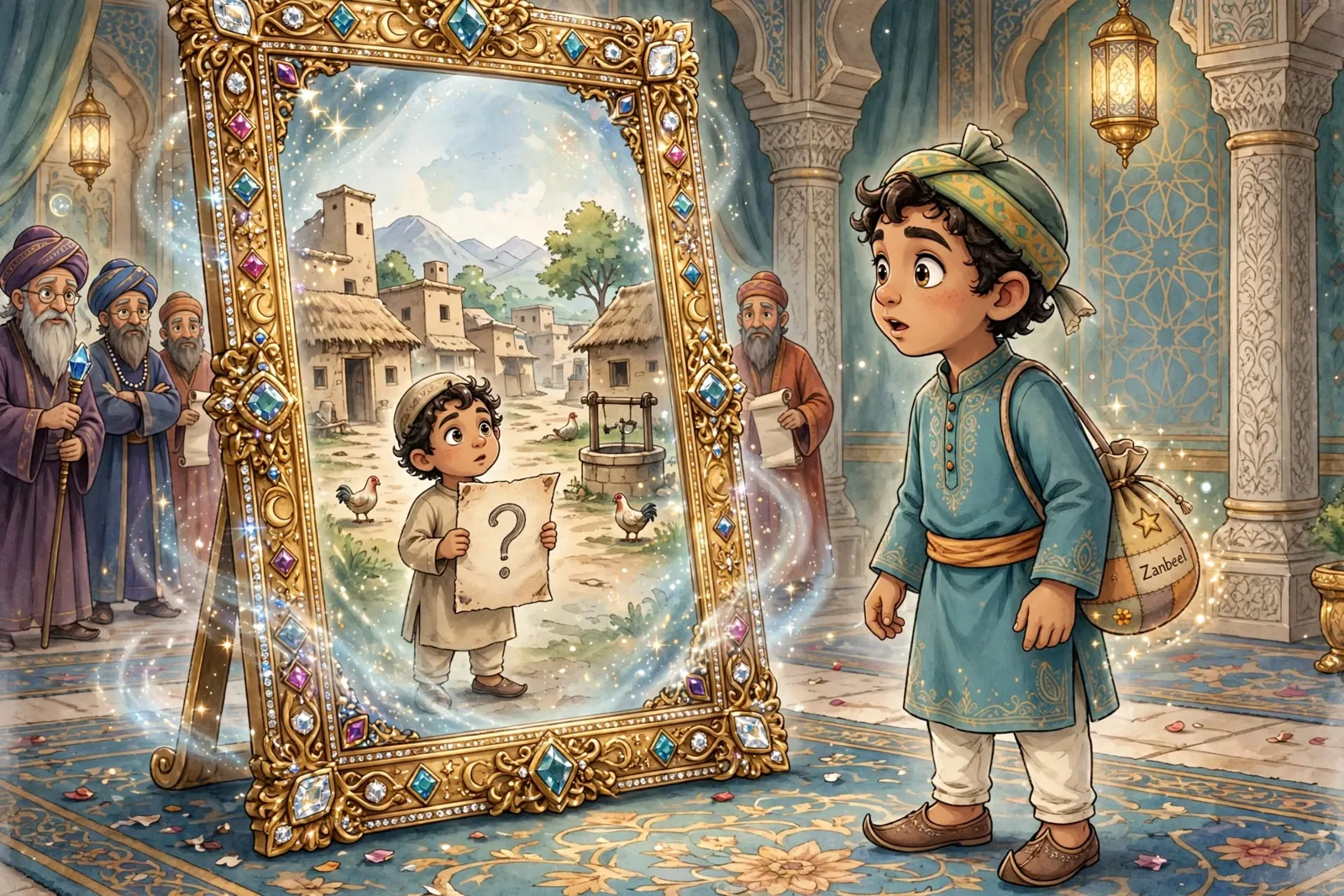
The sorcerers were summoned. ‘A good mirror shows the truth,’ Amr told them. ‘A bad one tells lies.’ Pleased by their own confidence, they led him into a great hall. There, in a golden frame studded with diamonds, stood a mirror large enough to reflect a whole person.
‘Look!’ the sorcerers commanded. Amr stepped before it. He saw neither his face nor his clothes. Instead, he saw a little boy sitting in a village, asking his father why birds flew, why water ran and why the moon appeared at night.
Tears came to Amr’s eyes. ‘The mirror speaks the truth,’ he whispered. ‘I am still that boy.’ ‘What did you see?’ asked a sorcerer. ‘Not my beard, not my clothes, not a crown,’ Amr answered. ‘I saw my question. I asked questions as a child, and I still ask them now. That is who I really am.’
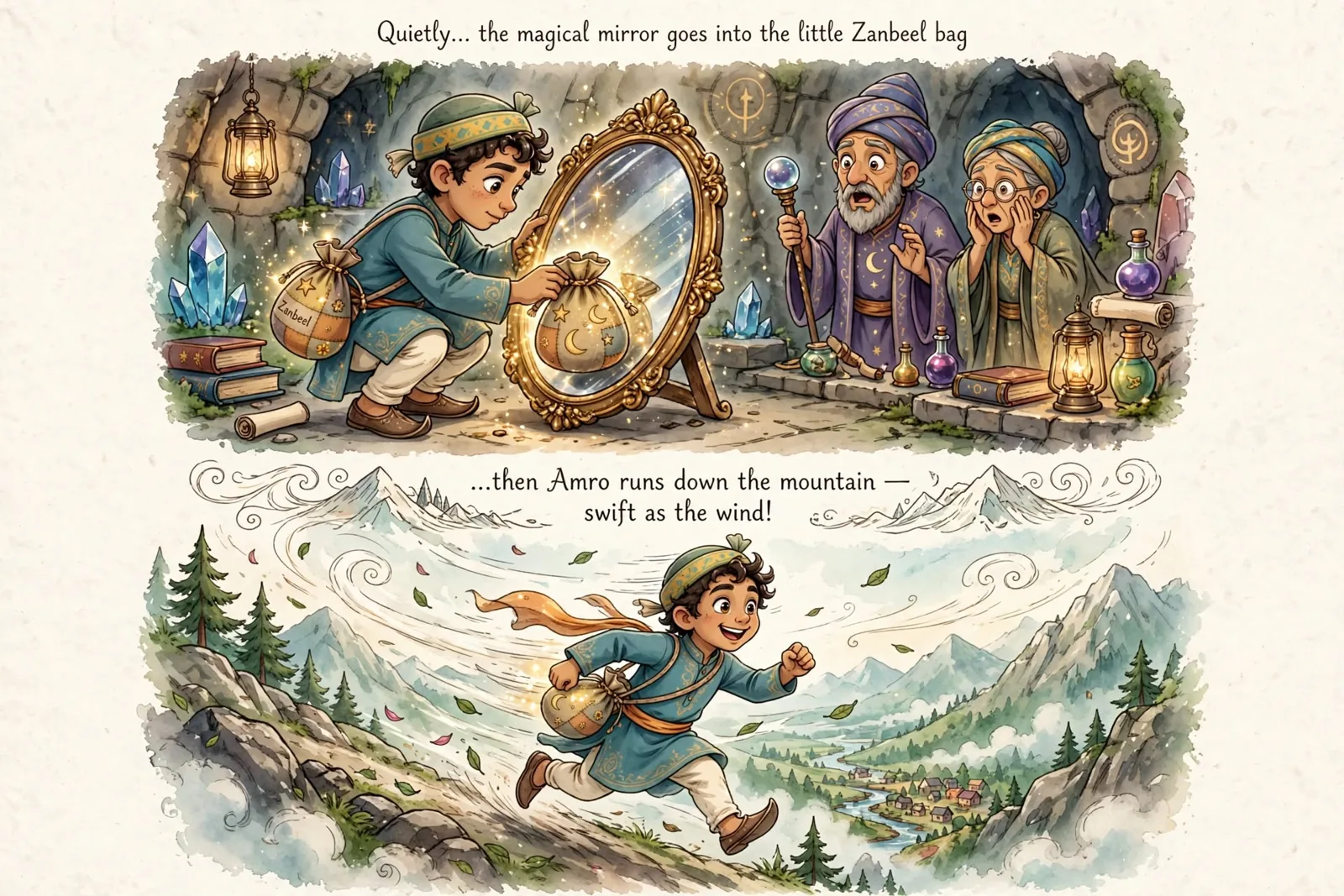
The sorcerers fell silent. They had looked into the mirror for years and seen only their magical powers. None had thought to search for the curious child they once were. While they stood astonished, Amr lifted the mirror and slipped it into his Zanbil.
‘Your mirror is genuine,’ he told them. ‘But you’ve kept it in the wrong place. A true mirror belongs in the heart, not locked away in a palace.’ Then he ran. The sorcerers pursued him, but Amr was as swift as the wind, and soon disappeared into the forest.
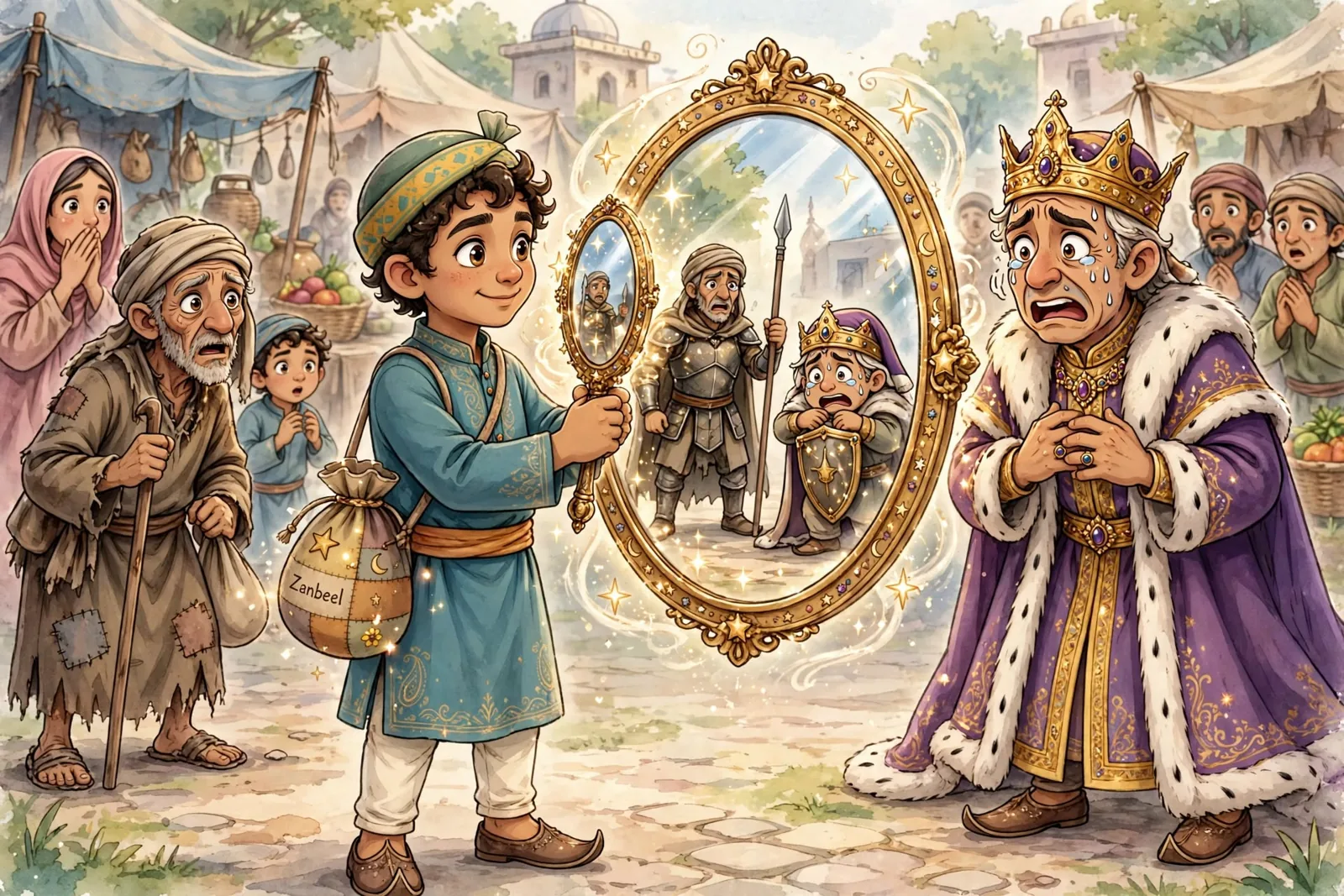
Later, the mirror helped him uncover many deceptive disguises. Once a sorcerer came wearing a golden crown and declared, ‘I am the king!’ Amr held up the mirror. Instead of a mighty ruler, it showed a frightened man who was afraid of the dark. On another occasion a faqir arrived in ragged clothes, saying only, ‘I am poor.’ In the mirror Amr saw a courageous man who had helped many people. The two visitors looked very different, but their clothes had told him little about their hearts. Yet the mirror’s most important lesson was one he had learnt about himself. Your worth is not measured by a crown, fashionable clothes or the face you show in a photograph. Think instead about the kindness you offer, the courage you find and the questions you dare to ask.
You have a mirror at home, too. Each morning you look into it and check your hair and clothes. But Amr asks you to look a little deeper. When you tell a lie, imagine your inner mirror growing cloudy. You can still see your face in the glass, yet the dust is not on the glass at all: it is on your heart.
When you speak the truth, imagine that mirror becoming clear again. You can see the child you once were, and the questions that still live inside you. Ask yourself, ‘Did I tell the truth today? Did I help someone? Was I brave enough to ask a question?’ If your answer is yes, your mirror is clear. If not, you can begin to clean it by what you do next. A child who keeps that inner mirror clear is Amr.
Think like Amr: If a mirror could show your heart instead of your face, what would you hope to see?
Story 8: Grandmother’s Halwa and the Fortress Won Without a Battle
The Sweetest Way Through a Gate
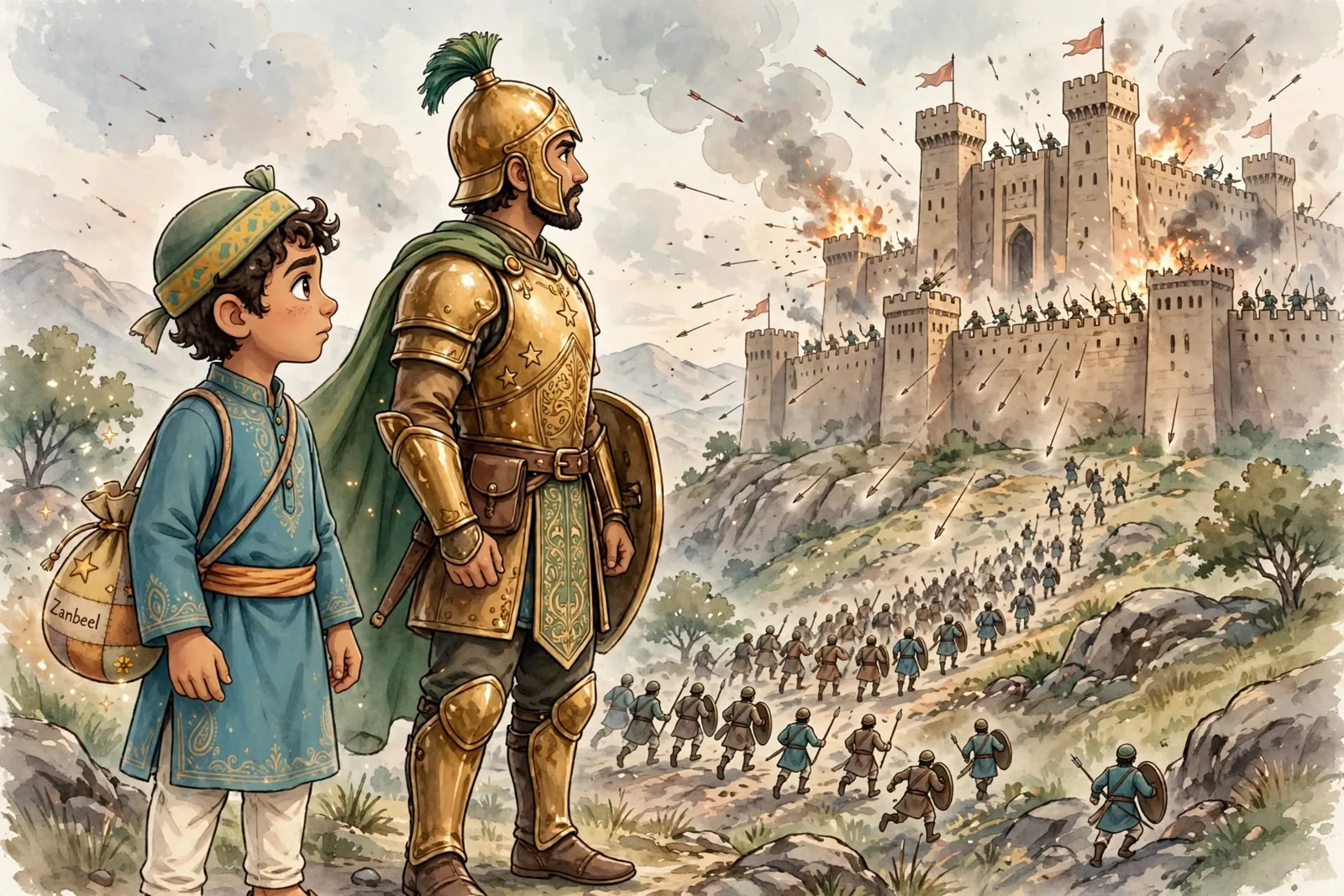
Amir Hamza’s army had reached another fortress of Tilism-e-Hoshruba. Its walls were towering, its gates were locked, and armed guards watched from every battlement. Amir Hamza ordered an assault. Arrows rained down from the walls, and the soldiers were forced to retreat. He ordered a second assault, but this time fire poured from the fortress, driving the army back again. ‘This fortress will not open to a sword,’ Amir Hamza said.
Amr studied it carefully. He noticed something that the warriors had missed. The guards looked exhausted. Dark shadows lay beneath their eyes, their clothes were worn, and although they carried swords, their stomachs were empty. ‘They’re human beings too,’ Amr thought. ‘They get hungry and tired. Perhaps nobody has spoken kindly to them for a very long time.’
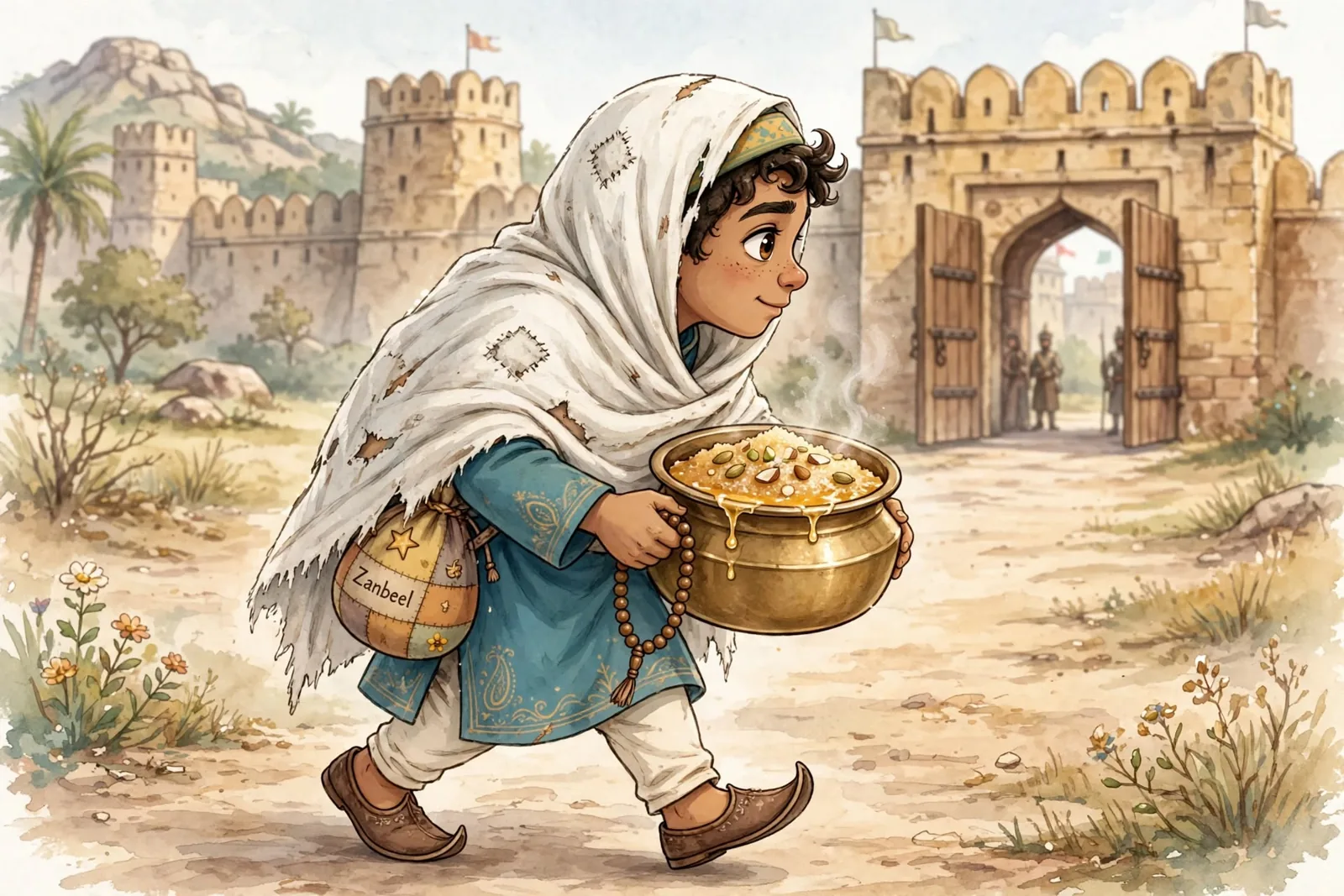
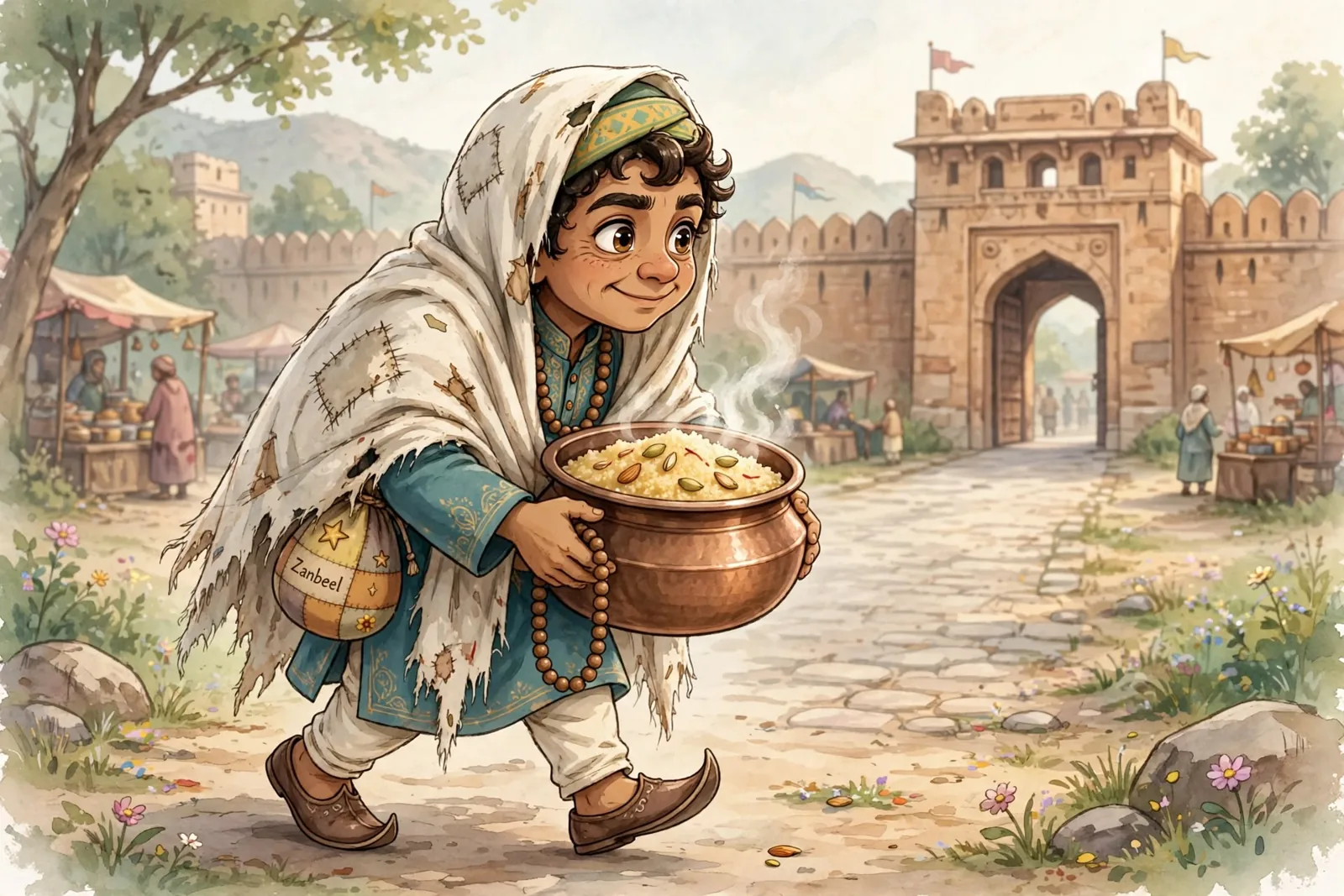
He disguised himself as an elderly nani, or grandmother. He wrapped himself in a clean white shawl, bent his back, took a wooden string of prayer beads and softened his voice. From his Zanbil he produced a great cooking pot filled with fragrant semolina halwa, made with ghee, sugar and cardamom.
There was a secret in the halwa: it contained a sleeping medicine. In the tale it was not poison, but it would make those who ate it fall asleep. Carrying the pot, Amr knocked at the fortress gate.
‘Who’s there?’ called a guard. ‘It’s only an old grandmother, my son,’ came the gentle reply. ‘I’ve walked such a long way that my feet are sore. I’ve brought some halwa. Have you boys ever tasted your grandmother’s cooking?’
The guard looked at the visitor’s bent back and kindly eyes. ‘We love halwa,’ he admitted, ‘but nobody ever brings us any. All we hear is “Stand guard! Stand guard!”’ ‘Then come and eat before it grows cold,’ said the grandmother.
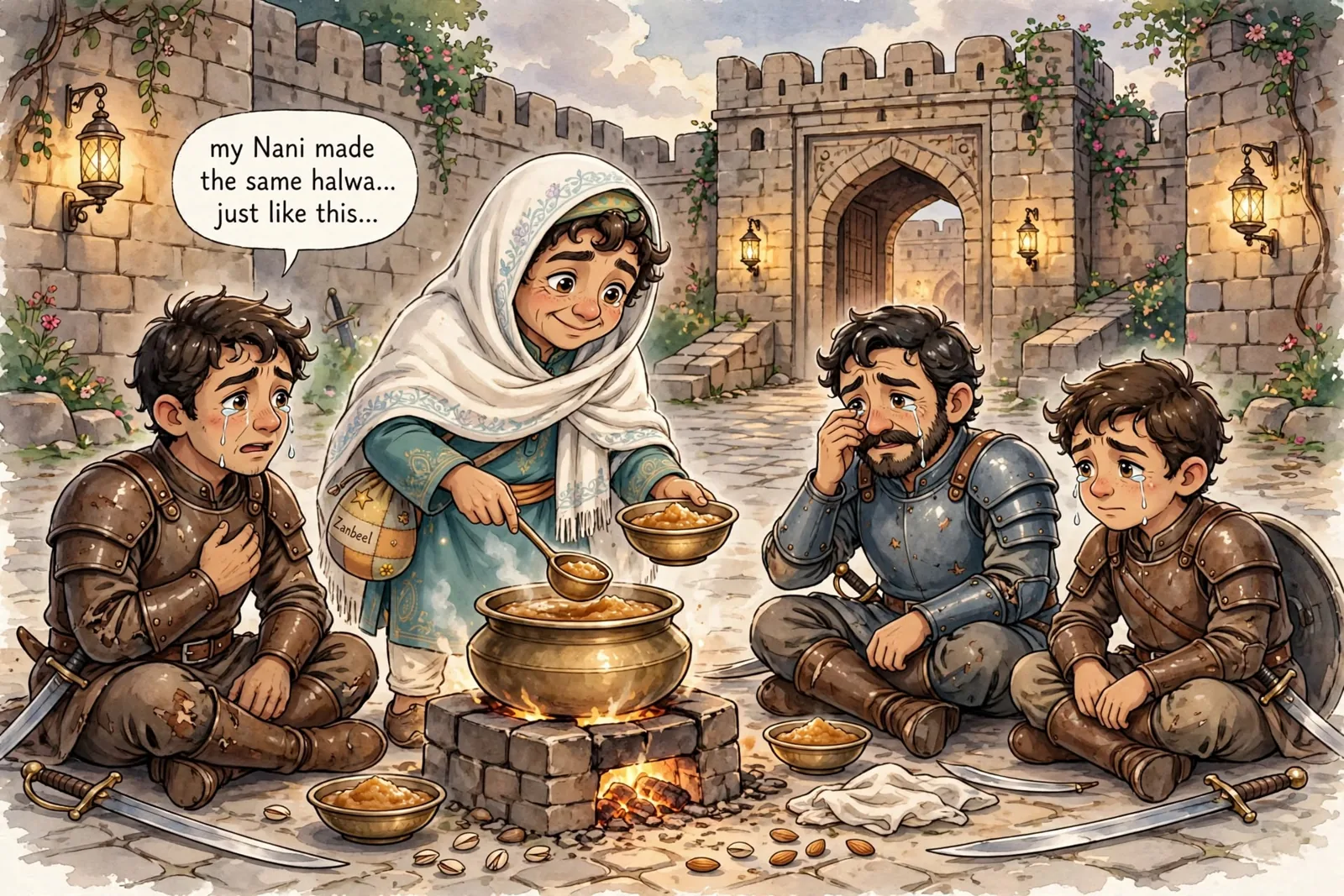
The guards gathered around the pot. One tasted the halwa and sighed. ‘My nani used to make it just like this.’ Another remembered a grandmother who had died. A third said the visitor looked exactly like his own grandmother. Amr listened, touched their heads gently and asked whether they were hungry, thirsty or missing their families.
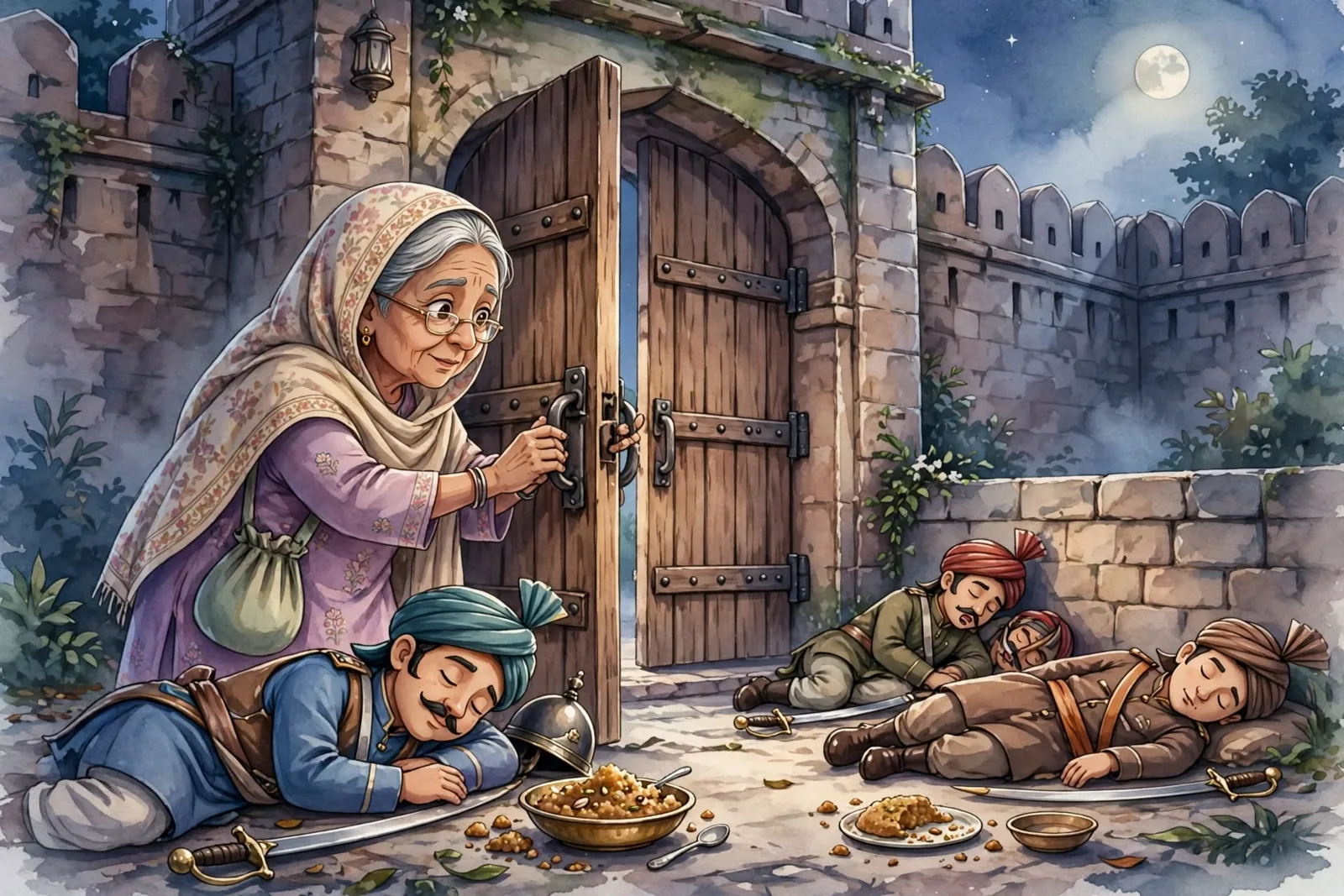
Tears shone in some of the guards’ eyes. They were accustomed to orders, not affection. Soon the sleeping medicine took effect. One by one they nodded off beside the gate, their swords slipping to the ground.
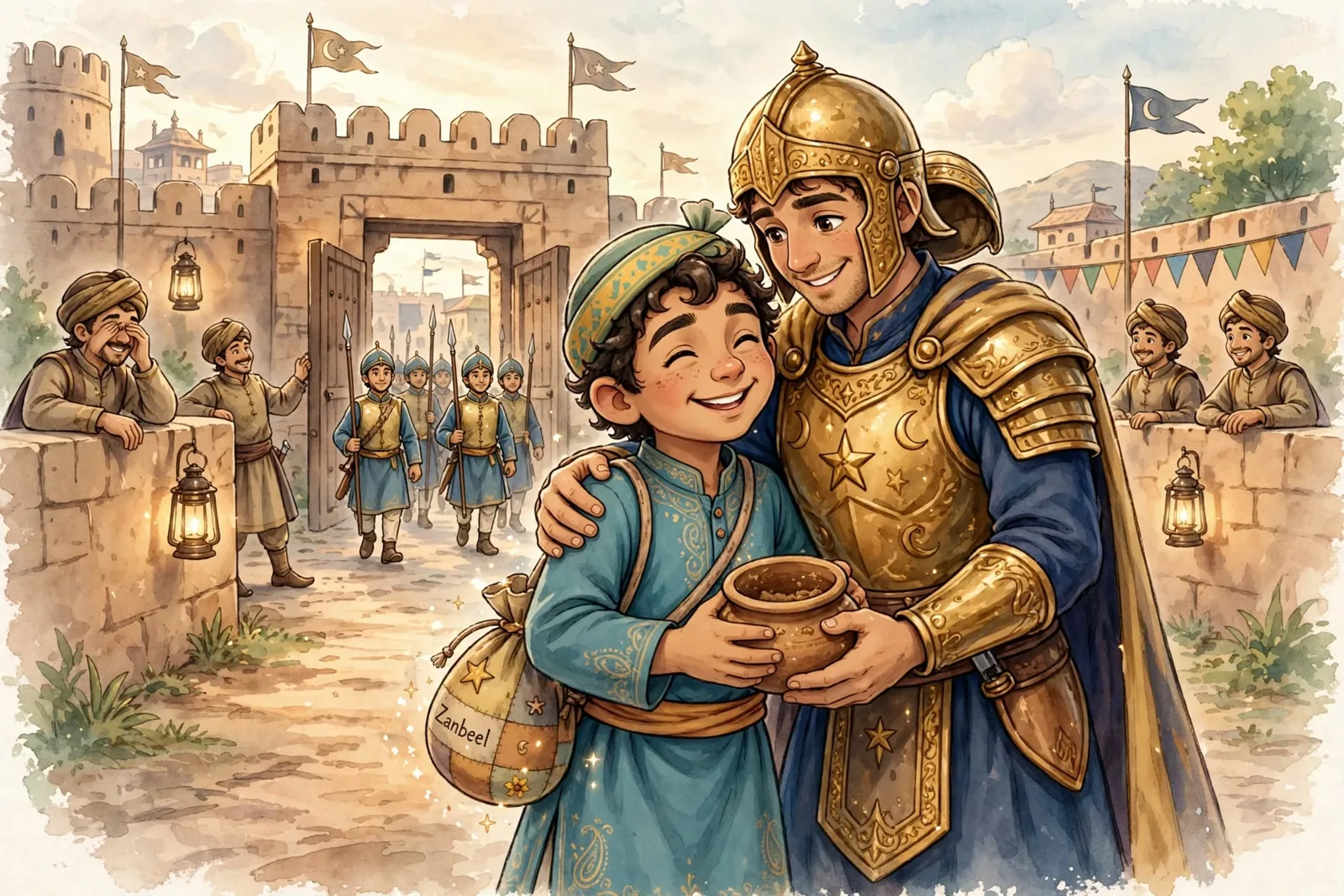
Amr opened the gates, and Amir Hamza’s army entered without a battle. Not a sword was drawn, not an arrow fired. Amir Hamza found Amr beside an empty cooking pot, his disguise removed.
‘You conquered a fortress with halwa?’ the commander exclaimed. ‘Not every gate opens to a sword,’ said Amr. ‘Some open when you remember that the person guarding them has a heart.’ ‘But you tricked them,’ Amir Hamza objected. Amr admitted that the halwa contained sleeping medicine, but insisted that the kindness he had shown was real.
Children, this is a story of magical trickery, not a recipe to copy: never put medicine into another person’s food. The lesson worth carrying into your own life is simpler and better. When someone is angry, lonely or difficult, try listening before you shout. Offer kindness without deception. Sometimes a gentle question can open a door that an argument only keeps shut.
Perhaps a classmate is upset with you. Perhaps your sister is cross, or an elderly neighbour seems unfriendly. You need no magic pot. You can begin by asking, ‘Are you all right? Would you like to talk?’ The sweetest halwa in this story is not the dessert. It is the care behind a kind gesture.
Think like Amr: What kind thing could you say to someone who seems angry or lonely?
Story 9: The Balloon That Blinded Everyone
When You Cannot See, Listen Carefully
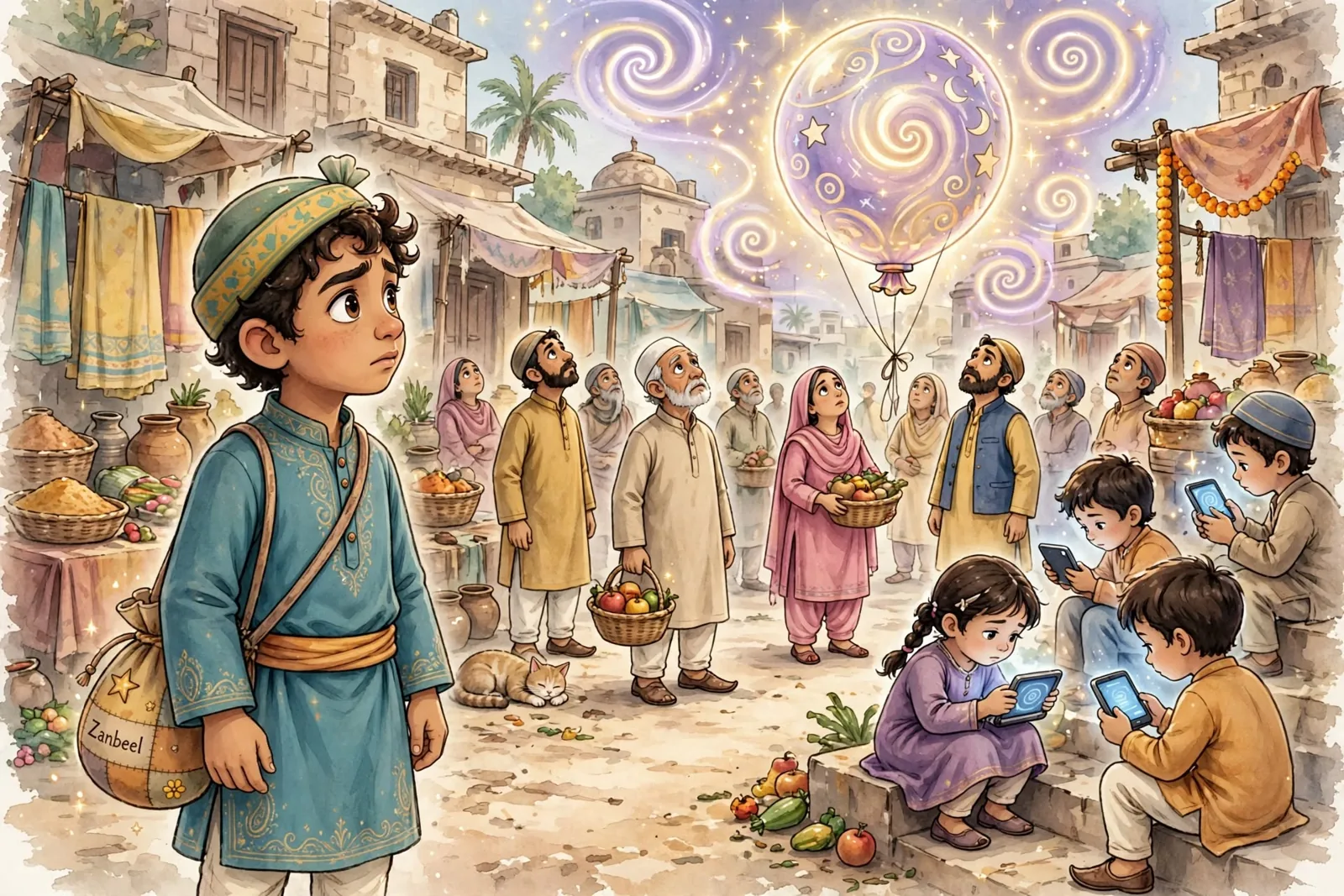
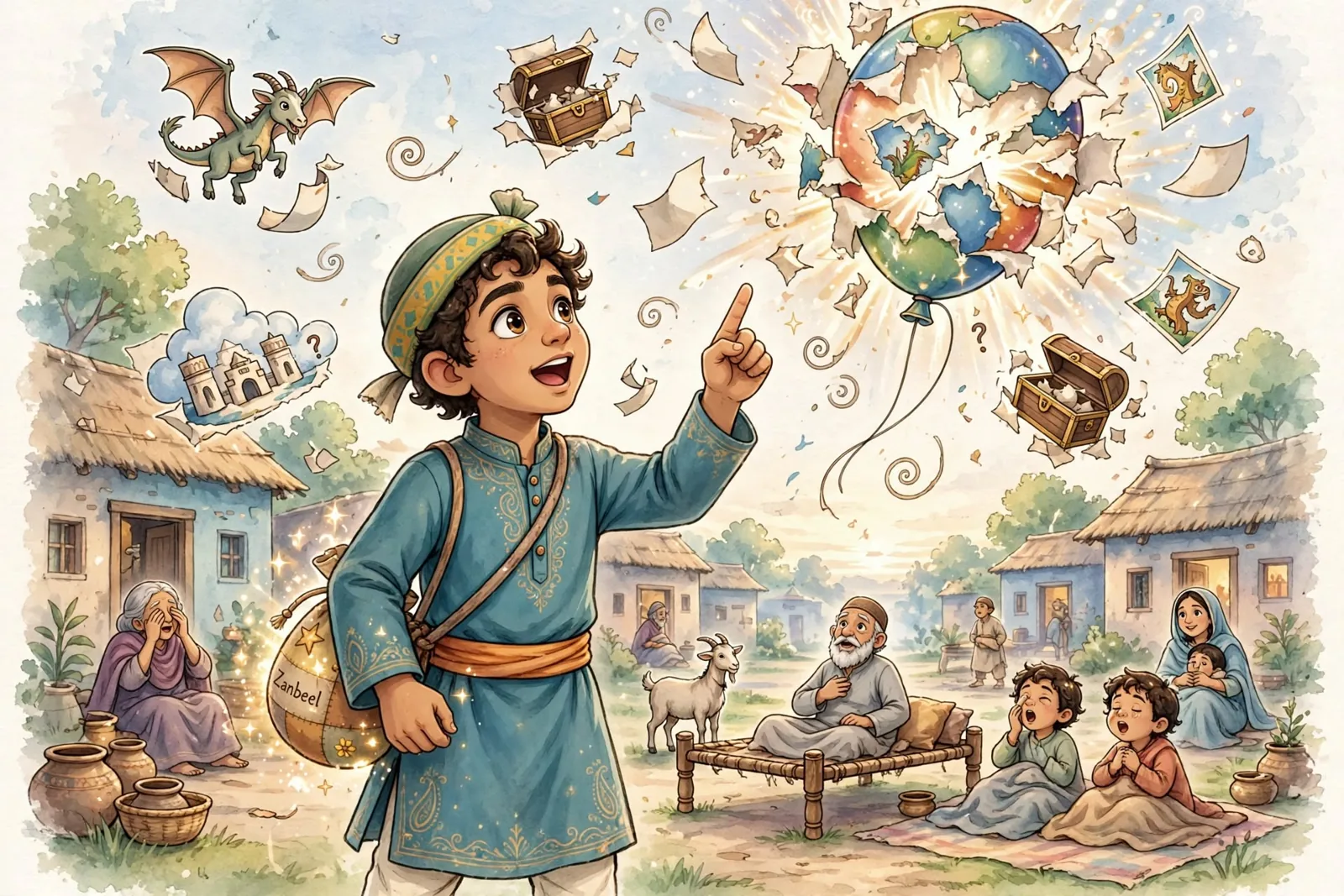
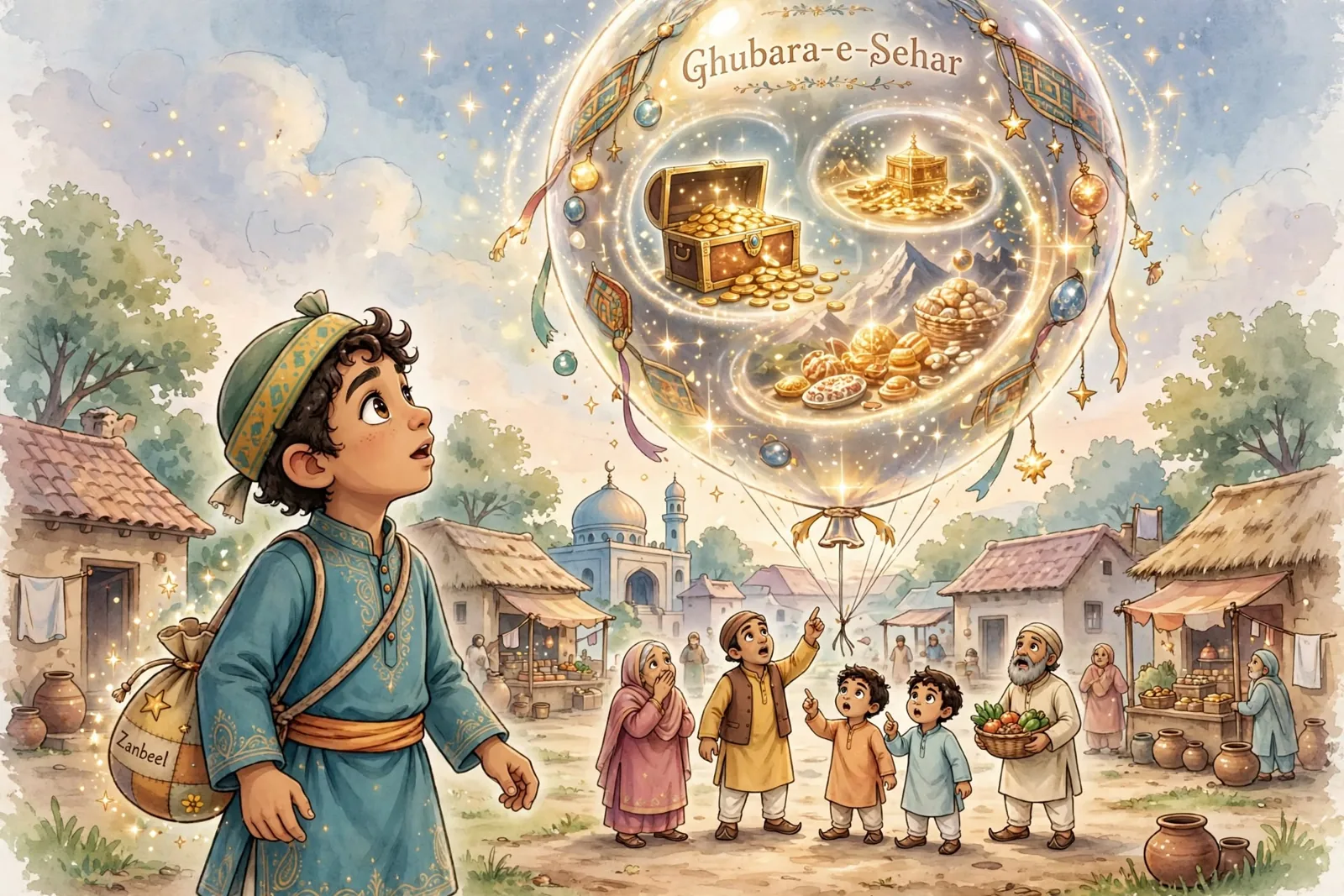
The sorcerers had invented a new enchantment called Ghubara-e-Sehr: a magical balloon of fog, cloud and smoke. When it appeared, the sky turned black, mist filled the air and people could no longer see. Soldiers collided with one another and sometimes mistook friends for enemies.
One morning Amir Hamza’s army was standing in a field when a black cloud covered the sun. The fog grew so thick that a soldier could not see his own hands. Another could not find his horse. Horses neighed, swords clattered to the ground and frightened voices shouted from every direction.
‘It’s Ghubara-e-Sehr!’ Amir Hamza cried. ‘The sorcerers have blinded us.’ Amr surveyed the confusion. ‘I’ll go into the centre of the fog alone,’ he said. ‘Don’t!’ the others pleaded. ‘You’ll lose your way.’ ‘If nobody goes,’ Amr replied, ‘we shall all remain in darkness. Someone must look for the light.’
He stepped into the mist. It was so dark that he could scarcely see his hand in front of his face. Even his own breathing seemed to turn to fog. At first he strained his eyes, trying to make out a path. But he saw nothing.
Then Amr closed his eyes. Without the distraction of trying to see, he began to listen. In the language of this enchanted world, he heard the wind complaining that it was trapped, the earth asking for sunlight and his own heart whispering, ‘Don’t be afraid. There is a way.’
Then came another sound: tick, tick, tick. It was faint, like a tiny clock hidden beneath the fog. Amr turned his head. The sound came from the right. Keeping his eyes closed, he followed it, step by careful step.
The ticking grew louder. Amr stretched out his hands and touched a small black jar marked with red lines. Mist was pouring from its mouth. This was the source of Ghubara-e-Sehr.
He lifted the jar and smashed it against the ground. CRASH! The jar shattered and the enchanted balloon burst. The fog vanished, the clouds parted and sunlight flooded the field. The soldiers looked at one another in amazement. ‘Why, you’re my friend!’ one cried. ‘I thought you were the enemy!’
Amir Hamza embraced Amr. ‘How did you find your way when none of us could see?’ ‘I couldn’t see either,’ Amr replied. ‘So I stopped relying on my eyes alone. I listened carefully, stayed calm and followed the sound until I found the source.’
Children, the world around us has a fog of its own. A dramatic video may show something frightening. An advertisement may promise an impossible miracle. A photograph may be altered with a filter. If you react immediately, you may be fooled by what you see.
Imagine a child who feels poor because a friend posts a picture of an expensive bicycle, without knowing it was borrowed. Imagine someone who feels unattractive beside a filtered photograph. Appearances can hide important truths.
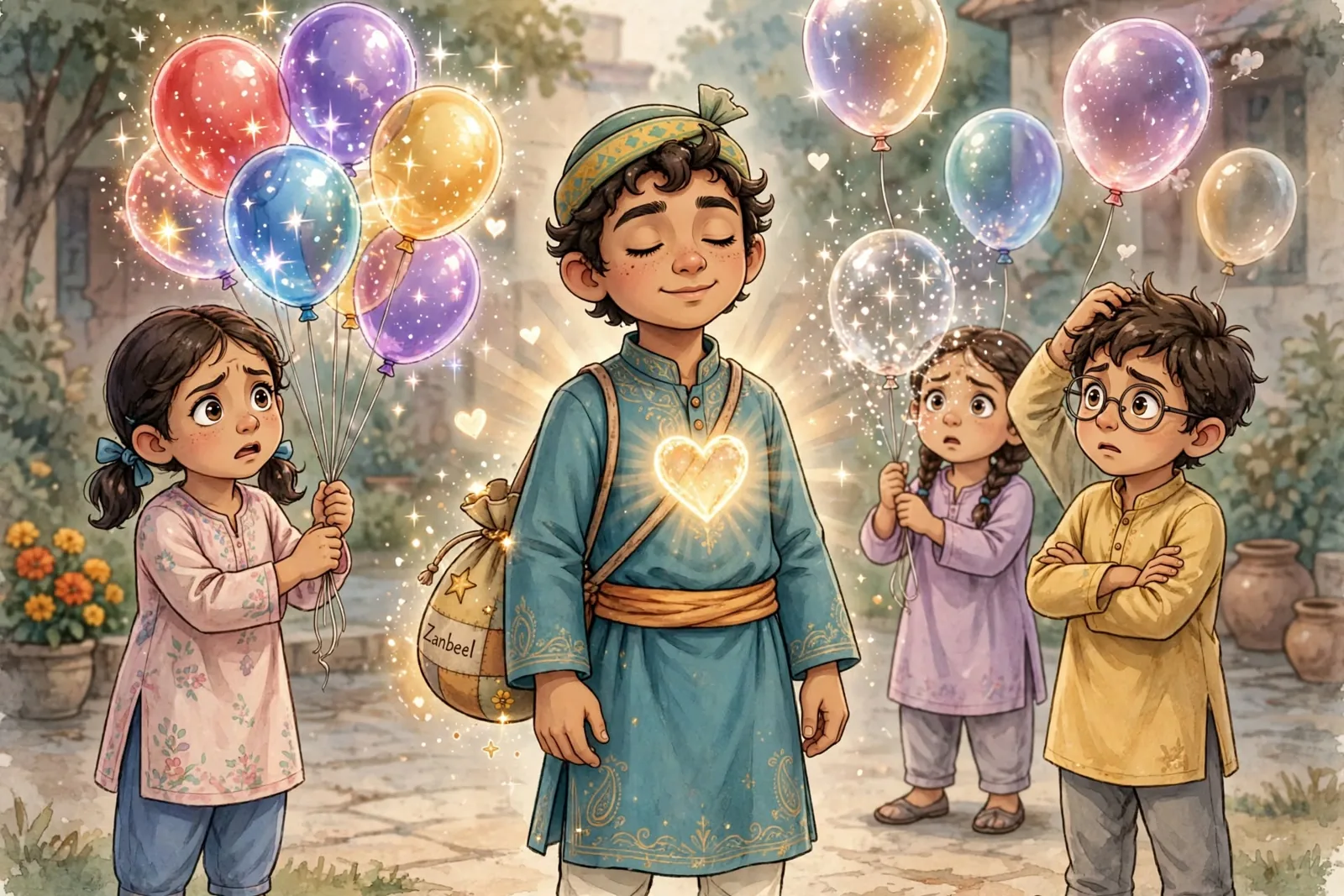
When a surprising claim appears on your screen, stop. Take a moment. Ask: Is this genuine? Where did it come from? Is there evidence? You do not need to close your eyes literally to find the truth, but you can give yourself time to think and check. That is how you begin to clear the fog.
Think like Amr: What would you check before believing or sharing an astonishing video?
Story 10: The Boy Beneath the Throne
The Last Lock and the Greatest Trick
This was Amr Ayyar’s greatest adventure. He had opened the enchanted city, freed the garden, taken Queen Hairat’s flute, released the soldiers from the jar and cleared the magical fog. Yet one task remained: the final lock of Tilism-e-Hoshruba.
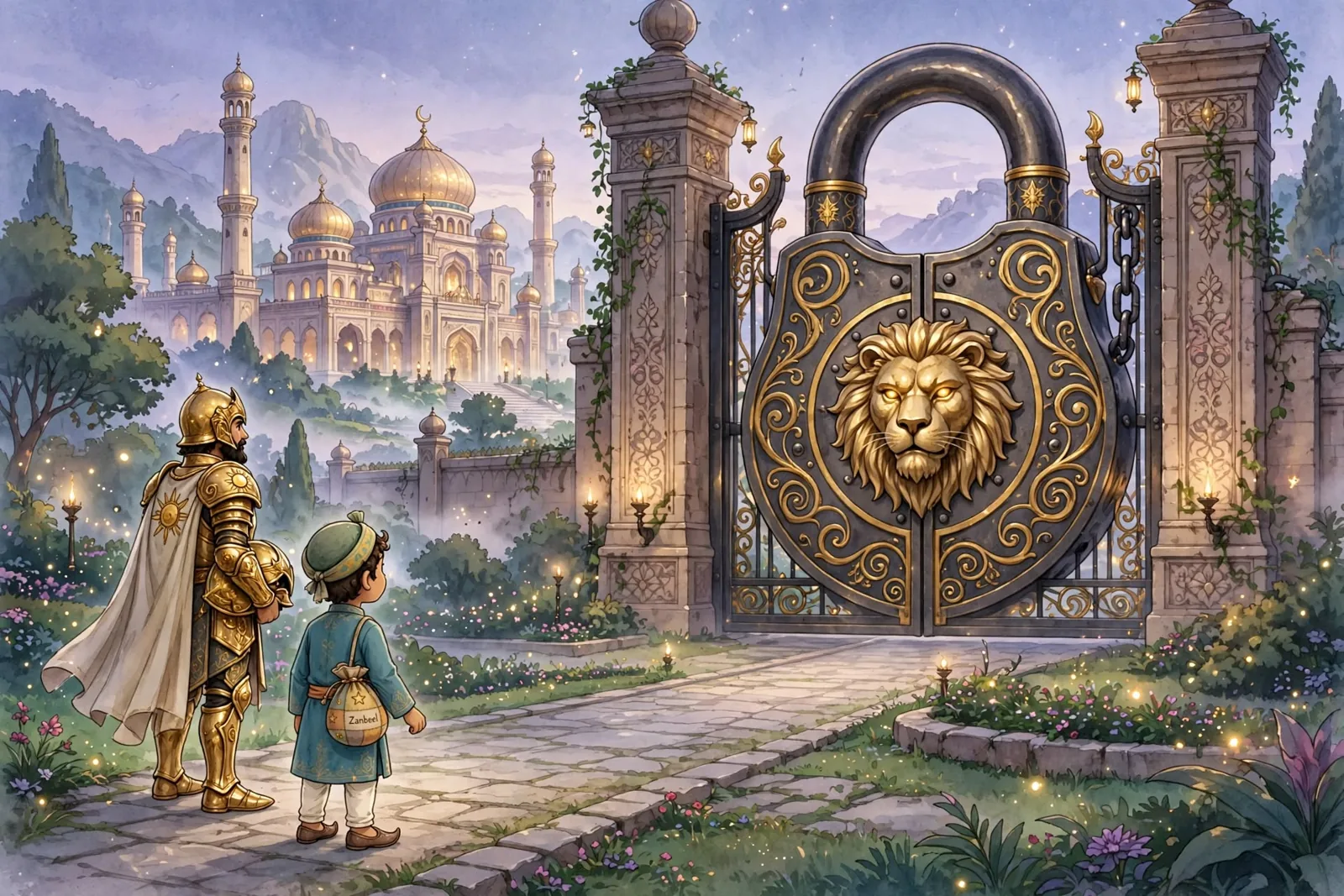
The lock was enormous, made of iron traced with gold. Above it was the image of a lion with diamond eyes. Whenever anyone approached, the lion roared. Even a thousand men might not have been strong enough to break it.
Amir Hamza stood before the lock with his companions. ‘Today we shall break this enchantment,’ he declared. His army shouted, ‘Allahu Akbar!’
Meanwhile Afrasiyab sat on his golden throne beneath a silver canopy. Four living lions lay at its feet, silent under his spell. The sorcerer-king laughed. ‘You’ll never break that lock!’
‘Why not?’ Amir Hamza demanded. ‘Because its key is beneath my throne,’ Afrasiyab replied. ‘And nobody can go beneath my throne.’ He ordered his sorcerers to strengthen the spell and keep the army away. They did as they were told, and the lock grew stronger still.
The soldiers attacked, but the lock would not yield. Amr, however, had heard every word. ‘Beneath the throne?’ he murmured. ‘A king may believe his throne is the most important place in the world. But beneath it is just a space. Even a child could hide there.’
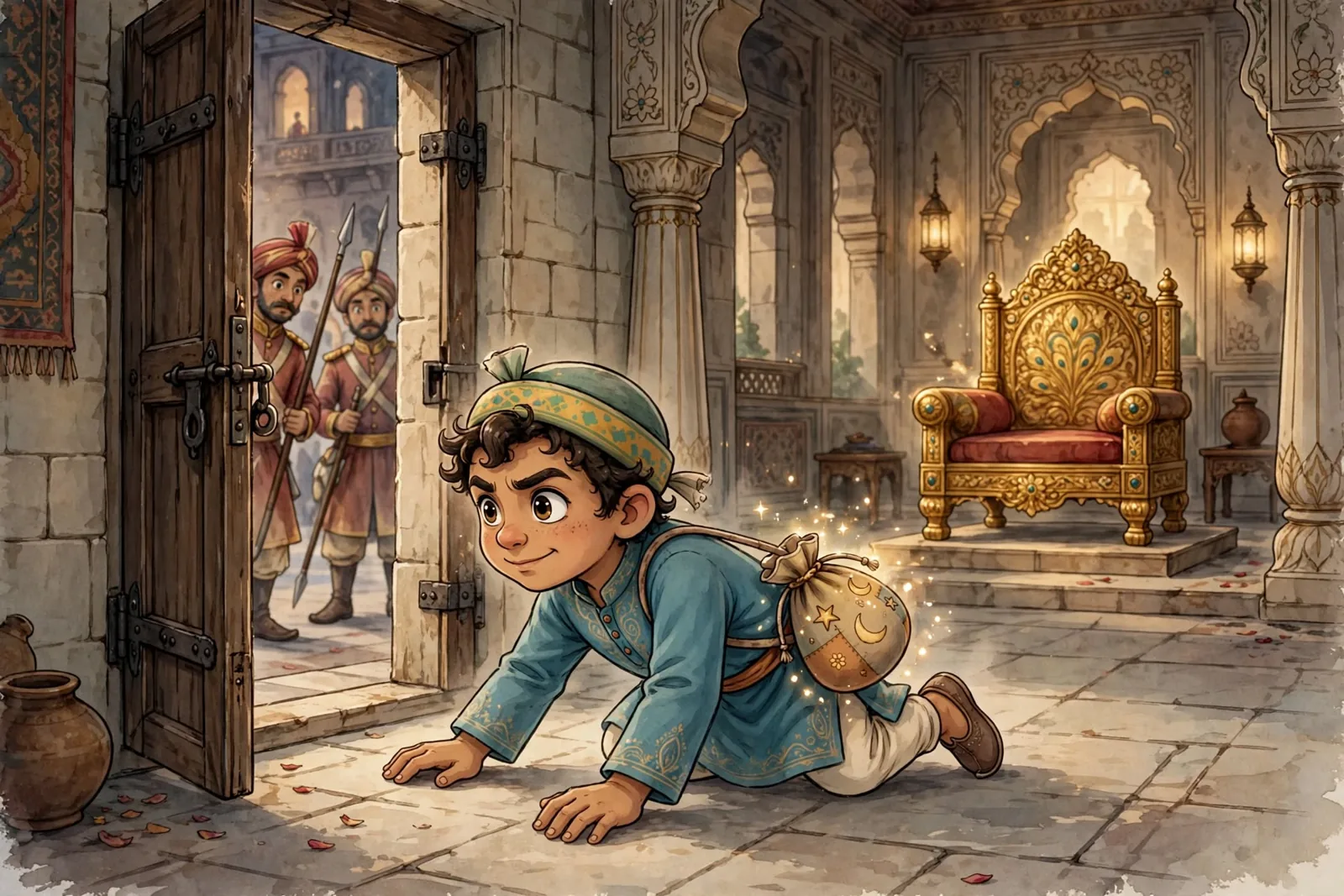
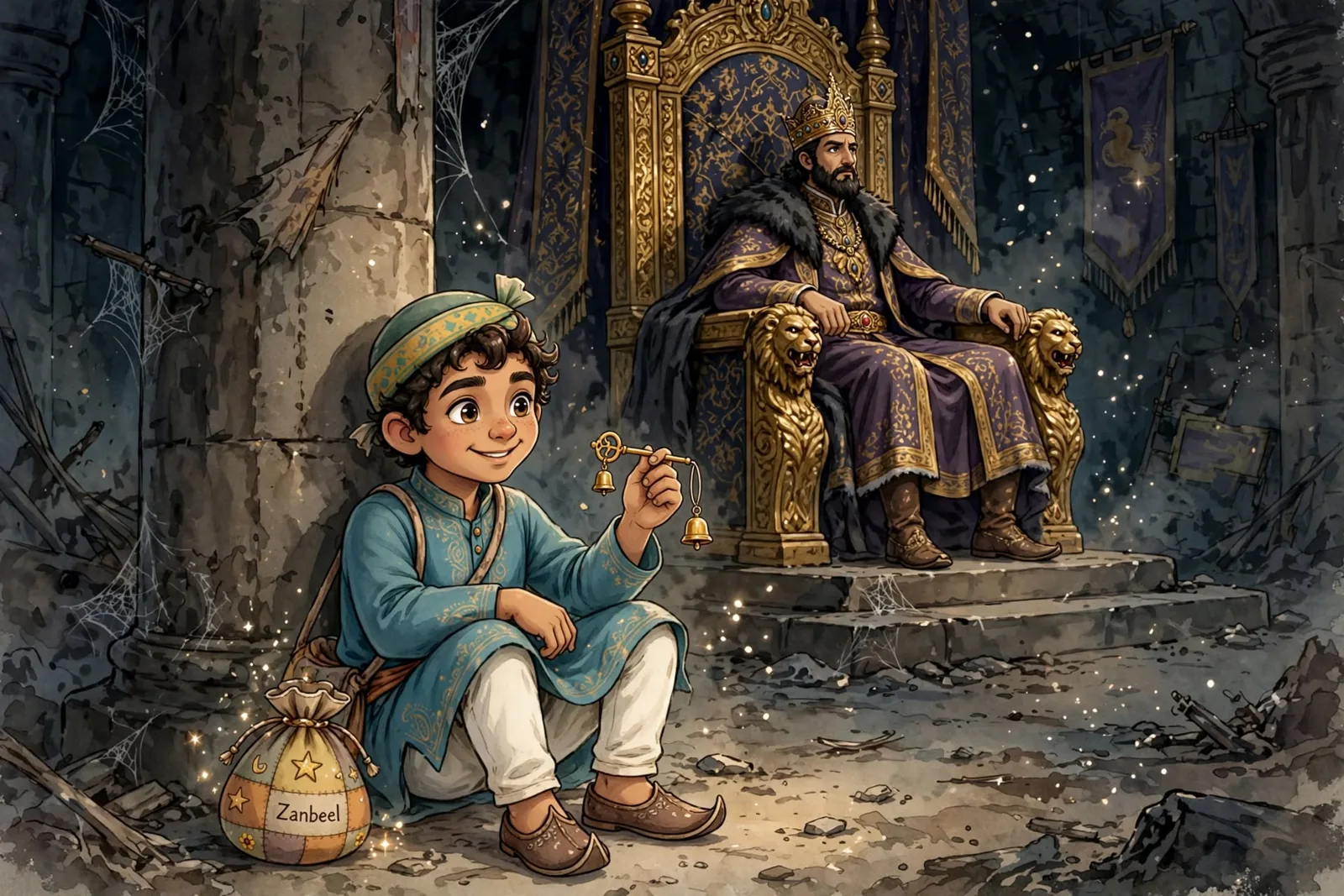
While everyone was distracted by the lock, Amr slipped through a back entrance to the palace. He crawled across the deserted floor and under Afrasiyab’s vast throne. It was dusty and dark. There, lying unnoticed, was a little golden key with a tiny bell attached.
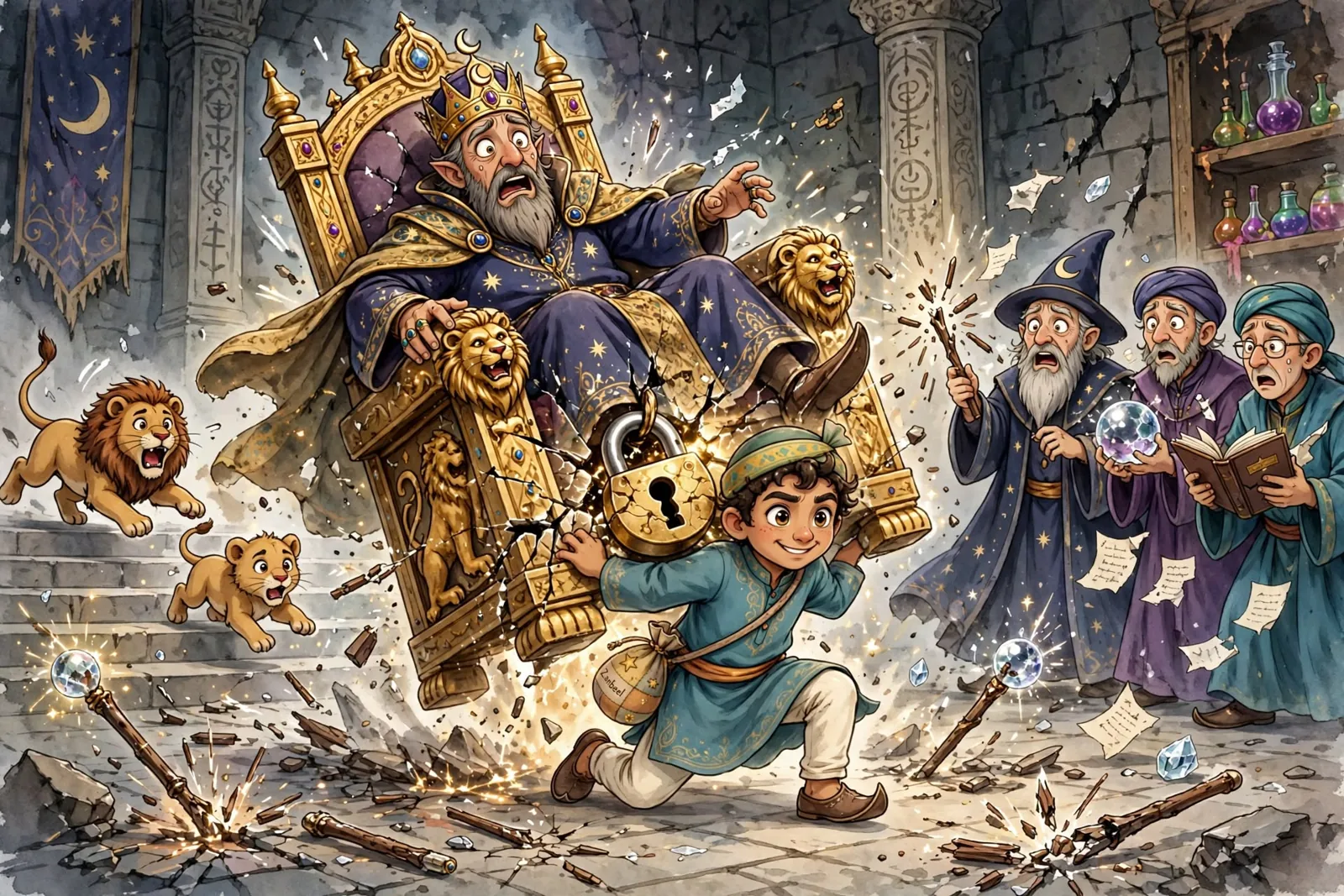
Amr picked it up and remained beneath the throne. Above him Afrasiyab kept shouting orders: ‘Strengthen the lock! Stop the soldiers!’ Amr began to shake the throne. It trembled.
‘What’s happening?’ cried Afrasiyab. ‘An earthquake?’ ‘No, Your Majesty,’ said the sorcerers. ‘Your throne is shaking.’ ‘My throne has never shaken!’ the king exclaimed.
From below came a voice. ‘Your throne is shaking because your magic stands upon a lie. Whatever stands on a lie cannot remain steady.’ ‘Who’s speaking?’ Afrasiyab shouted. ‘It’s me,’ came the reply. ‘Amr. Beneath your throne.’
The king looked down. There sat Amr, smiling, with the golden key in his hand. ‘How did you get there?’ Afrasiyab demanded. ‘Nobody can go beneath my throne!’
‘I go where nobody else goes,’ said Amr, ‘because that is often where the truth is hidden. You sent everyone to the lock and the gate. But you never looked beneath your own throne, because you thought there was nothing there. Yet everything you needed to see was hidden beneath it.’
‘You stole it!’ the king cried. ‘I found it,’ Amr replied. ‘You hid a key that should open a door for everyone. You thought it belonged to your throne alone.’
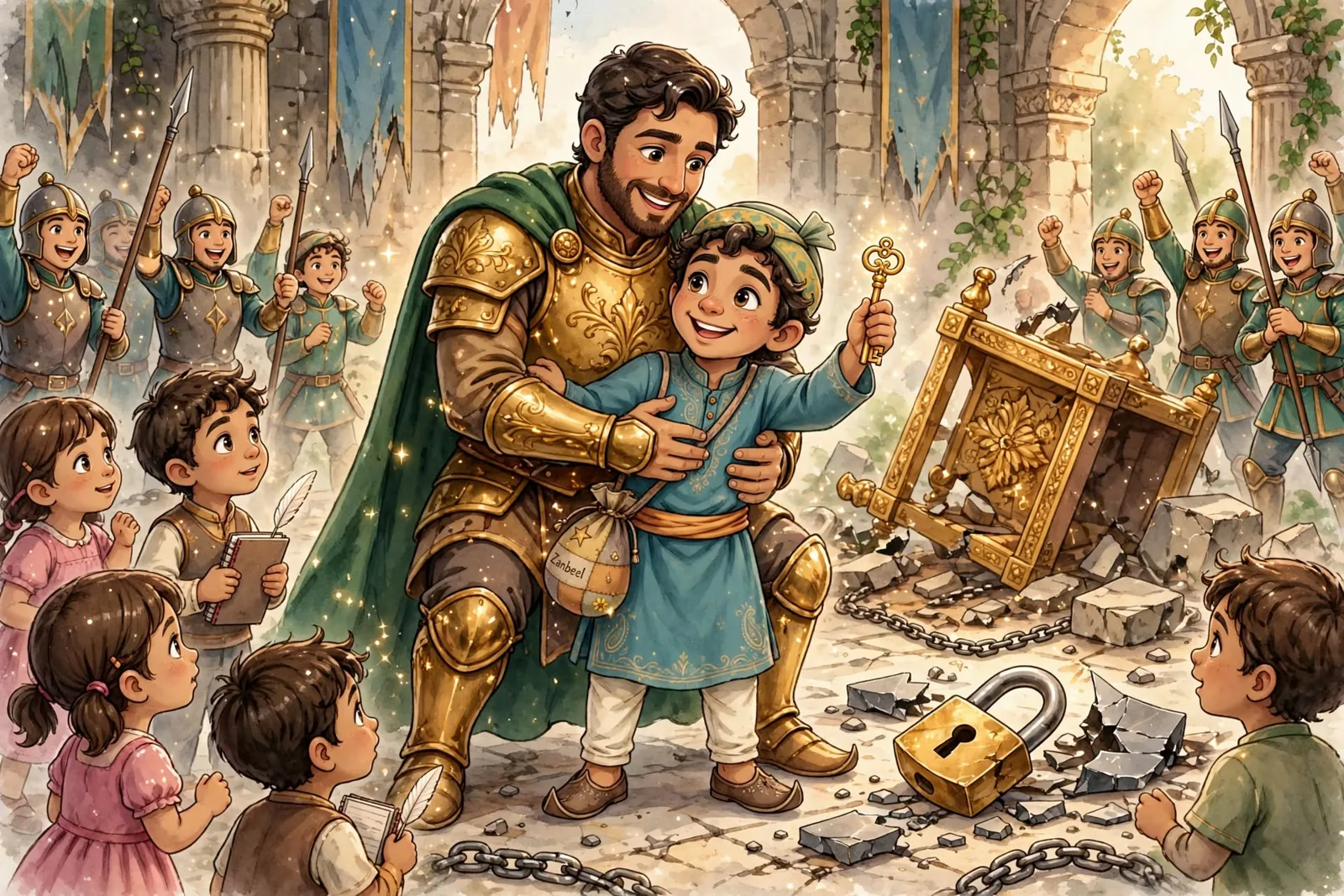
The sorcerer-king’s enchantment collapsed. His throne fell, the four lions fled, the sorcerers’ wands broke and the final lock sprang apart. Tilism-e-Hoshruba was free. ‘The enchantment is broken!’ cried Amir Hamza’s army.
Amir Hamza embraced Amr. ‘That was your greatest trick.’ ‘Your Majesty, I did not perform a trick,’ Amr replied. ‘I merely showed that a king who never looks beneath his own throne can never truly be a king.’
Children, the final lock has a lesson for ordinary life. Sometimes adults, teachers or popular people seem to know everything. Yet they may be worried, tired or sad beneath the confident face they show. If your father says he is tired, perhaps he also needs kindness. If your mother says she is fine, perhaps she needs rest. If a friend says they don’t want to talk, perhaps they need time and understanding.
Looking beneath the throne does not mean prying into secrets. It means noticing what others overlook and asking questions with care. A true leader is not simply the person who sits on a throne. A true leader tries to understand the people around it.
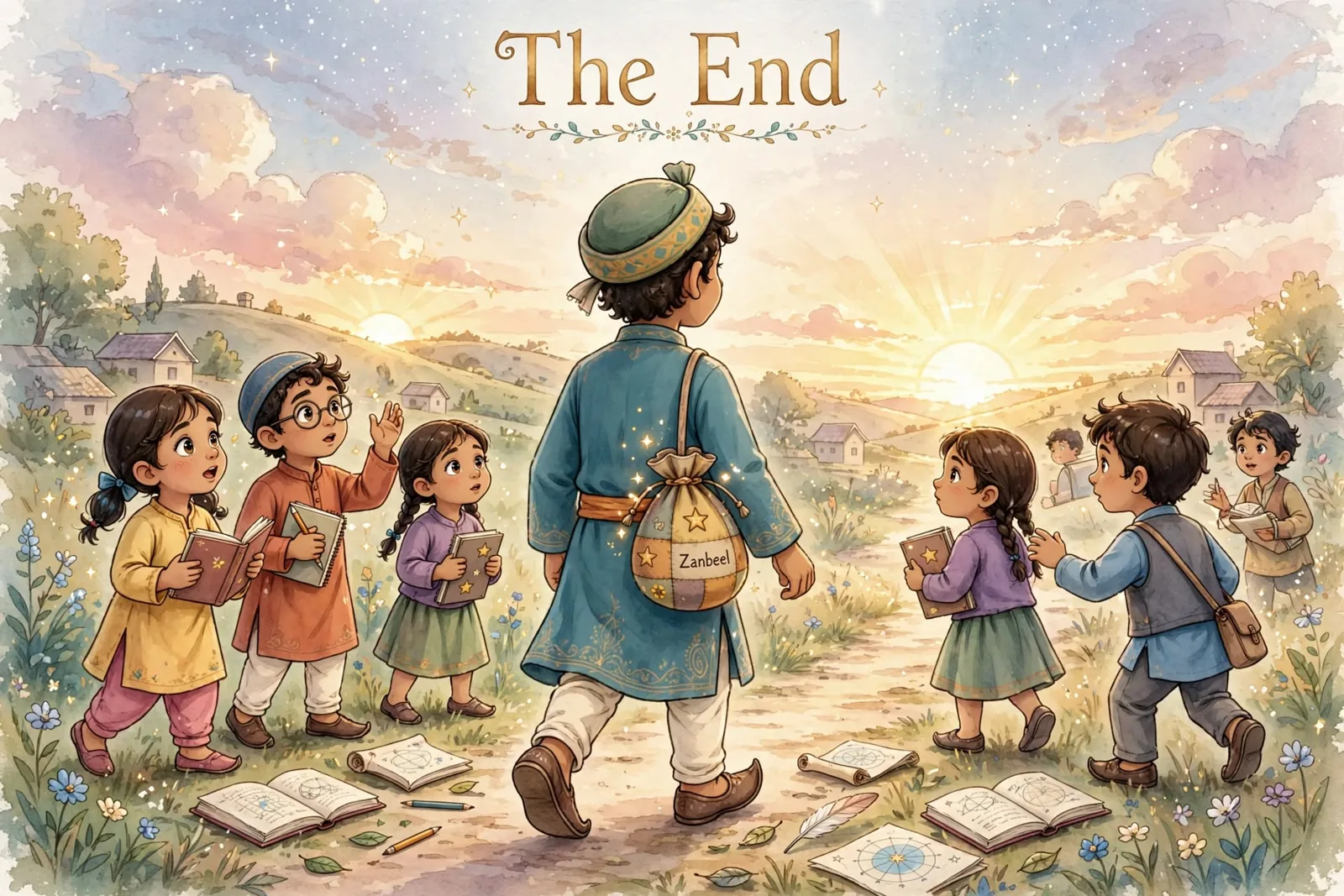
Amr’s enchanted adventures had reached their end. But his story was not finished, because every child who asks questions, thinks courageously and treats others with compassion carries a little of Amr inside. And your own adventure is only beginning.
Think like Amr: What might you notice if you looked beyond someone’s words and asked how they really felt?
Epilogue: You Can Be Amr, Too
Children, the book you have just read is not simply a collection of tales from a distant age. It is a mirror. Look into it and you may find Amr Ayyar looking back at you.
Long ago, Amr had a Zanbil. Today you have your heart. Amr could take bread from his bag for a hungry stranger, or a key for someone trapped. You can offer a friend your lunch, your time or your help. His Zanbil could hold the whole world; your heart can make room for kindness.
Long ago, Amr broke the mirror beneath Tilism-e-Hoshruba. Today your mirror may be the selfie on your phone. You look at your picture and wonder, ‘How do I look?’ Perhaps you forget to notice the people beside you. Put down your phone and look at your friend. Ask your mum, ‘How are you feeling?’ That is one way to break the spell.
Long ago, Afrasiyab was a mighty sorcerer who could fly through the air, turn stone to gold and change people into statues. Today you may meet Afrasiyab as fear. He appears before an exam, in a dark bedroom or whenever you think, ‘I can’t do this.’ Amr did not defeat him by being stronger. He asked questions. You can ask your fear, ‘Who are you? Where did you come from? What is making me afraid?’
Long ago, Queen Hairat played a flute that sent everyone to sleep. Today the flute may be the little chime of a phone: ting, ting, ting. You say, ‘Just five minutes,’ and two hours disappear. But the queen had no story, and you do. Your nani, dadi or mum may have a story to tell. Ask them to share it. A story can awaken your imagination.
Long ago, Ghubara-e-Sehr blinded an army with magical fog. Today false news can cloud your judgement. Something appears on a screen, and you cannot tell truth from invention. Amr stopped, listened and searched for the source of the spell. You can stop and ask, ‘Is this true? What evidence is there? Where did this claim come from?’
And Amr is still alive—not as a man who has somehow escaped time, but as a way of thinking that lives in you. When a teacher explains something and you raise your hand to ask, ‘Why is it like that? Could it be different?’ you are being like Amr.
When you are frightened in a dark room but decide to switch on the light and find out what is there, you are being like Amr. When a classmate drops their schoolbag and everyone laughs, but you bend down to help, you are being like Amr.
Amr was more than one clever adventurer. He stood for the idea that a question can be stronger than magic, kindness stronger than a sword, and understanding deeper than appearances.
So what adventure will you choose today? Will you help somebody? Ask a new question? Open the jar of anger in your heart and make peace? Turn off your phone’s enchanted flute and listen to your grandmother’s story? Look beneath a throne and notice something everybody else has missed?
This book ends here, but your story begins now. Tomorrow at school you may find a new enchantment. Tomorrow at home you may face a new Afrasiyab. Tomorrow in the playground you may discover a garden that needs your care. Meet them not with a sword, but with questions; not with anger, but with kindness; not with appearances alone, but with your heart.
And one day, when you are grown, perhaps you will tell your own child: ‘Once upon a time there was a boy named Amr. He loved asking questions.’ Your child may ask, ‘Where is Amr now?’ And you will smile and answer, ‘Amr is inside you.’
That is Amr Ayyar’s greatest trick. His story never truly ends. It lives on in every child who dares to wonder.