


DARK PAGE | WONDER & CURIOSITY
An inquiry into ghosts, God, consciousness and life beyond death—where the terror of the night meets the discipline of science, and certainty gives way to the courage of questioning.
The Night in Which a Question Entered the Room
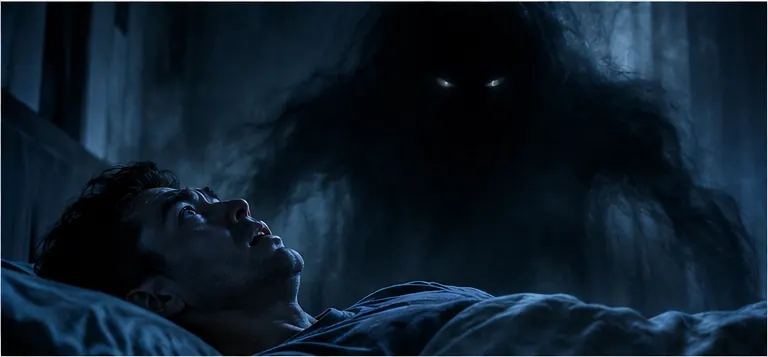
There is an hour of the night when even the familiar furniture of a room seems to belong to another world. A curtain moves. The floor remembers a footstep. A woman wakes and feels that somebody is standing beside her bed. She cannot move. She cannot speak. She knows that she is awake, and yet the room has acquired a second inhabitant. By morning she may have found a word for it: ghost. A scientist may find another: sleep paralysis. But between those two words lies the immense territory of human experience, a territory where fear is real even when its explanation is uncertain.
We live by naming things. We name the light and call it day; we name the darkness and call it night. What cannot be named becomes a mystery, and what frightens us becomes a presence. Perhaps the first ghost was born not in a cemetery but in the human effort to understand an unexplained sound. Perhaps the first prayer was born when a human being looked upward and discovered that the sky offered no immediate answer. Neither possibility tells us whether spirits or God exist. Both tell us why the questions have survived.
Dark Page begins with a refusal to confuse our convictions with the universe itself. An experience can be sincerely reported and sincerely misinterpreted. A scientific explanation can be powerful without explaining every conceivable event. A claim can remain unproved without becoming either true or impossible. The dignity of inquiry lies in holding these distinctions together.
The Invisible Universe and the Seduction of Numbers
A century ago, humanity had not yet observed many things now accepted as part of nature. Radio waves existed before receivers detected them; X-rays existed before anyone photographed the bones of a living hand; black holes were investigated mathematically long before compelling observational evidence accumulated. Nature does not wait for human permission to exist. Our instruments are invitations to reality, not its authors.
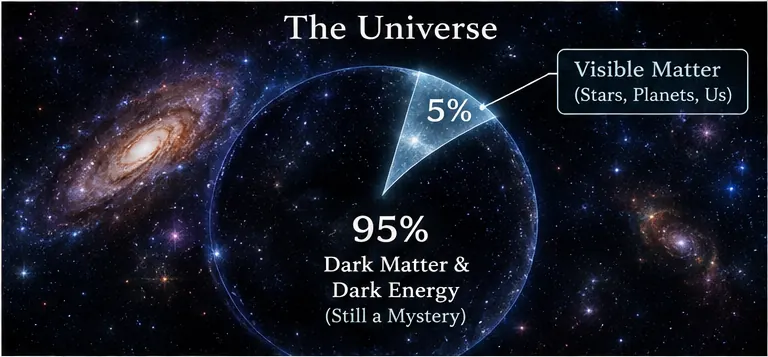
In contemporary cosmology, ordinary matter represents roughly five percent of the universe’s energy density. Dark matter and dark energy account for most of the rest in the standard model. They are inferred from measurable gravitational and cosmological effects, while their underlying nature remains unresolved. It is tempting to look at that vast unknown and announce that spirits must live there. But that would be to make the same mistake we accuse dogmatic skeptics of making: to transform ignorance into certainty. Dark matter is not a scientific name for ghosts; dark energy is not an afterlife waiting to be discovered.
Yet the numbers remain philosophically humbling. If the material universe still holds such fundamental puzzles, why should the human mind declare that it has reached the last page of existence? This is not an argument that the supernatural is likely. It is an argument against confusing a map with the country, a theory with the totality of things.
There is an old, useful analogy: discovering a counterfeit banknote does not establish that genuine banknotes do not exist. But it also does not authenticate another note found in a stranger’s pocket. Every alleged encounter with the unseen must stand on its own evidence. That principle protects the investigator from both credulity and contempt.
The Prisoner Who Wakes Inside His Own Body
During rapid-eye-movement sleep, the body normally suppresses most voluntary muscle movement. Sometimes waking awareness returns before that paralysis has ended. A person sees the bedroom, knows the hour, hears the sounds of the house—and cannot lift a hand. An intruder seems to approach. Something presses on the chest. A voice comes from nowhere. The experience may be accompanied by vivid hallucinations and a crushing sense of dread.
Sleep paralysis can explain many accounts once attributed to nocturnal visitors, demons or spirits. It does not make the suffering imaginary. The terror happened; the interpretation may have been mistaken. The distinction is delicate but essential. We should not humiliate someone for having an experience that neuroscience can help explain. Nor should we accept a supernatural cause merely because the experience felt more convincing than an ordinary dream.
Some people reply: but what of those who were fully awake, healthy and alert? Their accounts cannot simply be assigned to sleep paralysis without investigation. Nevertheless, waking consciousness is not a guarantee against misperception. The brain interprets signals continuously, and even an alert observer can mistake an ordinary event for an extraordinary one. We must examine the circumstances rather than award certainty to either side.
When the Self Becomes a Stranger
Psychology has another word for certain uncanny experiences: dissociation. Under stress, after trauma, or sometimes during ordinary routine, the unity of awareness may feel altered. A person may seem detached from their body or surroundings. On a familiar drive, attention can drift so completely that the journey feels as though it happened almost without conscious participation. Such everyday absorption is not identical to clinical dissociation, but it helps illustrate how variable our sense of presence can be.
Researcher Christine Simmonds-Moore has discussed the possibility that a sensed presence may arise when aspects of one’s own experience are processed as though they belong to someone else. Sleep deprivation and stress can make unusual perceptions more likely. The mind, which normally gives us the reassuring word “I,” may briefly offer the disturbing word “someone.”
Chris French and other psychologists have investigated how frightening encounters can arise from ordinary cognitive processes. Their explanations should be heard in full, not dismissed because they disappoint a cherished belief. Yet a mechanism explaining a class of experiences cannot, by itself, prove that no invisible being could exist anywhere. Scientific explanations and universal metaphysical denials are not the same proposition.
The Faces That the Darkness Paints
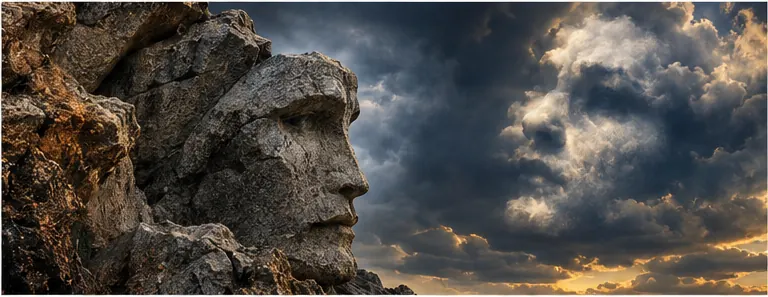
A knot in a wooden door becomes an eye. The folds of a curtain become a figure. Clouds assemble into the face of someone we have lost. This is pareidolia, the recognition of meaningful patterns in ambiguous information. Rodney Schmaltz of MacEwan University has discussed how peripheral vision and incomplete sensory information can lead us to mistake an object for a person or face.
Perhaps our ancestors survived because they treated an uncertain shadow as a possible predator. Better to run from an imaginary animal than fail to run from a real one. Folklorist Deborah Hyde has argued that our senses are shaped by survival rather than by a guarantee of perfect truth. This helps explain agency detection: the mind’s readiness to imagine that an event was caused by an intentional being.
But here we encounter an interesting symmetry. The fact that the brain can invent a face does not mean that every face is invented. The fact that a shadow can deceive does not mean that shadows can never conceal a real creature. A false alarm establishes the possibility of error, not the impossibility of danger. The responsible question is always particular: what happened here, and what evidence could distinguish one explanation from another?
Some animals detect sounds and environmental signals outside ordinary human perception. This invites speculation about unusual sensitivities in people too. But we should not smuggle a spirit into the argument under cover of an animal’s hearing. Claims that animals reliably predict earthquakes, or that human beings sense unknown presences through undiscovered channels, need independent evidence. Wonder becomes more interesting, not less, when we refuse to counterfeit proof.
The Old House Has a Nervous System of Its Own
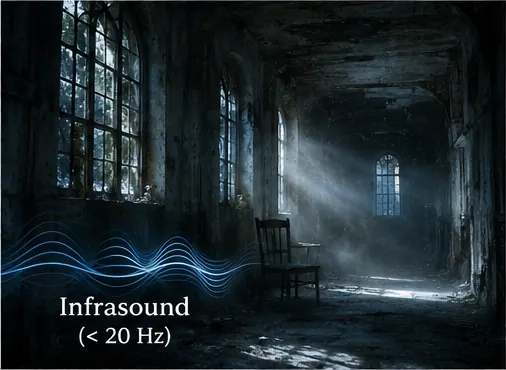
A building has its own orchestra: water moving through pipes, metal contracting after sunset, a heating system awakening in the walls, traffic trembling beneath the street. Low light makes the eye uncertain; unfamiliar acoustics make a footstep seem closer than it is. A high ceiling can turn an ordinary noise into a disembodied whisper. In an empty house, architecture itself may appear to be listening.
Researchers have investigated infrasound, sound below approximately twenty hertz. Some low-frequency vibrations are generated by machinery, traffic and building systems, and sufficiently intense exposure can influence discomfort. Schmaltz has discussed research reporting small changes in salivary cortisol and irritability under some conditions. But the relationship between infrasound and alleged hauntings remains disputed; research associated with Chris French has not established a reliable connection. Infrasound is neither a universal ghost-maker nor an explanation that can be dismissed without examining the evidence.
The scientific virtue here is not the possession of an answer. It is the willingness to say that findings are mixed. An unsettled experiment does not authorize a ghost story; neither does it authorize the pretense that every environmental influence has been fully mapped.
Is the Brain a Factory—or a Radio?
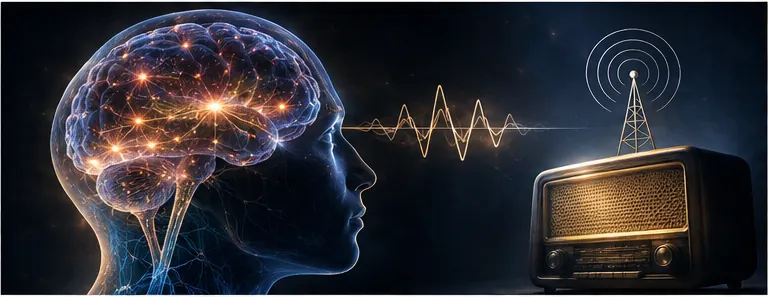
What is consciousness? A brain can be examined, its electrical activity recorded, its injuries mapped. But the intimate fact of being someone—the warmth of memory, the pain of loss, the sensation of seeing blue—continues to provoke profound philosophical debate. How does matter become experience? Or is that very question framed too simply?
Roger Penrose and Stuart Hameroff proposed the Orch-OR hypothesis, suggesting a role for quantum processes in neuronal microtubules in consciousness. The proposal is controversial and has not been established as a scientific account of conscious experience. It is sometimes retold as the idea that the brain does not produce consciousness but receives it, as a radio receives a broadcast. That is an evocative metaphor, not a demonstrated implication of the theory.
Imagine the radio broken while the broadcast continues. It is easy to see why the image appeals to someone grieving a death. If the body were only an instrument, perhaps the music might outlive it. Yet the metaphor does not show that such a broadcast exists, nor that a personal mind continues after irreversible brain death. A possibility imagined with beauty remains a possibility until evidence gives it greater standing.
Quantum superposition and entanglement are real features of physical theory. They are not proof that an ordinary object occupies two definite places at once, that distant particles transmit instant messages, or that ghosts are quantum beings. We do science no service by making the strange language of physics a passport for every untested claim. Its genuine strangeness is more remarkable than the myths we sometimes attach to it.
The Ancient Agreement of Unconnected Peoples
From the Amazon to Arabia, from the northern ice to the valleys of ancient rivers, people have told stories of ancestors, spirits, unseen beings and worlds beyond death. Their names differ, their rituals differ, their cosmologies sometimes contradict one another, yet the longing to address the invisible appears again and again. How could distant peoples arrive at such familiar stories?
One answer is that they encountered the same external reality. Another is that they shared the same human conditions: dreams, grief, fear, night, memory, sleep paralysis, imagination, and the universal certainty of mortality. Similar stories can arise without direct contact because human minds and human losses have common features. Cross-cultural recurrence is a subject for study, not a verdict for either interpretation.
Confirmation bias complicates every investigation. Someone who already believes in ghosts may read a creaking door as evidence of a visitor. Someone who regards all witnesses as foolish may refuse to listen even when a case deserves careful inquiry. Both attitudes can distort judgment. Yet the burden of proof is not perfectly symmetrical: the person claiming that a particular invisible being exists must provide evidence for that positive claim. The person who says “I am not yet convinced” need not demonstrate that every invisible being is impossible.
Why, then, might people want ghosts to be real? Because the apparition of a dead loved one offers more than a puzzle. It offers a bridge across the most terrible separation we know. In some stories the ghost is a frightening intruder; in others it is a promise that love has not been extinguished. We must understand that emotional meaning without confusing it with external verification.
The Hospital Bed and the Edge of Death
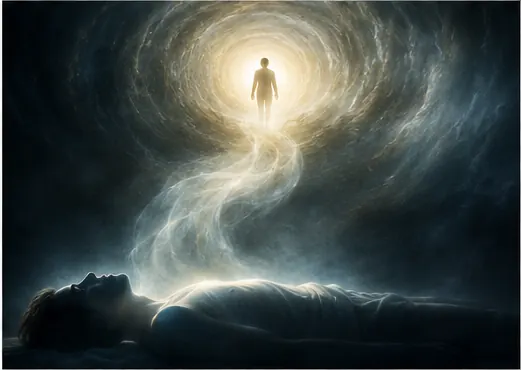
There are people who return from cardiac arrest or other life-threatening events describing a tunnel, an extraordinary light, a sense of leaving the body, voices from a hospital room, or encounters with deceased relatives. Some reports include claims of hearing conversations or noticing details that witnesses believe should have been inaccessible. Such accounts are often grouped under near-death experiences, or NDEs. They can transform the lives of those who report them.
But language matters. Cardiac arrest, temporary loss of consciousness, the clinical use of “dead,” and irreversible brain death are not interchangeable conditions. Establishing precisely when a remembered experience occurred is difficult. The brain’s activity during crisis and recovery, and the ways memory is formed and reconstructed, are active research questions. Thousands of testimonies are worth studying, but quantity alone does not establish that consciousness survived irreversible death.
Some cases may remain unexplained after investigation. That should not embarrass the researcher. An unexplained case is an invitation to better methods, not permission to announce a settled afterlife. To respect a witness is to take the testimony seriously enough to test it carefully.
Children Who Remember a House They Have Never Seen
At the University of Virginia, Ian Stevenson and later Jim Tucker investigated reports from children who appeared to recall previous lives. The research program has assembled more than two thousand cases. Some children reportedly described names, places, family circumstances, deaths or other details later compared with records and witnesses. Supporters consider certain correspondences striking, especially when information seemed difficult for a child to obtain by ordinary means.
Critics raise substantial questions: when were statements first recorded, who heard them, how much information could have circulated, what suggestions did adults offer, how were unsuccessful matches counted, and what influence did local beliefs have on the stories? These questions do not require contempt for the children or their families. They require careful standards of documentation. The case collection exists; the conclusion that reincarnation has been scientifically proved does not follow from its existence.
There is a poignant human image behind these investigations: a child speaking as though another life were hidden in the folds of the present one. Whether that image reveals an undiscovered fact about consciousness, a complex form of memory and suggestion, or some combination not yet understood is precisely what research must determine.
God and the Silence of the Instruments
Can a telescope discover God? Can an experiment weigh the soul? The questions may be badly framed if the reality under discussion is defined as beyond ordinary space, time and physical measurement. Science is extraordinarily powerful at examining claims with observable consequences. It cannot test every possible metaphysical definition by treating it as an object in a laboratory. At the same time, defining a claim as beyond testing does not make it true.
There is no widely accepted, reproducible scientific demonstration that personal consciousness continues after irreversible death. That fact should be stated without evasion. It does not, by itself, settle every philosophical or religious conception of an afterlife. Some religious assertions are empirically testable; others belong to debates about causation, existence, meaning and the limits of knowledge. Different kinds of questions demand different kinds of argument.
Absence of evidence is not always evidence of absence. But where a claim predicts a particular observation and repeated careful tests fail to find it, that absence can count against the claim. We cannot invoke the first principle to protect every cherished belief and forget the second whenever a prediction fails.
Perhaps the deepest error is to imagine science as a courtroom that has already ruled on every possible universe. Science is a disciplined method of inquiry, not an oracle of metaphysical certainty. Nor is theology an exemption from reason. The honest conversation begins when each acknowledges what it can and cannot establish.
The Mother, the Dream, and the Truth of a Feeling
A mother dreams of a child who has died. In the dream the child speaks, smiles, perhaps reaches for her hand. She wakes with tears and a certainty that the visit was real. A son hears the remembered voice of his father. Someone at prayer feels a presence more intimate than speech. It would be cruel to dismiss these people as liars merely because their experiences cannot be independently verified.
The feeling is real as a feeling. The memory is real as a memory. The love is real as love. Whether the event had an external supernatural source is a further claim. This distinction does not rob the experience of its meaning. It protects both compassion and inquiry.
Belief grows in a particular human life. It has roots in childhood, loss, language, family, culture, art, music, fear and hope. Psychologists also discuss transliminality, a trait associated in some research with heightened sensitivity to internal imagery, dreams and unusual experiences. People scoring highly on measures of this trait may be imaginative, emotionally responsive to art or music, and inclined to remember and interpret dreams. Associations are not diagnoses and do not establish that paranormal perceptions are externally caused.
Synesthesia offers another fascinating example of perception’s complexity. In some people, stimulation in one sensory domain consistently evokes an additional experience in another: letters may have colors, sounds may evoke shapes, or particular stimuli may evoke tastes. A person might describe pink as carrying a rose-like association, though ordinary associations should not be confused with a clinical synesthetic response. The point is that the mind can weave sensory experience in ways that feel immediate and involuntary. An unusual sensation need not be fabricated to have a neurological origin.
My belief may be a genuine fact about my inner world without being an established fact about the universe. My disbelief may honestly express the present limits of my knowledge without being a decree about the final limits of existence. Neither person gains the right to insult the other. Neither gains the right to abolish evidence.
The Two Arrogances
There are two ways of losing a mystery. One is to believe too quickly. The other is to deny too quickly. The believer may see a ghost in every shadow; the skeptic may call every testimony nonsense before listening to a word. One fills the unknown with certainty; the other empties it with certainty. Both are tempted to stop asking questions.
But doubt is not identical to dogmatic denial. “I do not have sufficient evidence to believe this” is a careful statement. “I know no such thing could ever exist” is a far stronger claim. Similarly, “I felt someone beside me” is testimony about an experience; “therefore a spirit was present” is an inference that needs independent support.
In a world of misinformation, this distinction is not a luxury. It is the difference between curiosity and gullibility, between skepticism and disdain. A serious magazine about mystery must refuse to manufacture proof in order to preserve wonder. The unknown is already extraordinary enough.
What If the Last Answer Is Another Question?
Human beings once attributed lightning to divine anger and disease to unseen forces. The growth of scientific knowledge changed those explanations. Many experiences called hauntings may similarly yield to sleep science, psychology, acoustics or the study of memory. We should welcome those discoveries. An explanation is not the death of wonder; it is the opening of another door.
And yet knowledge expands precisely because we have not reached its final boundary. The nature of dark matter, the interpretation of quantum theory, the origins of consciousness, and the philosophical meaning of personal identity remain subjects of serious inquiry. None proves ghosts. None entitles us to mock every question that does not fit neatly inside our present theories.
Return to the room at midnight. A figure seems to stand in the darkness. Perhaps it is a coat, a dream intruding upon waking, an episode of dissociation, an anxious brain searching for a human shape. Perhaps a physical cause has not yet been found. If the cause remains unknown, the honest name for it is unknown. We do not turn it into a spirit by wishing, and we do not settle all possible metaphysics by finding one ordinary explanation.
The universe does not become what we believe. It does not become what we deny. It remains what it is, whether we have the instruments to detect it, the language to describe it, or the courage to admit our uncertainty.
Perhaps the most beautiful and most difficult sentence in the human vocabulary is not “I believe” or “I deny,” but “I do not know—and I will keep looking.”
That is where science can meet philosophy without surrendering its methods, and where private faith can meet public evidence without surrendering its humanity. That is where Dark Page chooses to remain: not in the comfort of a final answer, but at the edge of the next question.
Editorial context: This original long-form essay expands the author’s Urdu manuscript, including psychological explanations discussed in BBC Urdu reporting. It distinguishes established findings, contested research, testimony, analogy and philosophical speculation. No claim about ghosts, reincarnation or survival after death is presented as scientifically proven.
Further reading: Life, Death and Beyond · Evidence Before Sensation.



