

On certain nights, the ocean seems to forget that darkness exists. Far from the lights of any city, sailors have reported an almost impossible sight: water glowing steadily from horizon to horizon, as though the sea itself had become a pale, luminous sky. There is no searchlight beneath it, no moonbeam painted on its surface, and no fleet of ships to explain the radiance. The phenomenon has a name as strange as its appearance: the milky sea.
A legend that left a measurable trace
Accounts of glowing oceans reach back centuries. Mariners described broad expanses of whitish light that remained unusually uniform even as a vessel moved through them. The stories sounded like maritime folklore: the kind of thing repeated on a dark deck, far from witnesses and instruments. Unlike the familiar sparks of blue bioluminescence that flash in breaking waves, a milky sea can appear to shine continuously. That distinction matters. It hints at a different biological process.
For much of modern scientific history, the difficulty was not imagining a cause but being present when the phenomenon occurred. Milky seas are rare, frequently reported in remote regions of the northwest Indian Ocean and waters around Indonesia, and difficult to predict. A research vessel cannot simply sail to a place that may glow once and remain dark for years.
The night a satellite saw the impossible
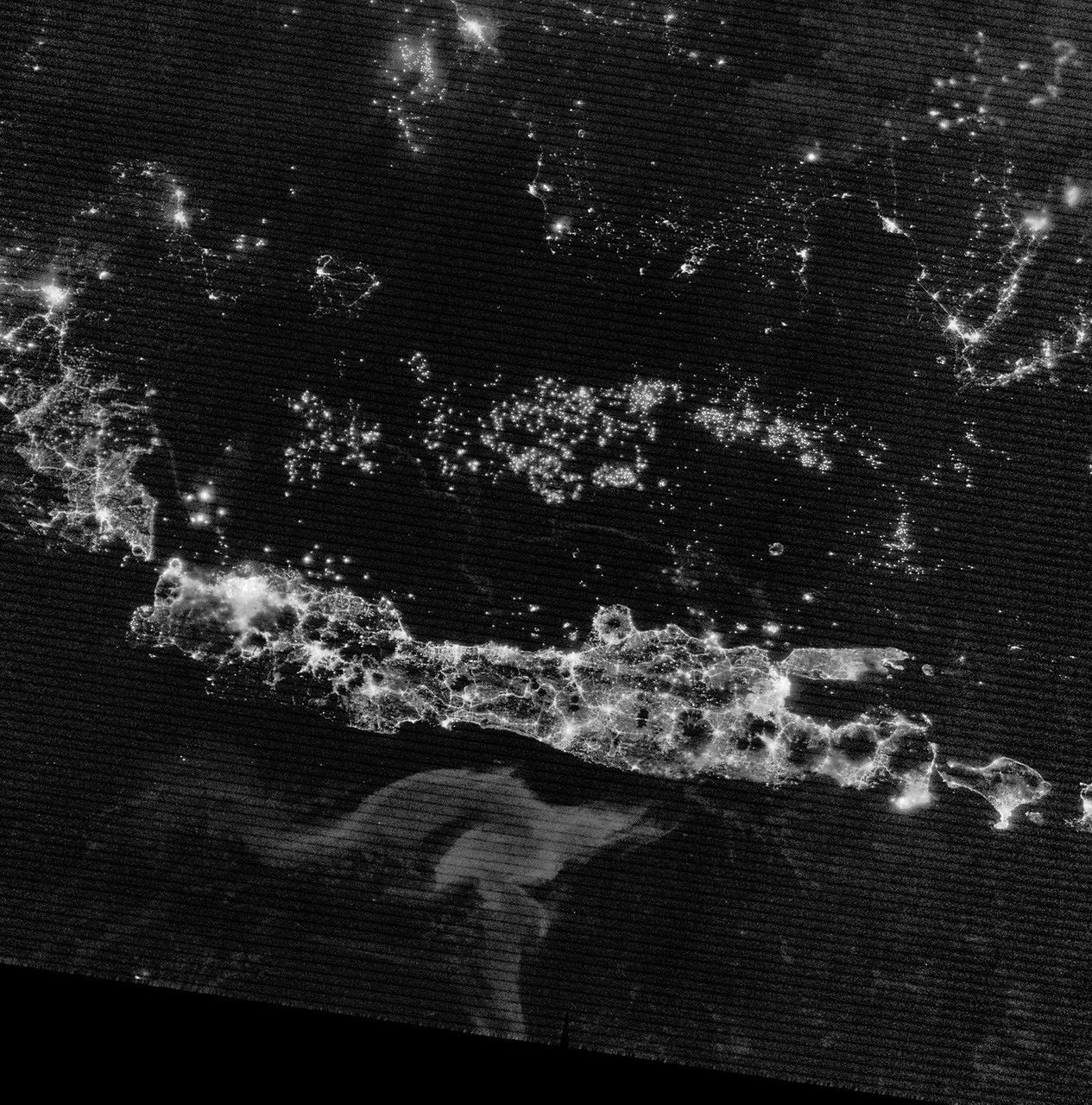
In late July 2019, an enormous patch of ocean south of Java began emitting a faint nocturnal signal. The low-light Day/Night Band of the Visible Infrared Imaging Radiometer Suite (VIIRS), aboard the NOAA–NASA Suomi NPP satellite, detected the glow. At its greatest extent, researchers estimated that the luminous region covered roughly 100,000 square kilometres—an area comparable to Iceland. The signal persisted across moon-free observation periods into early September.
That does not mean a single unbroken photograph recorded every moment of a continuously glowing ocean. Researchers reconstructed the event from repeated satellite observations. They compared night and day images, tracked movement consistent with surface currents, and checked other possible sources of brightness. City lights, fishing vessels, moonlight and clouds can all deceive a night-sensitive instrument. A credible discovery requires excluding those explanations, not merely admiring a bright patch.
In a 2021 study published in Scientific Reports, Steven D. Miller and colleagues reported 12 candidate milky-sea events in satellite data from 2012 to 2021. Their work changed the question from “Did sailors really see this?” to “How can we reach the next event in time to study it?”
A yacht sailed into the evidence
The most extraordinary confirmation arrived from people who had actually been there. After the satellite research appeared, members of the yacht Ganesha contacted the scientists about their passage through the Java event in 2019. Their recollections, route and photographs were examined in a 2022 paper in the Proceedings of the National Academy of Sciences. The encounter provided an unusually valuable connection between a faint orbital signal and human observation at sea.
The crew described a broad, steady glow rather than the quick flashes commonly associated with disturbed plankton. Photographs captured the scene, although cameras and human eyes do not necessarily render such weak light in the same way. The scientists did not claim to have solved the entire ecology of milky seas. They had something more valuable than a sensational answer: independent lines of evidence pointing to the same real event.
Who switched on the water?
The leading explanation involves enormous populations of light-producing marine bacteria, including organisms such as Vibrio harveyi. Bioluminescence is a chemical process in living organisms that produces light. Some microorganisms flash when disturbed; certain luminous bacteria can emit a more sustained glow. Researchers suspect that the bacteria may flourish under particular conditions associated with organic matter, algae and phytoplankton. But the exact chain of events remains uncertain.
Scientists have proposed that interactions with algal blooms could help sustain the bacteria. The light might also have ecological functions, possibly involving interactions with fish. These are research hypotheses, not settled descriptions of what happened in the Java event. No one has yet demonstrated a universal formula that predicts when an ocean will turn milky.
The scale is almost beyond intuition. In their analysis of the 2019 event, the 2021 researchers estimated that a phenomenon of this size could involve roughly 6 × 10²² to 6 × 10²³ luminous bacteria. Such estimates depend on assumptions about the concentration and brightness of organisms; they are not a direct bacterial census.
What the mystery teaches us
The temptation is to turn this story into a claim about an undiscovered civilization, an underwater machine or some force that science refuses to name. None of those claims is supported by the evidence. Yet reducing the milky sea to “just bacteria” would miss its genuine wonder. Living cells may, under rare circumstances, illuminate a region of ocean comparable in area to a country. A biological event too faint for ordinary daylight observation can become visible from orbit at night.
There is a larger lesson here about mystery itself. A mystery does not vanish when scientists begin to explain it. Often, the explanation opens a second, deeper set of questions: Why there? Why then? Which organisms were involved? What food web supported them? How did their collective light last so long? And could a satellite alert enable a research ship to collect samples during the next great event?
For centuries, the milky sea lived mainly in the space between testimony and doubt. Now it exists in navigational records, satellite measurements, peer-reviewed studies and photographs taken from a passing yacht. The ocean has not surrendered all its secrets. It has simply allowed us to ask better questions.
Dark Page — The Page Is Dark. The Book Is Alive.
Sources and image rights
- NASA Earth Observatory, “Hunting Milky Seas by Satellite” (2 November 2021) — satellite imagery, scientific background, and image credit.
- Miller et al., “Honing in on bioluminescent milky seas from space,” Scientific Reports 11, 15443 (2021) — peer-reviewed analysis of satellite detections and estimates.
- Miller, “Boat encounter with the 2019 Java bioluminescent milky sea,” PNAS 119 (2022) — yacht observations and photographs corroborating the satellite detection.
- NASA image-use guidance — NASA-produced imagery is generally not subject to US copyright; credit is given, and no endorsement is implied. Image: NASA Earth Observatory/Joshua Stevens; Suomi NPP VIIRS; Miller et al. (2021). No alteration claimed.
Editorial note: This article distinguishes direct observation, published estimates and hypotheses. The NASA satellite image shows the 2019 event, not a modern artist’s depiction or a photograph taken from a ship.
Further reading: The Ocean’s Last Dark Kingdom · The Secret World Beneath the Ocean.



