
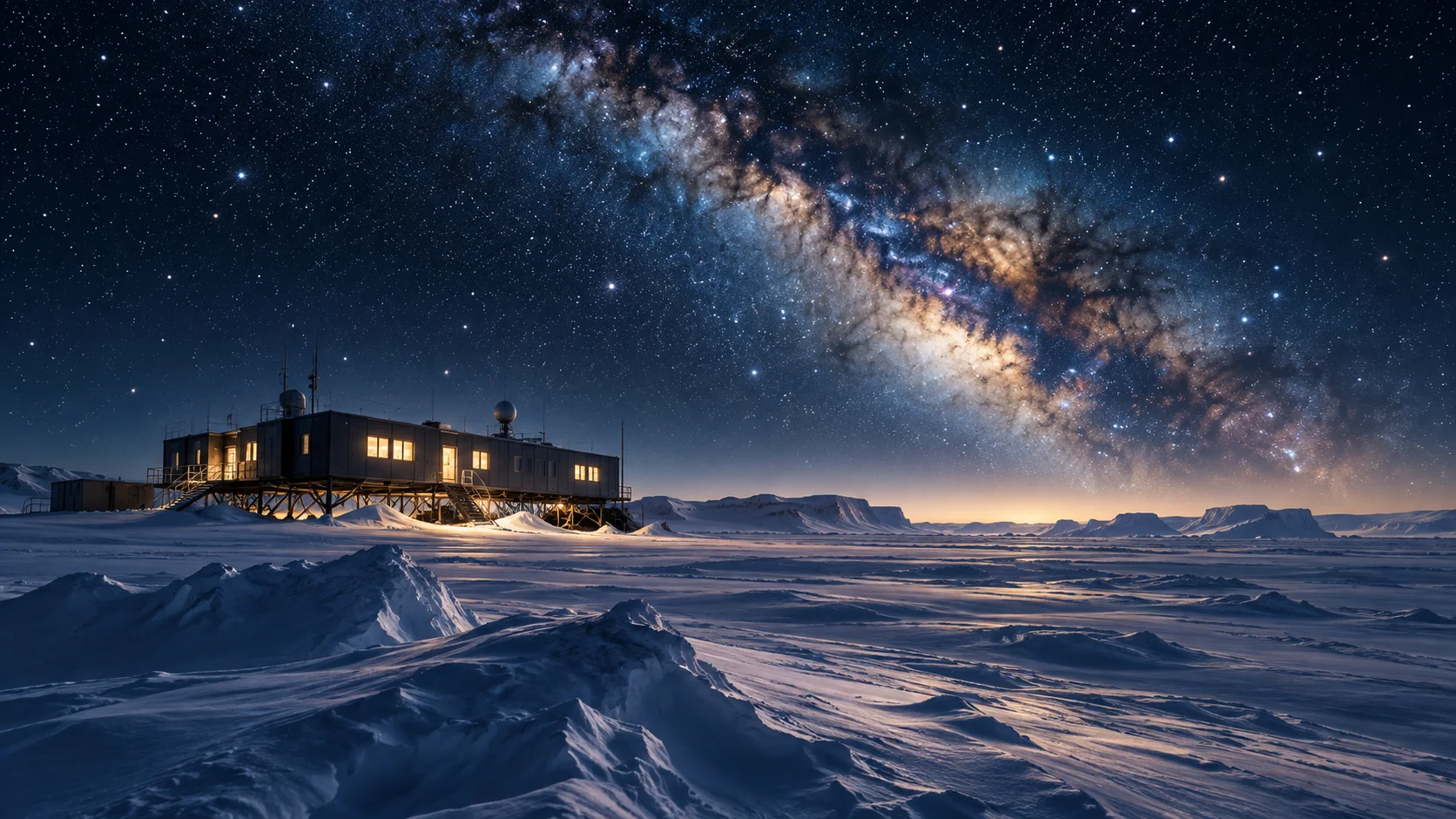

Featured image: AI-generated editorial illustration of an imagined Antarctic observatory, not a photograph of IceCube.
Imagine a messenger arriving from a distant galaxy without colour, sound or electric charge. It crosses cosmic dust, passes through planets and may pass through your body without leaving a trace. Scientists have built an observatory capable of catching a tiny fraction of these ghostly messengers—not in space, but deep beneath Antarctica.
Beyond the light we can see
Visible-light telescopes revealed planets, stars and galaxies. Radio, infrared, X-ray and gamma-ray astronomy extended our vision. But electromagnetic radiation can be absorbed, scattered or obscured. To investigate the universe’s most energetic and hidden environments, astronomers also study other messengers: gravitational waves, cosmic rays and neutrinos.
What is a neutrino?
A neutrino is an electrically neutral elementary particle with a very small mass. Nuclear reactions in the Sun, cosmic-ray interactions in Earth’s atmosphere, stellar explosions and energetic cosmic environments all produce neutrinos. Enormous numbers of solar neutrinos pass through our bodies every second, mostly without interacting. Neutrinos are difficult to detect because they participate in the weak nuclear interaction, not because they are supernatural.
They exist in three flavours—electron, muon and tau—and can change flavour while travelling. The discovery of neutrino oscillations, establishing that neutrinos have mass, earned Takaaki Kajita and Arthur B. McDonald the 2015 Nobel Prize in Physics. That award is distinct from the later recognition of high-energy neutrino astronomy.
A telescope made from a cubic kilometre of ice
The IceCube Neutrino Observatory at the South Pole uses roughly a cubic kilometre of Antarctic ice as its detecting medium. Its original array contains 5,160 digital optical modules on 86 strings, at depths of approximately 1,450–2,450 metres. Engineers drilled narrow holes, lowered the instrumented cables and allowed the water to refreeze.
Very occasionally, a neutrino interacts with matter in or near the ice. That interaction creates charged particles which can emit a blue flash called Cherenkov radiation when they move faster than light travels through ice—never faster than light in a vacuum. Sensors record the flash; researchers reconstruct the incoming particle’s probable direction and energy. IceCube does not see neutrinos glowing directly.
2013: a new cosmic messenger
In 2013 the IceCube Collaboration reported compelling evidence for high-energy neutrinos originating beyond Earth’s atmosphere. Earlier experiments had already observed solar neutrinos and neutrinos from supernova SN 1987A. IceCube’s advance was to open a new window onto the extremely high-energy universe. Detecting a cosmic neutrino does not automatically identify its source: directions carry uncertainties and require careful statistical analysis.
2017: a clue pointing to a distant black hole
On 22 September 2017, IceCube detected the high-energy neutrino IceCube-170922A. Follow-up observations associated it with TXS 0506+056, a blazar whose supermassive black hole powers a jet pointing roughly toward Earth. The results published in 2018 became a milestone in multimessenger astronomy. They did not show scientists looking inside a black hole’s event horizon: the signal helped probe energetic processes in the environment surrounding it.
2022: NGC 1068, a hidden cosmic engine
IceCube subsequently reported evidence of neutrino emission from the direction of the active galaxy NGC 1068, or Messier 77, roughly 47 million light-years away. This source is especially intriguing because dense surroundings can obscure high-energy electromagnetic radiation. Neutrinos offer a complementary way to investigate particle acceleration in such regions.
2023: the Milky Way mapped through neutrinos
In 2023 researchers announced evidence for high-energy neutrino emission associated with the plane of our own galaxy. This was not an ordinary photograph. It was a statistical reconstruction using detected particle events, advanced analysis and machine learning. Nevertheless, it offered a radically different way to study the Milky Way.
Why the 2026 Nobel matters
On 6 October 2026, Francis Halzen was recognised with the Nobel Prize in Physics for his decisive role in developing IceCube and establishing high-energy neutrino astronomy. The observatory is the work of an international collaboration, built over decades through physics, engineering and persistence in one of Earth’s harshest environments. Its planned expansion and upgrades aim to detect more events, refine their directions and identify more cosmic sources.
What neutrinos cannot tell us—yet
Neutrinos cannot carry information out from inside a black hole’s event horizon. Nor has IceCube detected the primordial cosmic neutrino background or established what happened before the Big Bang. Such claims would go beyond the evidence. The real breakthrough is extraordinary enough: matter can carry information from distant cosmic accelerators even when light alone cannot tell the full story.
The universe has more than one voice
Humanity once relied on its eyes to study the heavens. Now a frozen volume beneath the South Pole registers faint blue flashes left by particles that may have crossed galaxies. What accelerates most of these neutrinos? Which hidden engines produce them? How many cosmic sources remain unrecognised? The answers may be waiting in the ice.
For most of history, we listened to the messengers that shone. Now we are learning to hear the ones that pass through darkness.
Research and further reading
- IceCube Neutrino Observatory — official research and news
- Nobel Prize in Physics 2015 — neutrino oscillations
- IceCube detector and science
- IceCube research announcements and discoveries
Explore related science: Read about questions about neutrinos and astrology and the universe before the Big Bang.
Dark Page — Wonder & Curiosity. Scientific observations, hypotheses and open questions are distinguished throughout.




[…] related science: Read about IceCube and neutrino astronomy and the universe before the Big […]