

DARK PAGE / ANCIENT LANDSCAPES
Nazca Spider: How Peru’s Ancient Desert Geoglyph Was Made
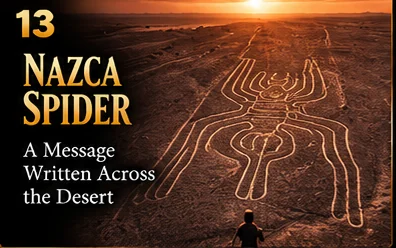
The Nazca Spider is a geoglyph in southern Peru. Its makers formed the design by moving dark surface stones aside to expose lighter ground. Archaeologists can explain how the lines were made. Their purpose, and why the makers chose a spider, remain open questions.
The Desert That Became a Page
In southern Peru, where rain is scarce and the ground holds its marks for astonishing lengths of time, a spider stretches across the Nazca desert. It has no colour of its own. Its form emerges because ancient people cleared darker surface stones, exposing lighter ground beneath. From close by, the lines can seem like paths with no destination. From above, they become an image.
The People Behind the Lines
The Nazca geoglyphs are associated with societies that lived in the region long before European arrival. The designs include animals, plants, geometric figures and long straight lines. Their creators worked within a distinctive desert environment and a complex cultural world. The spider is not an isolated puzzle but part of a much larger landscape of human activity.
How Could They Draw So Precisely?
Precision does not require a view from an aircraft. Stakes, ropes, measured distances and small-scale plans can help people translate a design onto the ground. Archaeologists investigate construction techniques through field surveys, experimental methods and the physical traces left by the lines. The astonishing achievement is human planning at a remarkable scale.
What Was the Spider For?
Proposals have connected Nazca imagery to ritual, movement through sacred landscapes, water, fertility and relationships with the natural world. Not every theory applies equally to every figure. No surviving statement from the makers definitively explains this spider’s meaning. The uncertainty should sharpen our curiosity, not become permission to claim an answer without evidence.
The Danger of an Easy Explanation
Popular accounts sometimes leap from an aerial view to the claim that the lines were designed for visitors from the sky. But the existence of a large drawing does not demonstrate an extraterrestrial audience. A stronger investigation asks about local cultures, chronology, materials and the surrounding archaeological landscape before reaching for extraordinary causes.
Why the Lines Endure
The desert has helped preserve the figures, but preservation is not guaranteed. Human activity, erosion and environmental changes can damage delicate surfaces. Protection matters because once a line is disturbed, its original context may be impossible to restore.
The Spider’s Last Question
Perhaps the strangest thing about the Nazca Spider is not that we can see it from the sky. It is that an ancient community imagined a mark that could outlive generations, and we are still standing before it, trying to understand what they wished to say.
The Spider and the Stories We Tell
Popular retellings sometimes identify the Nazca Spider with a distant species or claim it depicts anatomical detail impossible to observe without modern instruments. These suggestions are disputed. Resemblance can generate a hypothesis, but determining what ancient artists intended requires archaeological context. The figures may have served different ritual, social or landscape purposes rather than one universal function.
Editorial note: Archaeological interpretation is distinguished here from speculation; the precise purpose of the spider remains uncertain.
Research source: UNESCO World Heritage Centre — Lines and Geoglyphs of Nasca and Palpa. This official heritage record documents the archaeological landscape, construction method and conservation context; it does not establish a definitive meaning for the spider figure.
Editorial responsibility: About Dark Page · Editorial standards. Written and reviewed under the Dark Page Editorial Board byline.
Further reading: The Nazca Lines: Giant Drawings Across the Desert · The Turgai Geoglyphs · Five Giant Messages on Earth.




[…] reading: How the Nazca Spider Was Made · The Turgai Geoglyphs · Five Giant Messages on […]
[…] reading: How the Nazca Spider Was Made · Nazca Spider: Meanings and Myths · The Amazon’s Secret Geometry · The Turgai […]