
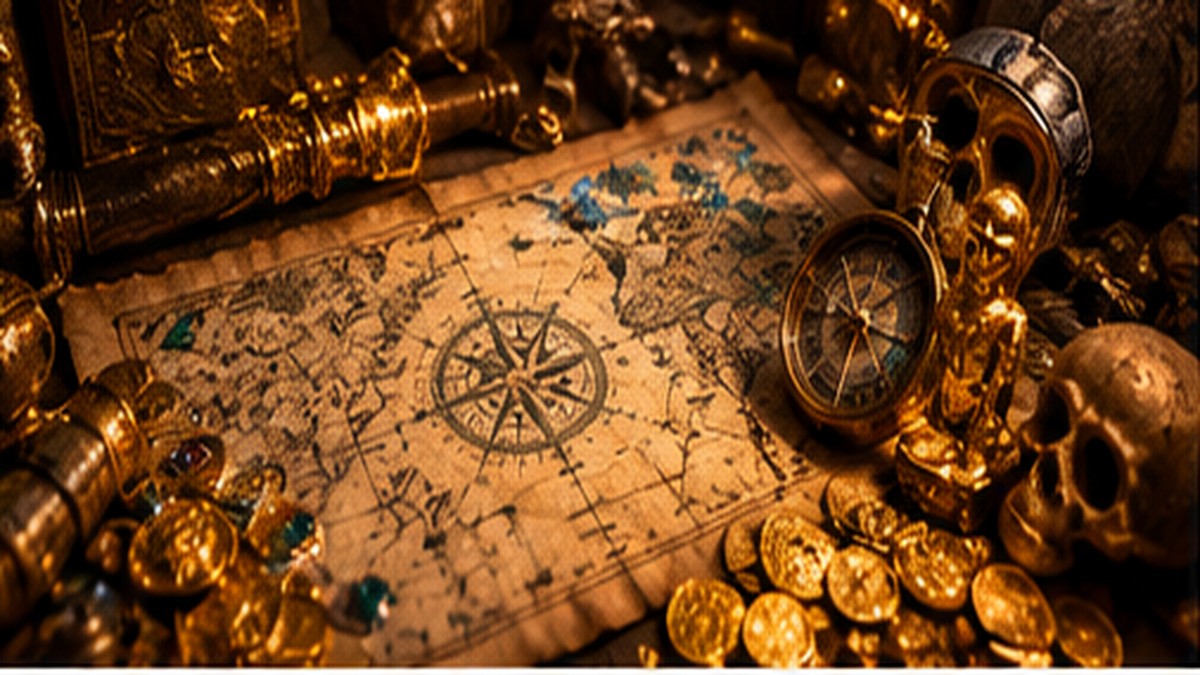


Tutankhamun’s tomb and the Staffordshire Hoard were found. The original amber panels of the Amber Room are still missing, and the location of the Flor de la Mar wreck remains uncertain. This guide compares what was recovered, what disappeared and where the evidence leaves room for doubt.
Famous treasures at a glance
| Treasure | Location | What the evidence shows |
|---|---|---|
| Tutankhamun’s tomb | Valley of the Kings, Egypt | Discovered in 1922. |
| Staffordshire Hoard | Staffordshire, England | First objects found in 2009. |
| Antikythera mechanism | Near Antikythera, Greece | Fragments recovered from a shipwreck in 1901. |
| Amber Room | Catherine Palace, Russia | A reconstruction exists. The fate of the original panels remains unresolved. |
| Flor de la Mar | Near Sumatra | The ship sank in 1511. The wreck location and cargo remain unconfirmed. |
| Oak Island treasure | Nova Scotia, Canada | The search is documented. The legendary treasure’s existence remains unconfirmed. |
Explore the Lost Treasures & Ancient Maps archive for individual investigations.
What makes a treasure truly lost?
A lost treasure is not always a chest of gold waiting beneath an X on a map. Sometimes it is a collection of objects scattered after a war, a ship whose last position was never recorded accurately, or a legend that became more valuable than anything it might conceal. The difference matters: archaeology follows evidence, while folklore often follows desire.
At Dark Page, we explore both sides of the story. We distinguish documented discoveries from unresolved searches and examine the maps, eyewitness accounts and historical records that keep these mysteries alive.
The treasures that emerged from the darkness
Tutankhamun’s tomb: a sealed doorway into ancient Egypt
In November 1922, Howard Carter’s team discovered the entrance to the tomb of Tutankhamun in Egypt’s Valley of the Kings. Its extraordinary survival gave historians an unusually rich view of royal burial practices, craftsmanship and belief. The discovery also inspired decades of sensational stories about a “curse.” The archaeological evidence is remarkable enough without treating that legend as established fact.
The Staffordshire Hoard: gold beneath an English field
In 2009, a metal detectorist discovered the first objects of what became known as the Staffordshire Hoard. The assemblage, dominated by Anglo-Saxon gold and silver fittings, transformed public understanding of elite metalwork in early medieval England. Its purpose and the circumstances of its burial remain subjects of interpretation. A find can be real while its full story remains unresolved.
The Antikythera mechanism: a machine recovered from the sea
Recovered from an ancient shipwreck near the Greek island of Antikythera in 1901, the corroded fragments of an intricate geared device revealed a sophisticated ancient approach to astronomical calculation. It was not a conventional treasure of jewels or coins. Its value lies in the history of human ingenuity—and in the questions that survived its recovery.
The treasures that have not returned
The Amber Room: a masterpiece lost in wartime
The Amber Room, famed for its elaborate amber panels, disappeared during the Second World War after being removed from the Soviet Union by German forces. A reconstruction can now be seen at the Catherine Palace, but the fate of the original panels remains unresolved. Claims of secret bunkers and hidden trains have produced many headlines, but no generally accepted recovery of the original room.
Flor de la Mar: a wreck surrounded by riches and uncertainty
The Portuguese ship Flor de la Mar sank in 1511 near Sumatra after taking part in the conquest of Malacca. Accounts associate it with valuable cargo, but stories about the exact quantity of treasure and the wreck’s location vary. The ship is a compelling historical mystery, not a verified promise of recoverable fortune.
Oak Island: when the search becomes the story
For generations, treasure hunters have dug, drilled and debated the supposed secrets of Oak Island in Nova Scotia. The island has inspired elaborate theories about hidden vaults and coded clues. Yet no widely accepted evidence establishes the existence of the legendary treasure at the center of those claims. Here, the history of the search is better documented than the treasure itself.
Can an ancient map be trusted?
Maps are powerful storytellers, but they are not neutral witnesses. Coastlines change, landmarks disappear, measurements can be imprecise, and later copies may introduce errors. A convincing-looking treasure map may be a genuine historical document, a misinterpreted navigational chart, a modern fabrication—or a fictional prop mistaken for evidence.
Responsible investigation asks four questions: Who made the map? When was it created? Can its landmarks be independently identified? And does any surviving record connect it to a real object or event? An “X” alone proves nothing.
What we will investigate next
Our Lost Treasures & Ancient Maps series will revisit celebrated finds, missing collections, disputed shipwrecks and the psychology of treasure hunting. We will label legends as legends, separate plausible hypotheses from proof, and explain what new evidence would actually change the story.
Because the darkest part of a treasure mystery is not always the place where something was buried. Sometimes it is the space between what people know—and what they desperately want to believe.
Further reading: The Lost Library of Ivan the Terrible · Lost Treasures and Ancient Maps: Discoveries and Legends · The Piri Reis Map.




[…] reading: Famous Lost Treasures: What Was Found and What Is Still Missing · The Piri Reis Map · The Staffordshire […]