

On a September morning in 1859, an astronomer watched two points of light appear on the Sun. Before the next day was over, the sky would glow in unexpected places, telegraph instruments would misbehave, and a young electrical civilisation would discover that its wires were connected to a much larger universe.
The Morning the Sun Changed Its Face
At his private observatory near Redhill in Surrey, England, Richard Carrington was drawing sunspots. These darker patches were already objects of scientific fascination, but what he saw on 1 September 1859 was different. At about 11:18 a.m., two intensely bright patches appeared within the group he was studying. Carrington left his telescope to seek another witness. By the time he returned, the brilliance had faded. Within minutes, the extraordinary display was gone.
The observation would become a landmark in solar astronomy. Carrington had witnessed a white-light solar flare, an exceptionally energetic eruption visible against the Sun’s brilliant surface. He did not yet possess the modern language of plasma physics, magnetic reconnection or coronal mass ejections. The consequences of the disturbance, however, would soon become visible on Earth.
Night Arrived Wearing the Colours of Dawn
Auroras, normally associated with regions nearer the poles, appeared at unusually low latitudes. Across parts of the Americas, observers reported skies illuminated with red and green light. Some accounts describe people mistaking the brightness for the approach of morning. The heavens looked beautiful, but the spectacle was evidence of a disturbance far beyond ordinary weather.
In 1859, the electric telegraph was one of the fastest technologies humanity had invented. Its wires linked towns and carried messages through circuits that operators believed they understood. During the geomagnetic storm, instruments produced erratic signals. Sparks appeared in telegraph offices. Operators reported shocks. In some cases, paper associated with receiving apparatus caught fire. The world’s newest communications network had encountered a force for which it had not been designed.
One of the strangest records comes from colonial Victoria in Australia. Telegraph superintendent Samuel McGowan later described communicating over a line roughly 32 miles long while the normal battery was disconnected. Electrical currents induced during the disturbance had temporarily become strong enough to operate the circuit. The episode is documented in his official report, discussed by Museums Victoria; it is not evidence of supernatural power, but of electricity generated by changing magnetic conditions on a planetary scale.
How Can the Sun Touch a Wire?
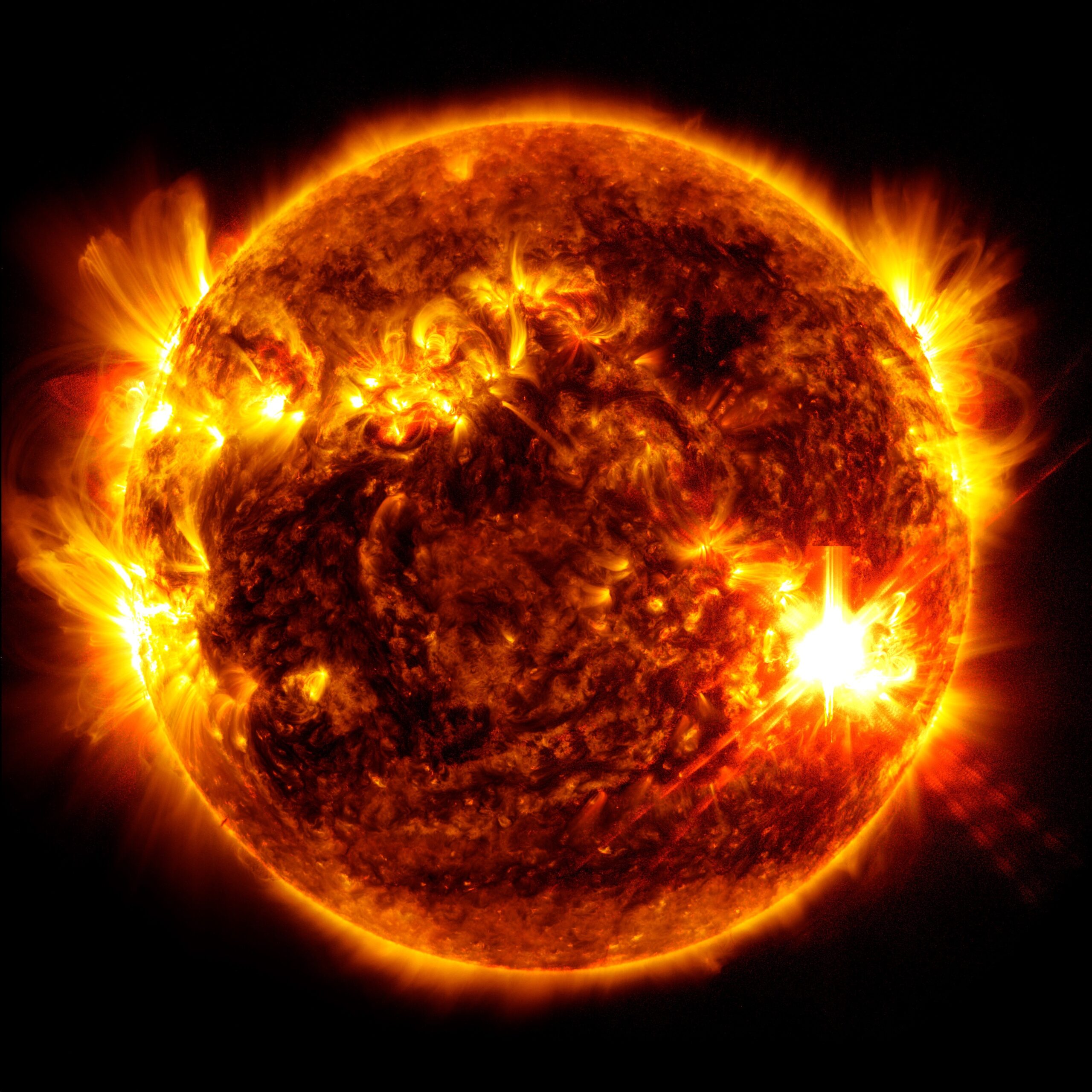
To understand the event, it helps to separate two phenomena that are often confused. A solar flare is a rapid release of energy that produces electromagnetic radiation. A coronal mass ejection, or CME, is an enormous cloud of plasma carrying magnetic fields away from the Sun. They can occur together, but they are not the same thing.
When a suitably directed CME strikes Earth’s magnetic environment, it can trigger a geomagnetic storm. Earth’s magnetic field changes; electrical currents flow in the upper atmosphere and can also be induced in long conductors at ground level. In 1859 those conductors were telegraph wires. Today they include power-transmission networks and other infrastructure. The danger is not that sunlight simply burns through a cable. It is that a changing magnetic field can generate unwanted electrical currents in systems built to carry carefully controlled ones.
Modern researchers link the great storm of early September 1859 to powerful solar activity, although the precise strength of a nineteenth-century event must be reconstructed from historical observations rather than measured with modern satellites. That distinction matters: an evocative story should not turn an estimate into a laboratory reading.
A Warning Written Before the Digital Age
Imagine a world dependent on satellites for navigation, on radio links for aviation and maritime operations, and on interconnected power grids for nearly every ordinary activity. A major geomagnetic storm can disturb some of those systems. But the familiar claim that a repeat of 1859 would certainly switch off the entire internet or end modern civilisation is not a scientific forecast. The scale and location of damage would depend on the eruption, its magnetic orientation, the technologies exposed and the protective measures taken.
We are not without defences. Solar-observing spacecraft, ground-based instruments and forecasting centres monitor space weather. Grid operators and satellite teams can take precautionary steps when warnings arrive. Forecasting remains imperfect, and the most severe scenarios deserve serious planning, but serious planning is different from announcing an unavoidable apocalypse.
The Carrington Event also offers a quieter lesson about scientific humility. Nineteenth-century observers saw the light in the sky and the disorder in their instruments, yet the physical connection between the two was not immediately obvious. Their records became clues for generations that followed. The universe had not changed its rules. Humanity had merely discovered another place where those rules were at work.
The Darkness Was Never Empty
What makes this history unsettling is not only the violence of the Sun. It is the intimacy of the encounter. An event unfolding across millions of kilometres announced itself in the smallest places: a needle that would not settle, a message that could not be read, a spark beside a human hand.
For a moment, the wires seemed to have acquired a will of their own. They had not. They had revealed a truth more astonishing than any ghost story: civilisation’s most practical inventions exist inside an immense physical world, and that world does not stop at the edge of the atmosphere.
The mystery is not whether the Sun can reach us. It already does. The question is how carefully we are learning to listen.
Research and Image Credits
- Museums Victoria, “The Carrington Event and the Electric Telegraph in Victoria” — Carrington’s observation and historical telegraph reports, including Samuel McGowan’s account.
- NOAA NESDIS, “What Was the Carrington Event?” — historical auroras, telegraph disturbances and contemporary space-weather risks.
- NOAA Space Weather Prediction Center, “Coronal Mass Ejections (CME)” — explanation of plasma eruptions and geomagnetic storms.
- NASA, “Sun Releases Strong Solar Flare” — modern solar-flare context and potential technological effects.
- NASA/SDO, solar flare image of 10 May 2024 — modern illustration only. SDO image-use and attribution guidance. NASA does not endorse Dark Page.
Editorial note: This is a documented historical and scientific account, not a prediction of a future disaster. The illustrative solar photograph dates from 2024, not 1859. No dialogue or eyewitness quotation has been invented.
Further reading: Project A119 · Svalbard Global Seed Vault.




[…] reading: The Carrington Event · Svalbard Global Seed […]