Explore the astonishing human mind through memory, imagination, consciousness, language and the science of how we think and perceive the world.
DARK PAGE / WONDER & CURIOSITY / HUMAN FRONTIERS
THE ASTONISHING HUMAN MIND
The Universe’s Greatest Mystery May Be the Mind That Questions It
How does the human mind imagine worlds, remember a childhood voice, master a language, contemplate the infinite—and now communicate through a computer connected to the brain? Journey from ancient Hindu philosophy and contemplative traditions to neuroscience, exceptional minds and neural interfaces.
5
Research worlds
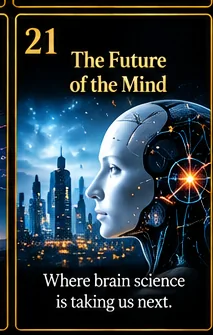
21
Explorable subjects
6
Further-reading sources
A Question Worth a Lifetime
Every discovery begins with a brain capable of wondering. Yet the organ that studies galaxies and builds machines still struggles to explain its own conscious experience. Dark Page approaches this mystery with curiosity, cultural respect and evidence—not exaggerated promises.
01 / THE MIND WE DO NOT SEE
Consciousness and Attention +
Conscious awareness is selective. Much perception, movement and prediction operates without deliberate attention. This does not imply a hidden all-knowing second mind.
Memory: A Story Rebuilt +
Memory is reconstructive rather than a perfect recording. Expectations, emotion and later information can change recollection; confidence alone is not proof of accuracy.
Dreams, Imagination and the Night +
Dreams draw on experience, emotion and spontaneous brain activity. They can occur in multiple sleep stages, with vivid dreaming common in REM. No universal dream-symbol code has been scientifically validated.
Intuition, Habits and Bias +
Experience can make judgments fast, but quick impressions may also reflect stereotypes and confirmation bias. Habits become easier through repeated context and reward.
02 / ANCIENT MINDS AND SACRED TRADITIONS
Hindu Philosophy: Mind, Intellect and Self +
The Katha Upanishad uses the chariot analogy: senses are horses, mind the reins, intellect the driver. It is a philosophical model of self-discipline, not an anatomical description of the brain.
Yoga, Dharana and Dhyana +
Classical yoga distinguishes concentration (dharana) and meditation (dhyana), alongside ethical and bodily practices. Different Hindu traditions understand their goals differently; claims of supernatural mental power should not be presented as established science.
Buddhist Attention and Awareness +
Buddhist contemplative traditions examine attention, impermanence and the experience of self. Modern studies investigate specific practices, but spiritual aims and laboratory measures are not identical.
Islamic, Christian and Other Contemplative Paths +
Islamic remembrance and reflection, Christian contemplative prayer, and other traditions cultivate forms of inward attention and ethical discipline. They should be described on their own terms rather than merged into one universal technique.
03 / CAN WE TRAIN A MORE CAPABLE BRAIN?
Sleep, Movement and Learning +
Consistent sleep, physical activity and repeated meaningful learning support cognitive health. The evidence is stronger for these foundations than for sensational promises to unlock unused brain power.
Meditation: Possibilities and Limits +
Some studies report modest benefits for attention, stress or wellbeing, while methods and findings vary. Meditation is not a substitute for appropriate medical or mental-health care.
Memory Champions and Exceptional Minds +
Memory competitors often use deliberate mnemonic systems, imagery and extensive practice. Mathematical, musical or linguistic expertise is usually domain-specific, not evidence of unlimited intelligence.
Neuroplasticity and Lifelong Change +
The brain can change with learning, injury and experience, but plasticity has limits. Repetition can strengthen helpful skills and unhelpful habits alike.
Mental Fatigue and Recovery +
More hours of effort do not always mean better thinking. Rest, breaks and realistic workloads matter, particularly for sustained creative or analytical work.
04 / THE BRAIN MEETS THE MACHINE
What Is a Brain–Computer Interface? +
A BCI detects selected neural signals and translates them through software into commands. It may help a person move a cursor, select letters or communicate using synthetic speech.
Implanted Chips and Non-Invasive Sensors +
Implanted electrode systems require surgery and medical oversight; external EEG-based systems measure signals at the scalp. Their capabilities and limitations differ substantially.
What Brain Chips Cannot Do +
Current interfaces cannot read every private thought, transfer a complete personality, or reliably make an ordinary healthy person a genius. Demonstrations should not be confused with everyday clinical availability.
Neural Privacy and Human Rights +
Questions include informed consent, surgical risk, cybersecurity, ownership of neural data, accessibility and ongoing support if a company stops servicing a device.
05 / ANCIENT QUESTIONS, MODERN EVIDENCE
Where Traditions and Science Meet +
Both ancient traditions and neuroscience investigate attention, experience and disciplined practice. This overlap in questions is real; it is not proof that ancient texts discovered modern brain mechanisms.
Where They Fundamentally Differ +
Religious and philosophical traditions may seek liberation, wisdom or ethical transformation. Experimental neuroscience seeks testable explanations and measurable outcomes. These are distinct standards of knowledge.
The Myth of the Ten Percent Brain +
The popular claim that people use only ten percent of the brain is false. Different networks are active at different times; normal brain function depends on extensive coordinated activity.
The Unsolved Problem of Consciousness +
Researchers study neural correlates of conscious experience, but no single theory has settled why subjective experience exists. Uncertainty is an invitation to careful inquiry, not evidence for any one supernatural answer.
Try This: A Five-Minute Attention Experiment
Choose a familiar object. Study it for thirty seconds, then look away and list its details. Look again. Which features did you overlook? Repeat on another day. This simple observation illustrates selective attention; it is not a diagnostic or intelligence test.
A widely repeated estimate compares the brain’s potential information capacity to 2.5 petabytes (2.5 million gigabytes), sometimes illustrated as centuries of television. This is a speculative analogy, not a scientifically measured storage limit. Human memory is distributed and reconstructive, unlike digital files.
02 / SLEEP
The Mystery of Sleep
At eight hours a night, humans spend about one-third of life asleep—approximately 25 years over a 75-year lifetime. Science has established important roles for sleep in learning, memory and health, but researchers continue to investigate why sleep is indispensable and precisely how dreams arise.
03 / PERCEPTION
The World Our Brain Constructs
The eye’s optics project an inverted image onto the retina. The brain processes visual signals into our upright experience and fills in missing information, including the blind spot where the optic nerve exits the eye. Vision is an active interpretation of reality, not a perfect camera recording.
Scientific note: The digital-memory comparison is illustrative, not an established measurement.
Research Library & Primary Context
These resources offer historical context and modern research. A linked source does not automatically validate every claim in a historical tradition.