
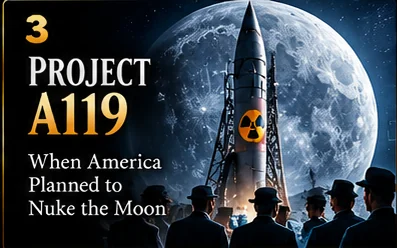

In the late 1950s, the space race was as much a contest of prestige as of science. After the Soviet Union launched Sputnik, American planners explored dramatic demonstrations of technological capability. Among the strangest was a classified study commonly known as Project A119.
A flash visible from Earth?
The study considered the possibility of detonating a nuclear device on or near the lunar surface. Researchers examined scientific and technical questions, as well as the potential psychological impact of such a spectacle. The work is associated with physicist Leonard Reiffel, and the young Carl Sagan contributed to related calculations.
It is tempting to describe this as a plan to “blow up the Moon.” That would be misleading. The concept concerned a nuclear explosion on the lunar surface, not the destruction of the Moon itself. Likewise, claims that the blast would have knocked the Moon out of orbit are not supported by the scale of the proposed device.
Why it never happened
The project did not proceed to a lunar detonation. Its existence illustrates how military rivalry and public perception shaped early space-age thinking. It also raises an enduring question: when a scientific frontier becomes a political stage, how far are governments willing to go to be seen as first?
Editorial note: Project A119 was a study, not a completed mission. Sensational descriptions of destroying the Moon are inaccurate.
Further reading: The Carrington Event · Svalbard Global Seed Vault.




[…] reading: Project A119 · Svalbard Global Seed […]