
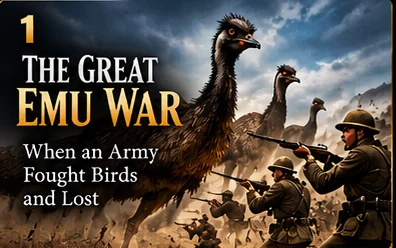

In late 1932, a strange confrontation unfolded in Western Australia. Farmers in the wheat-growing district around Campion were struggling with large numbers of emus moving through agricultural land, damaging crops and fences. The response was extraordinary: soldiers arrived with machine guns.
A battle nobody expected
Major G. P. W. Meredith led a small military detachment equipped with Lewis guns. Their task was not to fight a foreign army, but to reduce emu numbers at the request of farmers. Early attempts proved frustrating. The birds dispersed quickly, moved across difficult terrain and were remarkably hard to hit in groups.
Newspapers reported on the campaign with a mixture of amusement and criticism. The operation soon became a political embarrassment, and the military effort was halted after limited results. It later resumed briefly, but the problem of protecting crops was not solved by machine guns.
Did the emus really win?
Popular retellings describe a formal war in which Australia surrendered to birds. That is a memorable joke, not a literal description. No war was declared against emus, and the birds did not defeat an army in conventional combat. The historical episode was a short wildlife-control operation whose awkward results became a national legend.
What makes the story unforgettable is the mismatch between modern military technology and a fast-moving animal population. It is a reminder that a powerful tool is not necessarily an effective solution to the problem at hand.
Editorial note: This account distinguishes the documented 1932 operation from the humorous “emu victory” legend.
Further reading: The Staffordshire Hoard · The Nazca Lines.




[…] Further reading: Mike the Headless Chicken · The Great Emu War. […]